Music symbols and what they mean
Notes say which keys and when; the other signs on the page say how. Of the 231 pieces in Clefsight's library, the commonest sign is the slur, in 170, and 159 mark loud and soft. Others are rare: the turn appears in only 4.
- Slur170
- Piano124
- Forte124
- Crescendo117
- Tie116
- Diminuendo or decrescendo109
- Staccato102
- Repeat signs88
- Mezzo forte84
- Fermata72
- Accent67
- Grace note57
- Pianissimo48
- Mezzo piano39
- Fortissimo37
- Ritardando, rallentando35
- Sustain pedal34
- Octave sign34
- Sforzando29
- Marcato29
- Tenuto22
- Mordent22
- Arpeggio (rolled chord)22
- Trill19
- First and second endings17
- A tempo17
- Legato17
- D.C. al Fine16
- Dolce12
- Forte-piano8
- Turn4
Every symbol below is shown engraved, with what it asks of you and the easiest library pieces where you will meet it.
Loud and soft
Dynamics are written under the staff (between the staves in piano music) in bold italic letters, short for Italian words. Each one holds until the next.
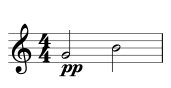
Pianissimopp
Very soft.
In 48 of the 231 library pieces; the easiest: Berceuse, from Enfantillages pittoresques (Satie, level 2), Elementary Study, Op. 176 No. 3 (Duvernoy, level 2) and Elementary Study, Op. 176 No. 2 (Duvernoy, level 2).
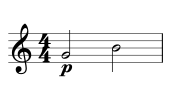
Pianop
Soft. The instrument's full name, pianoforte, means soft-loud.
In 124 of the 231 library pieces; the easiest: Old German Dance (Praetorius, level 2), Rule, Britannia! (Arne, level 2) and Elementary Study, Op. 176 No. 3 (Duvernoy, level 2).
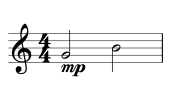
Mezzo pianomp
Moderately soft: a little louder than p.
In 39 of the 231 library pieces; the easiest: The Blue Danube (theme) (II, level 2), Carousel Waltz (Gobbaerts, level 2) and Elementary Study, Op. 176 No. 4 (Duvernoy, level 2).
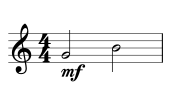
Mezzo fortemf
Moderately loud: an easy, singing tone.
In 84 of the 231 library pieces; the easiest: Old German Dance (Praetorius, level 2), Elementary Study, Op. 176 No. 3 (Duvernoy, level 2) and The Blue Danube (theme) (II, level 2).
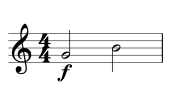
Fortef
Loud.
In 124 of the 231 library pieces; the easiest: Old German Dance (Praetorius, level 2), Rule, Britannia! (Arne, level 2) and Carousel Waltz (Gobbaerts, level 2).
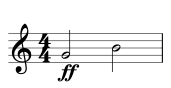
Fortissimoff
Very loud.
In 37 of the 231 library pieces; the easiest: Rule, Britannia! (Arne, level 2), Elementary Study, Op. 176 No. 4 (Duvernoy, level 2) and Elementary Study, Op. 176 No. 1 (Duvernoy, level 2).
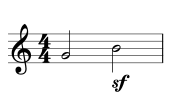
Sforzandosf or sfz
A sudden strong accent on one note or chord, then back to the dynamic before it.
In 29 of the 231 library pieces; the easiest: Jingle Bells (Pierpont, level 3), Arabesque, Op. 100 No. 2 (Burgmüller, level 3) and Short Exercise, Op. 821 No. 4 (Czerny, level 3).
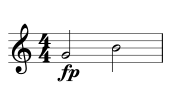
Forte-pianofp
Loud on the first note, then soft at once.
In 8 of the 231 library pieces; the easiest: First Loss, Op. 68 No. 16 (Schumann, level 4), Little Romance, Op. 68 No. 19 (Schumann, level 4) and Knecht Ruprecht, Op. 68 No. 12 (Schumann, level 4).
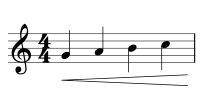
Crescendoan opening wedge, or cresc.
Get gradually louder, until the wedge or the dotted line after cresc. ends.
In 117 of the 231 library pieces; the easiest: Rule, Britannia! (Arne, level 2), Elementary Study, Op. 176 No. 4 (Duvernoy, level 2) and Elementary Study, Op. 176 No. 1 (Duvernoy, level 2).
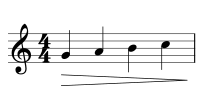
Diminuendo or decrescendoa closing wedge, or dim.
Get gradually softer.
In 109 of the 231 library pieces; the easiest: Rule, Britannia! (Arne, level 2), Elementary Study, Op. 176 No. 3 (Duvernoy, level 2) and Carousel Waltz (Gobbaerts, level 2).
How to play each note
Signs on or over a notehead say how to start, hold and end that one note.
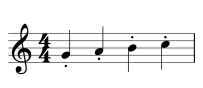
Staccatoa dot over or under the note
Short and detached: let go early, leaving a small gap before the next note.
In 102 of the 231 library pieces; the easiest: Rule, Britannia! (Arne, level 2), Study, Op. 139 No. 2 (Czerny, level 2) and Gavotte (Telemann, level 2).
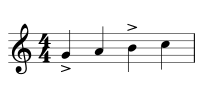
Accenta sideways wedge (>)
Play this note louder than the ones around it.
In 67 of the 231 library pieces; the easiest: Rule, Britannia! (Arne, level 2), Brindisi, from La traviata (Verdi, level 3) and La Violette (Gobbaerts, level 3).
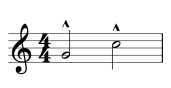
Marcatoan upright wedge (^)
A stronger accent: marked and forceful.
In 29 of the 231 library pieces; the easiest: Brindisi, from La traviata (Verdi, level 3), La Violette (Gobbaerts, level 3) and Children's Study, Op. 37 No. 14 (Lemoine, level 3).
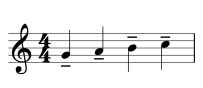
Tenutoa short line over or under the note
Hold the note for its full value, with a slight weight.
In 22 of the 231 library pieces; the easiest: Rule, Britannia! (Arne, level 2), Papageno's Aria, from The Magic Flute (Mozart, level 2) and Study in Thirds (Czerny, level 3).
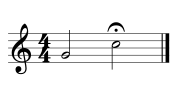
Fermataa dot under an arch
Hold the note (or rest) longer than written, as long as feels right, then go on.
In 72 of the 231 library pieces; the easiest: Chorale, Op. 68 No. 4 (Schumann, level 3), Sonatina in G, Anh. 5 (Beethoven, level 3) and Jingle Bells (Pierpont, level 3).
Lines that join notes
Curved lines join notes; which kind it is depends on whether the notes have the same pitch.
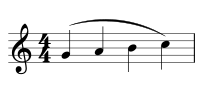
Slura curve over or under notes of different pitches
Play the notes under it smoothly joined (legato), with no gaps. The end of a slur is often lifted slightly.
In 170 of the 231 library pieces; the easiest: Old German Dance (Praetorius, level 2), Berceuse, from Enfantillages pittoresques (Satie, level 2) and Rule, Britannia! (Arne, level 2).
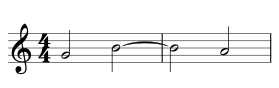
Tiea curve joining two notes of the same pitch
Play the first note and hold it through the second: one note, the two values added together. A tie often crosses a bar line.
In 116 of the 231 library pieces; the easiest: The Blue Danube (theme) (II, level 2), Carousel Waltz (Gobbaerts, level 2) and We Wish You a Merry Christmas (Traditional, level 2).
Ornaments
Small signs for quick extra notes around a written one, mostly in music from Bach's time to Mozart's.
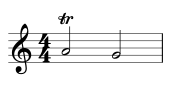
Trilltr
Alternate quickly between the written note and the note above it for the note's length.
In 19 of the 231 library pieces; the easiest: Spring, from The Four Seasons (Vivaldi, level 3), Andante in C, K. 1a (Mozart, level 3) and Impertinence, HWV 494 (Handel, level 3).
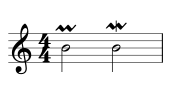
Mordenta short zigzag, with or without a line through it
One quick flick away and back: to the note above (no line) or the note below (a line through it), then the written note.
In 22 of the 231 library pieces; the easiest: Giga (Arnold, level 3), Minuet in G, BWV Anh. 114 (Petzold, level 3) and Minuet in F, K. 1d (Mozart, level 3).
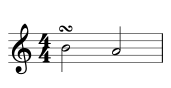
Turna sideways S
Four quick notes round the written one: the note above, the note, the note below, the note.
In 4 of the 231 library pieces; the easiest: Gigue (Guerre, level 4), Courante (Guerre, level 4) and Nocturne No. 10 (Field, level 4).
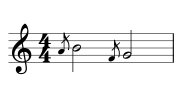
Grace notea small note, often with a slash through its stem
A quick note squeezed in just before (or on) the beat of the main note. It takes no time of its own.
In 57 of the 231 library pieces; the easiest: Allegro in C, K. 1b (Mozart, level 2), Brindisi, from La traviata (Verdi, level 3) and Song Without Words (Spindler, level 3).
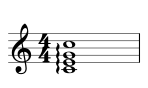
Arpeggio (rolled chord)a wavy line before a chord
Spread the chord quickly from the bottom note up instead of playing its notes together.
In 22 of the 231 library pieces; the easiest: Jingle Bells (Pierpont, level 3), Amazing Grace (Traditional, level 3) and Sarabande, HWV 437 (Handel, level 3).
Pedal and octave signs
Signs that change what your feet and hands do for a stretch of music.
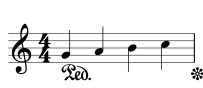
Sustain pedalPed. and a star, or a bracket under the staff
Press the right pedal at Ped. (or where the bracket starts) and lift it at the star (or where it ends).
In 34 of the 231 library pieces; the easiest: Brindisi, from La traviata (Verdi, level 3), Spring, from The Four Seasons (Vivaldi, level 3) and March from Scipio (Handel, level 3).
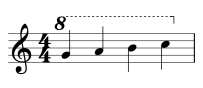
Octave sign8va or 8vb and a dotted line
Play the notes under the dotted line an octave higher (8va, over the notes) or lower (8vb, under them) than written.
In 34 of the 231 library pieces; the easiest: Elementary Study, Op. 176 No. 4 (Duvernoy, level 2), Elementary Study, Op. 176 No. 10 (Duvernoy, level 3) and Elementary Study, Op. 176 No. 18 (Duvernoy, level 3).
Repeats
Signs that send you back, so a page can hold more music than it shows.
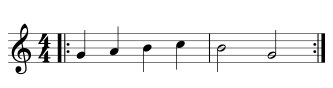
Repeat signsa thick bar line with two dots
Go back to the facing repeat sign (or to the start, if there is none) and play the passage again.
In 88 of the 231 library pieces; the easiest: Minuet (Hook, level 2), Gavotte (Hook, level 2) and Study, Op. 139 No. 2 (Czerny, level 2).
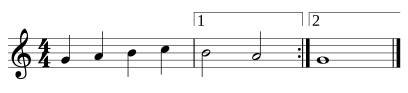
First and second endingsbrackets numbered 1. and 2.
Play the first ending the first time; on the repeat, skip it and play the second.
In 17 of the 231 library pieces; the easiest: Tedesca (Haydn, level 3), Jingle Bells (Pierpont, level 3) and Arabesque, Op. 100 No. 2 (Burgmüller, level 3).
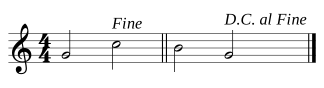
D.C. al FineD.C. al Fine, and Fine
Da capo al fine: go back to the beginning and play until the word Fine (the end).
In 16 of the 231 library pieces; the easiest: La Violette (Gobbaerts, level 3), Elementary Study, Op. 176 No. 8 (Duvernoy, level 3) and Children's Study, Op. 37 No. 14 (Lemoine, level 3).
Words for speed and character
Tempo and character are mostly written in Italian, above the staff. A tempo word at the top says how fast the piece goes; others change it on the way.
- rit.
Ritardando, rallentandorit., ritard., rall.
Slow down gradually. Ritenuto (riten.) is held back at once.
In 35 of the 231 library pieces; the easiest: Arabesque, Op. 100 No. 2 (Burgmüller, level 3), Sonatina in G (Attwood, level 3) and Pastorale, Op. 100 No. 3 (Burgmüller, level 3).
- a tempo
A tempoa tempo
Back to the speed before the last change.
In 17 of the 231 library pieces; the easiest: Arabesque, Op. 100 No. 2 (Burgmüller, level 3), Sonatina in G (Attwood, level 3) and Children's Study, Op. 37 No. 19 (Lemoine, level 3).
- legato
Legatolegato
Smoothly joined, every note connected to the next.
In 17 of the 231 library pieces; the easiest: Children's Study, Op. 37 No. 1 (Lemoine, level 3), Children's Study, Op. 37 No. 14 (Lemoine, level 3) and Children's Study, Op. 37 No. 4 (Lemoine, level 3).
- dolce
Dolcedolce
Sweetly, gently.
In 12 of the 231 library pieces; the easiest: Elementary Study, Op. 176 No. 6 (Duvernoy, level 3), Sonatina in G, Anh. 5 (Beethoven, level 3) and Short Exercise, Op. 821 No. 4 (Czerny, level 3).
Tempo words, slowest first
| Word | Means | Library pieces |
|---|---|---|
| Largo | broad, very slow | 3, such as Prelude in E minor, Op. 28 No. 4 |
| Adagio | slow, at ease | 2, such as Nocturne No. 10 |
| Andante | at a walking pace | 11, such as Elementary Study, Op. 176 No. 6 |
| Andantino | a little faster than andante | 13, such as Elementary Study, Op. 176 No. 10 |
| Moderato | moderate | 31, such as Old German Dance |
| Allegretto | fairly quick, lightly | 26, such as Carousel Waltz |
| Allegro | quick and bright | 37, such as Elementary Study, Op. 176 No. 1 |
| Vivace | lively | 7, such as Air from Little Russia, Op. 107 No. 3 |
| Presto | very fast | 3, such as Sonata in E minor, Hob. XVI:34: I |
Many pieces give a metronome mark instead of a word, or as well: ♩ = 96 means 96 quarter notes a minute.
See them in a real piece. Every piece in the library is printed with its markings, and Clefsight follows you through it as you play from the page on a MIDI keyboard.
Browse the libraryThe notes themselves: how to read piano sheet music, and rhythm for note values, rests, dots and ties.