Learn to read music · Hands together
Two voices on one staff: stems up, stems down, one hand
One hand often plays two parts at once, printed on one staff: the upper part with its stems up, the lower part with its stems down. Of the 844 pieces in Clefsight's library, 446 set two voices sounding at once on a staff somewhere, and 216 do it in half their bars or more. Each way it happens is below with two bars of our own, how to read and play it, and two real bars where a library piece asks it, the notes that show it in blue pencil.
- A note held under moving notes410
- Two moving lines251
- A rest in one part only236
- A shared notehead234
- Three parts in one hand68
How to read two voices on one staff
When one staff carries two parts, the stems tell them apart: the upper voice's stems point up and the lower voice's point down, whatever the notes' height. Each voice fills its bar on its own, so the beats of each add up separately, and each has its own rests.
Read the staff as two lines, not as chords. Follow the stems-up notes as one melody and the stems-down notes as another; where both start together they look like a chord, but one may be held long after the other moves on.
It is the texture of minuets and dances with a held bass, of hymns and chorales (soprano and alto on the treble staff, tenor and bass on the bass staff), and of Bach's inventions and fugues.
A note held under moving notes a long note with its own stem, and quicker notes over or under it
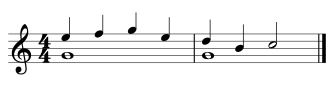
One part holds a note while the other moves: a half or whole note with its stem down under quarter notes with their stems up, or the reverse. It is how a bass note or a melody note goes on sounding under a running part, in minuets, studies and chorales.
How to play it: Hold the long note down with its finger for its whole length while the other fingers play the moving notes. Practise the moving part alone, then add the held note and check it is still down at the end of its beats. The pedal would hide a lifted finger; the score asks the finger.
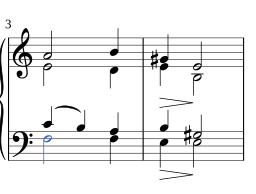
From If Thou But Suffer God to Guide Thee (Neumark, level 2), bars 3 to 4, as its edition prints them; the notes that show it in blue pencil.
410 of the 844 pieces ask it, in 5,954 bars in all. The easiest of them: If Thou But Suffer God to Guide Thee (Neumark, level 2), Annie Laurie (Spottiswoode, level 2) and Old Hundredth (Bourgeois, level 3).
Two moving lines two melodies at once, stems up and stems down, both moving
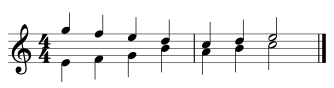
Two parts of equal weight, each a melody of its own, in one hand: the texture of Bach's inventions and fugues, and of many minuets. Each note belongs to one line, and the stems say which.
How to play it: Play each line alone first, with the fingering it will have together, and sing one while playing the other. Then join them slowly, listening for both: a common slip is to let the lower line go quiet or break its legato.
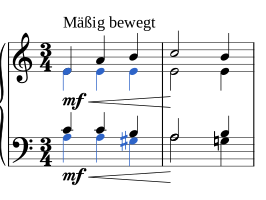
From If Thou But Suffer God to Guide Thee (Neumark, level 2), bars 1 to 2, as its edition prints them; the notes that show it in blue pencil.
251 of the 844 pieces ask it, in 2,622 bars in all. The easiest of them: If Thou But Suffer God to Guide Thee (Neumark, level 2), Annie Laurie (Spottiswoode, level 2) and O for a Thousand Tongues to Sing (Gläser, level 3).
A shared notehead one notehead with a stem up and a stem down
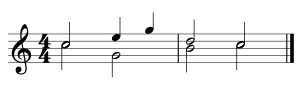
Both parts meet on the same note at the same time, so the note is printed once with two stems, one for each part. It is played once.
How to play it: Strike the key once and hold it for the longer of the two values. If one part goes on before the other, keep the key down for the part that lasts and move the other.
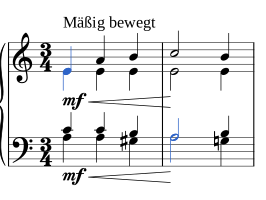
From If Thou But Suffer God to Guide Thee (Neumark, level 2), bars 1 to 2, as its edition prints them; the notes that show it in blue pencil.
234 of the 844 pieces ask it, in 1,513 bars in all. The easiest of them: If Thou But Suffer God to Guide Thee (Neumark, level 2), Annie Laurie (Spottiswoode, level 2) and O for a Thousand Tongues to Sing (Gläser, level 3).
A rest in one part only a rest printed high or low on the staff while the other part plays
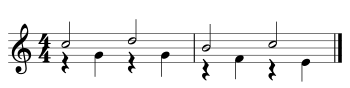
One part rests while the other goes on: a rest set high on the staff belongs to the upper part, one set low to the lower part. The hand still plays the other part's notes through it.
How to play it: Read the rest as part of its line: the line it belongs to is silent, not the hand. Count it, so the next note of that part comes in on time, often just after the beat, against the other part's held note.
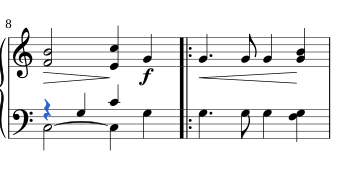
From Hymn, Op. 117 No. 27 (Gurlitt, level 3), bars 8 to 9, as its edition prints them; the notes that show it in blue pencil.
236 of the 844 pieces ask it, in 2,786 bars in all. The easiest of them: Hymn, Op. 117 No. 27 (Gurlitt, level 3), Clair de lune (Debussy, level 3) and The Tin Soldiers Marching, Op. 98 No. 3 (Gretchaninov, level 3).
Three parts in one hand three lines on one staff, or two stems on one side
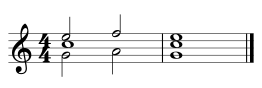
Three parts at once on one staff: in a chorale or a hymn the soprano and alto share the treble staff and the tenor and bass the bass staff, but a fugue or a slow movement can give one hand three. The middle part is the hardest to hear.
How to play it: Learn the parts in pairs before all three: top and middle, then middle and bottom. Finger it so the held notes stay down; where the hand can't hold everything, keep the top line and the bass and let the middle part go.
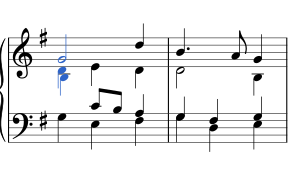
From Chorale: Aus meines Herzens Grunde, BWV 269 (Bach, level 3), bars 1 to 2, as its edition prints them; the notes that show it in blue pencil.
68 of the 844 pieces ask it, in 333 bars in all. The easiest of them: Chorale: Aus meines Herzens Grunde, BWV 269 (Bach, level 3), Sailor's Song, Op. 68 No. 1 (Grieg, level 3) and The First Nowell (Traditional, level 3).
Two voices level by level
How many of the library's pieces at each level set two voices sounding at once on a staff, and how many three. Even the easiest pieces hold a note under a moving one now and then; three parts in one hand stay rare.
What Clefsight grades
Clefsight follows every note of both voices: each key you strike is checked against the score, and so is when you strike it, against your own steady beat. A held note counts when it is struck at its time.
How long you hold a note isn't graded, so a held note let go early isn't marked. Listen for it: if the long note stops before the moving part does, the score asks the finger to stay down, and the pedal is no substitute where the edition prints none.
Try it at the keyboard. The easiest library piece that holds a note under moving notes is If Thou But Suffer God to Guide Thee (Neumark, level 2).
Play itMore on the page: playing with both hands, piano finger numbers, slurs and ties, fugues and music symbols and what they mean.