Playing piano with both hands
Playing with both hands is five different jobs, and they come one at a time: the hands take turns, play together, one holds while the other moves, a hand moves to a new place, and last the hands play different rhythms. Every one of the 842 pieces in Clefsight's library uses both hands, and 65% of all their notes are struck together with the other hand. Each way is below, in the order a reader meets it, with two bars of a real piece and how to practise it.
- Hands playing together
- One hand moving while the other holds
- Hands taking turns
- Hands in different rhythms
- Other hand silent
What changes as pieces get harder is not how often the hands play together but how often they move and part: at level 2, a hand moves to a new position on 6% of notes and the hands play different rhythms on 1%; by level 5, 25% and 5%.
Three things true of every way
Read down, then across. The two staves are one line of music: the notes straight above each other sound together. Read each beat from the top staff to the bottom one before you move on.
Each hand alone first. Learn a new piece with the right hand alone, then the left, then together slowly. The hands-together take goes faster once each hand knows its notes without looking.
Slower, never stopping. Pick a speed where both hands keep going. Clefsight's player waits for both hands in Wait, then keeps a metronome that waits for you, and marks a note late only when you fall behind your own beat.
Hands taking turns
One hand plays, then the other. Only one hand is moving at a time, so you read one staff at a time and pass the tune from hand to hand.
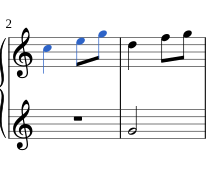
From Piece in C, Op. 117 No. 5 (Gurlitt, level 2), bars 2 to 3: the notes in blue are the ones that ask it, as its edition prints them.
Asked in 614 of the 842 pieces, on 10% of all their notes; a tenth or more of the notes in 273. The easiest of those: Piece in C, Op. 117 No. 5 (Gurlitt, level 2), Old MacDonald Had a Farm (Traditional, level 2) and Ode to Joy (Beethoven, level 2).
Practise it: Keep both hands resting over their keys the whole time, so the hand that comes next is already in place. Count out loud through the hand-over, so the beat doesn't stop while your eyes jump staves.
It is the first way the hands meet in First page, the course for readers who have never read music.
Hands playing together
Both hands strike at the same moment. You read the two staves as one: look straight down the page from the right hand's note to the left hand's.
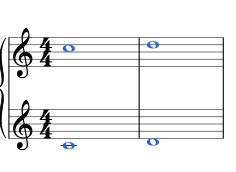
From Exercise Piece in C, Op. 190 No. 1 (Köhler, level 2), bars 1 to 2: the notes in blue are the ones that ask it, as its edition prints them.
Asked in 836 of the 842 pieces, on 65% of all their notes; a tenth or more of the notes in 823. The easiest of those: Exercise Piece in C, Op. 190 No. 1 (Köhler, level 2), Exercise Piece in C, Op. 190 No. 19 (Köhler, level 2) and Exercise Piece in C, Op. 190 No. 2 (Köhler, level 2).
Practise it: Read each pair of notes as one chord before you play it. Practise slowly with the hands apart first, then together at half the speed, landing both hands at once rather than one a hair after the other.
Clefsight brings it in with its lesson in the reading course, and fresh sight-reading uses it once you have it.
One hand moving while the other holds
One hand holds a long note while the other keeps moving. The held note has to stay down, counted to its end, while you read on in the other hand.
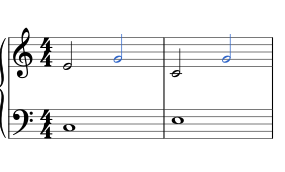
From Exercise Piece in C, Op. 190 No. 21 (Köhler, level 2), bars 1 to 2: the notes in blue are the ones that ask it, as its edition prints them.
Asked in 756 of the 842 pieces, on 22% of all their notes; a tenth or more of the notes in 622. The easiest of those: Exercise Piece in C, Op. 190 No. 21 (Köhler, level 2), Exercise Piece in C, Op. 190 No. 6 (Köhler, level 2) and Piece in C, Op. 117 No. 1 (Gurlitt, level 2).
Practise it: Hold the long note with a finger that stays relaxed, and count its beats while the other hand plays. Check it is still down when the other hand moves: lifting it early is the usual slip.
Clefsight brings it in with its lesson in the reading course, and fresh sight-reading uses it once you have it.
Moving the hand to a new position
A hand leaves its five-finger position for a new one. The notes no longer fit under the fingers where they were, so you read ahead to see where the hand is going.
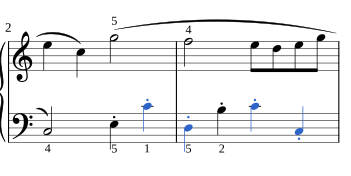
From Gavotte (Telemann, level 2), bars 2 to 3: the notes in blue are the ones that ask it, as its edition prints them.
Asked in 796 of the 842 pieces, on 19% of all their notes; a tenth or more of the notes in 607. The easiest of those: Silent Night (Gruber, level 2), Gavotte (Telemann, level 2) and The Blue Danube (theme) (Strauss, level 2).
Practise it: Find the move before you play: mark the note where the hand jumps, look at the new position during the note before it, and move during a rest or a long note where you can.
Clefsight brings it in with its lesson in the reading course, and fresh sight-reading uses it once you have it.
Hands in different rhythms
The hands play different rhythms: one hand starts notes while the other's are still sounding, so each keeps its own rhythm.
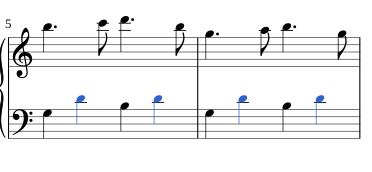
From Study, Op. 101 No. 61 (Beyer, level 2), bars 5 to 6: the notes in blue are the ones that ask it, as its edition prints them.
Asked in 353 of the 842 pieces, on 3% of all their notes; a tenth or more of the notes in 49. The easiest of those: Study, Op. 101 No. 61 (Beyer, level 2), Study in G, Op. 17 No. 5 (Couppey, level 2) and The Little Beggar, Op. 123 No. 2 (Gretchaninov, level 3).
Practise it: Learn each hand's rhythm alone until you can tap it without thinking, then tap both on a table, the right hand on your right knee and the left on the left. Put them together on the keys one beat at a time, with the metronome slow.
Clefsight brings it in with its lesson in the reading course, and fresh sight-reading uses it once you have it.
Practise on a real page. Every library piece can be played a hand at a time, then together in Wait, which waits for both hands, and the result marks which hand slipped.
Open the libraryMore on the page: reading the grand staff, piano finger numbers, five-finger positions, and a week of steps for learning a piece.