Articulation in music: staccato, accents, slurs and ties
Articulation marks say how each note is played: short or held, struck or leaned on, joined to the next or apart from it. Of the 842 pieces in Clefsight's library, 387 print slurs and 491 put a mark on single notes. Each mark is below with what it asks, how to play it and two real bars where it is printed, the mark in blue pencil.
What articulation is
The notes say which keys and when; articulation says how. The same four quarter notes played staccato, legato under a slur or with accents are three different tunes, though the notes and the rhythm never change.
A note with no mark and no slur is played plainly: not joined, not cut short, held for most of its value. Editions differ in how much they mark, so in older music, Bach's above all, much of the articulation is left to the player.
Staccato a dot over or under the note head
Short and detached: the note is let go early, leaving a small gap before the next. It takes the same time in the bar as without the dot; only the sound is shorter.
How to play it: Let the key come up as soon as it has sounded, with a light bounce from the wrist or the finger, as if the key were hot. Keep counting the full beat: the gap is part of the note's time, not a reason to hurry.
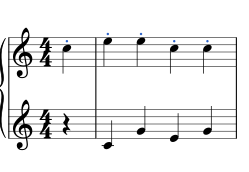
From Exercise Piece in C, Op. 190 No. 18 (Köhler, level 2), the upbeat and bar 1, as its edition prints them; the mark in blue pencil.
Printed in 325 of the 842 pieces. The easiest of them: Exercise Piece in C, Op. 190 No. 18 (Köhler, level 2), Piece in C, Op. 117 No. 10 (Gurlitt, level 2) and Rule, Britannia! (Arne, level 2).
Staccatissimo a small wedge or a teardrop over or under the note head
Very short and sharp, shorter than staccato, often with a little edge to it.
How to play it: A quick, pointed touch from the fingertip, off the key at once. Not louder than the notes around it unless the dynamic says so.
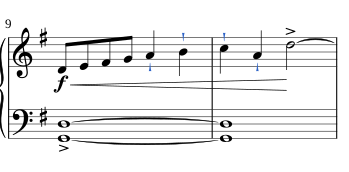
From Study in G, Op. 17 No. 5 (Couppey, level 2), bars 9 to 10, as its edition prints them; the mark in blue pencil.
Printed in 33 of the 842 pieces. The easiest of them: Study in G, Op. 17 No. 5 (Couppey, level 2), Andante in F, Op. 82 (Gurlitt, level 2) and Allegro in F, K. 1c (Mozart, level 3).
Accent a sideways wedge, >
This note louder than the notes around it, a stress within the dynamic of the passage.
How to play it: A little more weight into that one note, dropped from the arm rather than pushed by the finger, then back to the level before it: an accent in p is a strong note for p, not f.
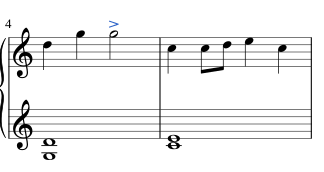
From Piece in C, Op. 117 No. 8 (Gurlitt, level 2), bars 4 to 5, as its edition prints them; the mark in blue pencil.
Printed in 245 of the 842 pieces. The easiest of them: Piece in C, Op. 117 No. 8 (Gurlitt, level 2), Exercise Piece in C, Op. 190 No. 18 (Köhler, level 2) and Rule, Britannia! (Arne, level 2).
Marcato an upright wedge, ^
A strong accent: marked and forceful, usually a little detached too.
How to play it: More weight than an accent, from a firm finger and a loose wrist, and let go a little early, so each marked note stands apart.
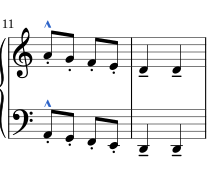
From For Children No. 8 (Bartók, level 2), bars 11 to 12, as its edition prints them; the mark in blue pencil.
Printed in 71 of the 842 pieces. The easiest of them: For Children No. 8 (Bartók, level 2), Brindisi, from La traviata (Verdi, level 3) and La Violette (Gobbaerts, level 3).
Tenuto a short line over or under the note head
Held: the note sounds for its full value, often with a slight weight, as if leaning on it.
How to play it: Press into the key and keep it down right up to the next note, with no gap. Lean on it a little rather than strike it.
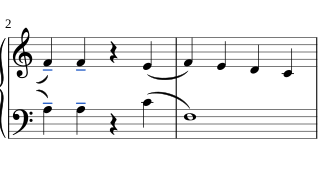
From Rule, Britannia! (Arne, level 2), bars 2 to 3, as its edition prints them; the mark in blue pencil.
Printed in 92 of the 842 pieces. The easiest of them: Rule, Britannia! (Arne, level 2), For Children No. 4 (Bartók, level 2) and For Children No. 1 (Bartók, level 2).
Portato a dot and a line together, or dots under a slur
Between legato and staccato: each note gently separated, with only a small breath between them.
How to play it: Hold each note for most of its value, then lift just before the next, without a bounce. It sounds like a soft, spoken line.
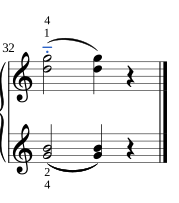
From Berceuse, from Enfantillages pittoresques (Satie, level 2), bar 32, as its edition prints them; the mark in blue pencil.
Printed in 10 of the 842 pieces. The easiest of them: Berceuse, from Enfantillages pittoresques (Satie, level 2), For Children No. 13 (Bartók, level 3) and Sonatina in G, Op. 55 No. 2: I (Kuhlau, level 3).
Fermata a dot under an arch, over a note, a rest or a bar line
A pause: hold the note or rest longer than written, as long as feels right, then go on.
How to play it: Hold it about half as long again, or more at the end of a piece, then lift and breathe before the beat starts again. Count again from the note after it.
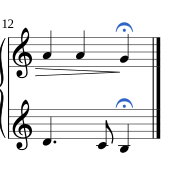
From Evening Song, Op. 101 No. 58 (Beyer, level 2), bar 12, as its edition prints them; the mark in blue pencil.
Printed in 242 of the 842 pieces. The easiest of them: Evening Song, Op. 101 No. 58 (Beyer, level 2), For Children No. 4 (Bartók, level 2) and The Little Traveller, Op. 98 No. 14 (Gretchaninov, level 2).
Slur a curve over or under notes of different pitches
The notes under it are joined, legato, with no gap between them. A long curve over a whole phrase, a phrase mark, shapes the line the same way.
How to play it: Hold each key until the next one goes down, so the sound never breaks. Lift the hand gently at the slur's end, a little early, as if taking a breath; the next note starts afresh.
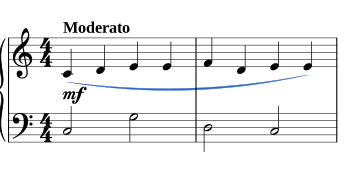
From Old German Dance (Praetorius, level 2), bars 1 to 2, as its edition prints them; the mark in blue pencil.
Printed in 387 of the 842 pieces. The easiest of them: Old German Dance (Praetorius, level 2), Study, Op. 101 No. 38 (Beyer, level 2) and Allegro in C (Reinagle, level 2).
Tie a curve joining two notes of the same pitch, often across a bar line
One note: play the first and hold it through the second, the two values added together. The second is not played again.
How to play it: Strike the first note and keep the key down while you count both values. Watch for the tie across a bar line: the new bar starts with your finger still down.
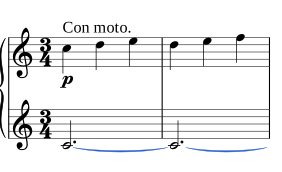
From Piece in C, Op. 117 No. 3 (Gurlitt, level 2), bars 1 to 2, as its edition prints them; the mark in blue pencil.
Printed in 415 of the 842 pieces. The easiest of them: Piece in C, Op. 117 No. 3 (Gurlitt, level 2), The Chase, Op. 117 No. 15 (Gurlitt, level 2) and Study in A minor, Op. 101 No. 60 (Beyer, level 2).
Slur or tie?
Both are the same curve. A tie joins two notes of the same pitch: play the first and hold it through the second. A slur joins notes of different pitches: play every one, joined. Look at the note heads at each end of the curve: on the same line or space it is a tie, on different ones a slur.
A curve can be both at once: a slur over a phrase can contain a tie, and a tie inside a chord joins only the notes that stay the same. A tie goes from one note head to the very next; a slur can span a whole phrase.
What Clefsight grades
A tie is one note: Clefsight expects the first note struck and held, and a tied note struck again counts as an extra note. At a fermata, hold as long as you like: it isn't counted as a stop, and the beat is followed afresh after it.
Staccato, accents, tenuto and slurs are printed for you to follow, not graded: a MIDI keyboard sends how hard and how long each key is pressed, but in the library's pieces Clefsight marks which keys you play and when, not how short or how loud. Your ear is the judge of those, and the take's playback lets you hear them back.
Play the marks on a real page. Open a piece, play from the printed page on a MIDI keyboard, and Clefsight follows you through it.
Open the libraryMore on the page: music symbols and what they mean, dynamics for how loud, musical terms for words like legato and marcato, and rhythm for note values and ties.