Dynamics in music: from pp to ff
Dynamics are the marks that say how loud to play, from ppp, as soft as you can, to fff, as loud. Of the 842 pieces in Clefsight's library, 502 print them. 440 set a level in their first two bars, and the commonest by far is p, in 257: most music starts soft and saves loud for later. Each mark is below with what it asks at the piano and two real bars where it is printed, in blue pencil.
pieces that print itpieces that open at it
How to read them
A mark holds until the next one. A p at the start means every note is soft until the music says otherwise, however many pages that is. Sudden marks like sf are the exception: they touch one note or chord, then the level before them comes back.
They are written between the staves in piano music, in bold italic letters, short for Italian words: p for piano, soft, and f for forte, loud. m (mezzo) means moderately, and each extra letter means more: pp very soft, ff very loud.
They are relative. There is no exact loudness for mf: it depends on the piano, the room and the music around it. What matters is the difference: f should sound clearly louder than the p before it.
From soft to loud
The eight levels, softest first. A piece that prints them uses 3 as a rule; the outer ones are kept for the very quietest and the climaxes.
Pianississimo ppp
As soft as you can play and still have every note sound.
At the piano: Rest the fingers on the keys and press them down slowly, from the key's surface, never from above it. Too slow and a note doesn't sound at all, so try the softest note your keyboard makes before the piece.
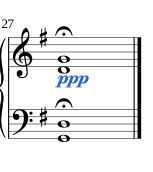
From Study in G, Op. 17 No. 5 (Couppey, level 2), bar 27, as its edition prints them; the mark in blue pencil.
Printed in 29 of the 842 pieces. The easiest of them: Study in G, Op. 17 No. 5 (Couppey, level 2), For Children No. 8 (Bartók, level 2) and For Children No. 6 (Bartók, level 3).
Pianissimo pp
Very soft.
At the piano: Play from the surface of the keys, with little weight: the fingers do the work, the arm stays light.
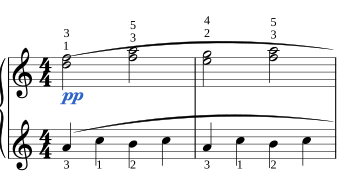
From Berceuse, from Enfantillages pittoresques (Satie, level 2), bars 1 to 2, as its edition prints them; the mark in blue pencil.
Printed in 178 of the 842 pieces. 21 open at it. The easiest of them: Berceuse, from Enfantillages pittoresques (Satie, level 2), For Children No. 4 (Bartók, level 2) and Elementary Study, Op. 176 No. 3 (Duvernoy, level 2).
Piano p
Soft. The instrument's full name, pianoforte, means soft-loud.
At the piano: A gentle press from close to the key. Soft is not weak: keep each note clear and the melody a little over the rest.
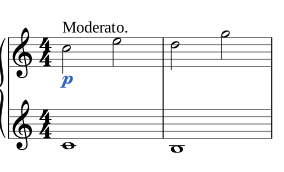
From Piece in C, Op. 117 No. 1 (Gurlitt, level 2), bars 1 to 2, as its edition prints them; the mark in blue pencil.
Printed in 391 of the 842 pieces. 257 open at it. The easiest of them: Piece in C, Op. 117 No. 1 (Gurlitt, level 2), Old German Dance (Praetorius, level 2) and Piece in C, Op. 117 No. 3 (Gurlitt, level 2).
Mezzo piano mp
Moderately soft: a little louder than p.
At the piano: Between p and mf: a little more weight than p, with the same closeness to the key.
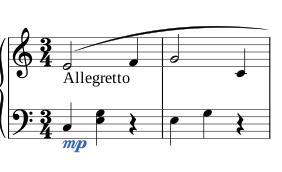
From Carousel Waltz (Gobbaerts, level 2), bars 1 to 2, as its edition prints them; the mark in blue pencil.
Printed in 69 of the 842 pieces. 9 open at it. The easiest of them: The Blue Danube (theme) (Strauss, level 2), Carousel Waltz (Gobbaerts, level 2) and Elementary Study, Op. 176 No. 4 (Duvernoy, level 2).
Mezzo forte mf
Moderately loud: an easy, singing tone, about how you play with no mark at all.
At the piano: Your ordinary playing: relaxed arm weight into the keys, nothing forced.
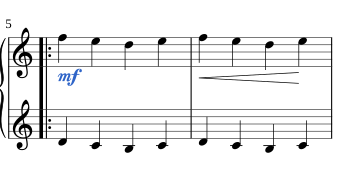
From Piece in C, Op. 117 No. 2 (Gurlitt, level 2), bars 5 to 6, as its edition prints them; the mark in blue pencil.
Printed in 247 of the 842 pieces. 79 open at it. The easiest of them: Piece in C, Op. 117 No. 2 (Gurlitt, level 2), Old German Dance (Praetorius, level 2) and Study in A minor, Op. 101 No. 60 (Beyer, level 2).
Forte f
Loud.
At the piano: More arm weight and a quicker key: let the weight of the arm drop into the keys rather than pushing with the fingers, and keep the wrist loose.
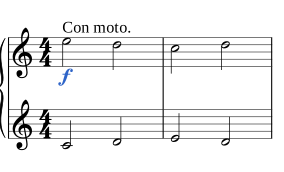
From Piece in C, Op. 117 No. 4 (Gurlitt, level 2), bars 1 to 2, as its edition prints them; the mark in blue pencil.
Printed in 353 of the 842 pieces. 67 open at it. The easiest of them: Piece in C, Op. 117 No. 4 (Gurlitt, level 2), Piece in C, Op. 117 No. 2 (Gurlitt, level 2) and Old German Dance (Praetorius, level 2).
Fortissimo ff
Very loud.
At the piano: The full weight of the arm, from a little above the keys. Stay loose: a tight arm makes a hard, short sound and tires quickly.
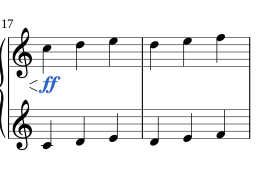
From Piece in C, Op. 117 No. 3 (Gurlitt, level 2), bars 17 to 18, as its edition prints them; the mark in blue pencil.
Printed in 93 of the 842 pieces. 7 open at it. The easiest of them: Piece in C, Op. 117 No. 3 (Gurlitt, level 2), Rule, Britannia! (Arne, level 2) and Elementary Study, Op. 176 No. 4 (Duvernoy, level 2).
Fortississimo fff
As loud as the music allows, kept for climaxes.
At the piano: Arm and shoulder weight through a loose wrist, often in big chords. Save it: the climax only sounds loud if what came before was softer.
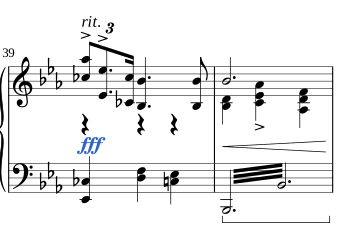
From Nimrod, from the Enigma Variations (Elgar, level 4), bars 39 to 40, as its edition prints them; the mark in blue pencil.
Printed in 6 of the 842 pieces. The easiest of them: Nimrod, from the Enigma Variations (Elgar, level 4), Hino Nacional Brasileiro (Silva, level 4) and Russian Dance (Trepak), from The Nutcracker (Tchaikovsky, level 4).
Sudden accents
Marks that change the loudness of one note or a few, then let the level before them return.
Sforzando sf, sfz or fz
A sudden strong accent on one note or chord, then back to the dynamic before it.
At the piano: A quick drop of weight into that one note or chord, then lighten at once: sf in a p passage is a loud note for p, not ff.
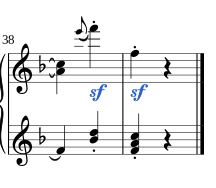
From On the Accordion, Op. 123 No. 12 (Gretchaninov, level 2), bars 38 to 39, as its edition prints them; the mark in blue pencil.
Printed in 129 of the 842 pieces. The easiest of them: On the Accordion, Op. 123 No. 12 (Gretchaninov, level 2), Tarantella, Op. 100 No. 20 (Burgmüller, level 3) and Study in A minor, Op. 47 No. 3 (Heller, level 3).
Rinforzando rf or rfz
Reinforced: a stress on a note or a short group, gentler and broader than sf.
At the piano: Lean into the notes under it with a little more weight, and let the sound swell rather than strike.
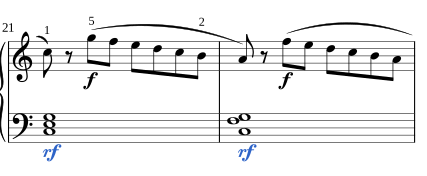
From Elementary Study, Op. 176 No. 1 (Duvernoy, level 2), bars 21 to 22, as its edition prints them; the mark in blue pencil.
Printed in 9 of the 842 pieces. The easiest of them: Elementary Study, Op. 176 No. 1 (Duvernoy, level 2), Study in A minor, Op. 47 No. 3 (Heller, level 3) and Study in F, Op. 17 No. 19 (Couppey, level 3).
Forte-piano fp (or sfp)
Loud on the first note, then soft at once.
At the piano: Strike the first note or chord f, then play the very next notes p. On a piano the loud note dies away, so the drop is in what follows.
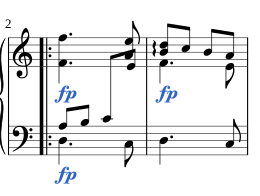
From Little Canon, Op. 68 No. 27 (Schumann, level 3), bars 2 to 3, as its edition prints them; the mark in blue pencil.
Printed in 17 of the 842 pieces. The easiest of them: Little Canon, Op. 68 No. 27 (Schumann, level 3), Sonata in G minor, Op. 49 No. 1: II (Beethoven, level 3) and Elegy, Op. 38 No. 6 (Grieg, level 3).
Getting louder and softer
A wedge under the notes, or the words cresc. and dim. with a dotted line, change the loudness gradually over the notes they cover.
Crescendo an opening wedge, or cresc.
Get gradually louder, until the wedge or the dotted line after cresc. ends.
At the piano: Plan where it starts and where it arrives. Start it softer than you think, and add weight a little at each note, so there is room to grow.
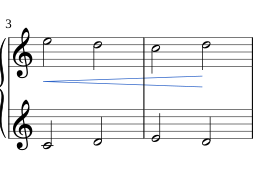
From Piece in C, Op. 117 No. 4 (Gurlitt, level 2), bars 3 to 4, as its edition prints them; the mark in blue pencil.
Printed in 375 of the 842 pieces. The easiest of them: Piece in C, Op. 117 No. 4 (Gurlitt, level 2), Piece in C, Op. 117 No. 2 (Gurlitt, level 2) and Piece in C, Op. 117 No. 3 (Gurlitt, level 2).
Diminuendo or decrescendo a closing wedge, or dim. or decresc.
Get gradually softer.
At the piano: Take a little weight off at each note, keeping the notes even, so the line fades rather than stops.
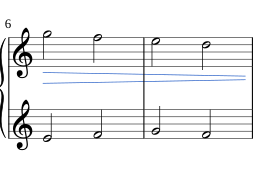
From Piece in C, Op. 117 No. 4 (Gurlitt, level 2), bars 6 to 7, as its edition prints them; the mark in blue pencil.
Printed in 349 of the 842 pieces. The easiest of them: Piece in C, Op. 117 No. 4 (Gurlitt, level 2), Evening Song, Op. 101 No. 58 (Beyer, level 2) and Piece in C, Op. 117 No. 8 (Gurlitt, level 2).
Dynamics level by level
Easy pieces often print few dynamics or none, so the reader can think about the notes. At level 2, 43% of the library's pieces print one; by level 5, 75%, and the range widens: ff or louder goes from 4% of pieces to 23%. The widest span in the library runs 7 levels, from pp to fff; the easiest piece that spans it is Nimrod, from the Enigma Variations (Elgar, level 4).
On a MIDI keyboard
A touch-sensitive keyboard measures how fast each key goes down and sends it as a velocity, from 1 to 127; the sound is louder the faster the key. Keyboards differ in how hard you must play for the same number, and many let you choose a softer or harder touch curve in their settings. Pick one where pp and ff both feel within reach.
Clefsight grades the notes you play and when you play them, not how loud: loudness depends on each keyboard, so it is only ever compared with your own playing (how Clefsight grades). Play the dynamics anyway; they are half of what makes a page sound like music.
Play them on a real page. Every library piece is printed with its dynamics, and Clefsight follows you through it as you play from the page on a MIDI keyboard.
Open the libraryMore on the page: music symbols and what they mean, musical terms for words like cresc. and subito, and tempo markings for how fast.