Fugues for piano
7 fugues to read and learn at your keyboard, levels 4 to 5, easiest first, each with easier versions made from the score itself.
What a fugue is
A piece for several voices that each enter with the same tune, the subject, one after another. Bach wrote 48 of them in The Well-Tempered Clavier, a prelude and fugue in every key, twice.
How it goes
Steady from start to finish: every voice moves at the same pulse, so no hand can take time.
What to read for
Find the subject in the first bars, where one voice plays it alone; then watch for it entering in another voice, higher or lower, while the first goes on. Each hand often plays two voices at once.
What the library's 7 fugues print
Time signatures: 4 in 4/4, 1 in 12/8, 1 in 2/2, and 1 in 12/16. Tempo words at the start: Andante (2) and Adagio (1); 4 print none. Keys: 3 major and 4 minor, most often E minor (2), E major (1), and A minor (1).
By Johann Sebastian Bach (6) and Frédéric Chopin.
- Pieces
- 7
- Levels
- 4 to 5
- Key signatures
- 3 flats to 6 sharps
- Length
- 54 to 85 bars
Level 4
Real independence between the hands and more accidentals.
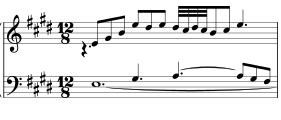
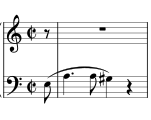
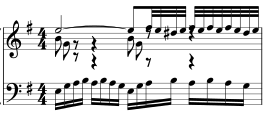
Level 5
The edge of early intermediate: dense textures, fast passages and far keys.
-
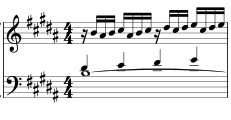 Prelude and Fugue in B, BWV 868
Johann Sebastian Bach 5 sharps, 4/4, 54 bars Community source -
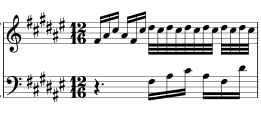 Prelude and Fugue in F sharp, BWV 858
Johann Sebastian Bach 6 sharps, 12/16, 66 bars Community source -
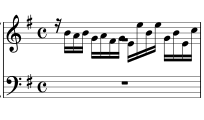 Fugue in E minor, BWV 914
Johann Sebastian Bach 1 sharp, 4/4, 72 bars Two sources agree -
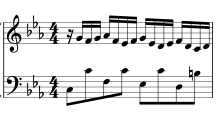 Prelude and Fugue in C minor, BWV 871
Johann Sebastian Bach 3 flats, 4/4, 85 bars Community source
A piece is listed here when its title calls it a fugue, in English, German, French or Italian.
Other forms
Every form five or more library pieces are named for.
Learning with someone? Send them this page by email