Marches for piano
15 marches to read and learn at your keyboard, levels 2 to 4, easiest first, each with easier versions made from the score itself.
What a march is
Music for walking in step: soldiers, processions, weddings and funerals. A march for the keyboard keeps the beat of feet, from the little marches in Bach's notebook to Chopin's funeral march and Mendelssohn's wedding march.
How it goes
Two strong beats in a bar, left and right foot, whether it is written in 2/4, 4/4 or 2/2. A funeral march walks slowly; a soldiers' march is brisk. Usually written in 2/4, 4/4, 2/2, and 6/8.
What to read for
Dotted rhythms (a long note and a short one) and repeated notes on the beat. Keep every beat the same length: a march that slows down stops marching.
What the library's 15 marches print
Time signatures: 5 in 2/4, 5 in 4/4, 4 in 2/2, and 1 in 6/8. Tempo words at the start: Allegro (3), Allegretto (2), and Moderato (1); 9 print none. Keys: 10 major and 5 minor, most often D major (4), G major (3), and C major (2).
By Carl Philipp Emanuel Bach (2), Pyotr Ilyich Tchaikovsky (2), Frédéric Chopin (2), Erik Satie, Jeremiah Clarke, George Frideric Handel, Robert Schumann, Anonymous, Wolfgang Amadeus Mozart, Charles Gounod, Felix Mendelssohn, and Edvard Grieg.
- Pieces
- 15
- Levels
- 2 to 4
- Key signatures
- 3 flats to 2 sharps
- Length
- 24 to 194 bars
Level 2
A tune over a simple left hand, mostly in one hand position.
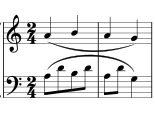
Level 3
Both hands busy, the hand moves around, a sharp or flat or two.
-
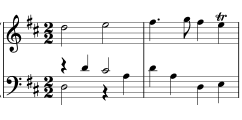 The Prince of Denmark's March
Jeremiah Clarke 2 sharps, 2/2, 24 bars Checked against the edition -
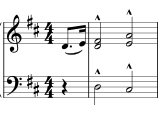 March from Scipio
George Frideric Handel 2 sharps, 4/4, 33 bars Community source -
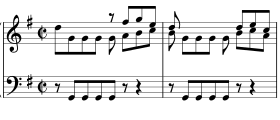 March in G, BWV Anh. 124
Carl Philipp Emanuel Bach 1 sharp, 2/2, 44 bars Two sources agree -
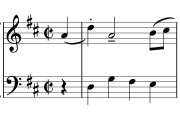 March in D, BWV Anh. 122
Carl Philipp Emanuel Bach 2 sharps, 2/2, 45 bars Community source -
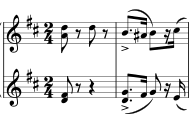 March of the Wooden Soldiers, Op. 39 No. 5
Pyotr Ilyich Tchaikovsky 2 sharps, 2/4, 48 bars Two sources agree -
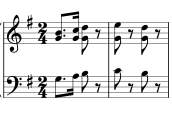 Soldiers' March, Op. 68 No. 2
Robert Schumann 1 sharp, 2/4, 48 bars Community source -
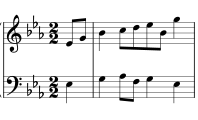 March in E flat, BWV Anh. 127
Anonymous (Notebook for Anna Magdalena Bach) 3 flats, 2/2, 57 bars Community source -
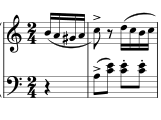 Rondo alla turca (Turkish March)
Wolfgang Amadeus Mozart no sharps or flats, 2/4, 65 bars, shortened Community source -
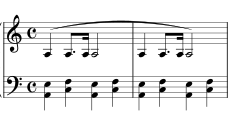 Funeral March, from the Sonata No. 2
Frédéric Chopin no sharps or flats, 4/4, 108 bars Community source
Level 4
Real independence between the hands and more accidentals.
-
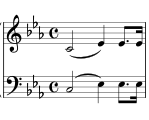 Funeral March in C minor, Op. 72
Frédéric Chopin 3 flats, 4/4, 76 bars Community source -
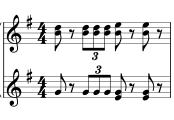 March, from The Nutcracker
Pyotr Ilyich Tchaikovsky 1 sharp, 4/4, 88 bars Checked against the edition -
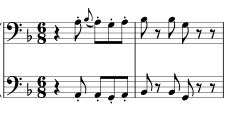 Funeral March of a Marionette
Charles Gounod 1 flat, 6/8, 152 bars Checked against the edition -
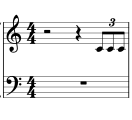 Wedding March, from A Midsummer Night's Dream
Felix Mendelssohn no sharps or flats, 4/4, 187 bars Checked against the edition -
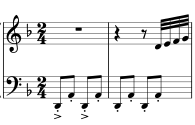 March of the Trolls, Op. 54 No. 3
Edvard Grieg 1 flat, 2/4, 194 bars Checked against the edition
A piece is listed here when its title calls it a march, in English, German, French or Italian.
Other forms
Every form five or more library pieces are named for.
Learning with someone? Send them this page by email