Learn to read music · Time signatures
Time signature changes: how to count across a new time signature
A time signature change is a new time signature partway through a piece: from that bar on, count the new number of beats, and sometimes a new beat. Of the 844 pieces in Clefsight's library, 21 print a change of time at least once, and 13 of them come back to the time they started in. Each way a time changes is below with four bars of our own, the counts under the notes, what to count and what your hands do, and real bars where a library piece changes time that way, the new signature in blue pencil.
How to read a time signature change
A time signature change is printed as a new time signature in the middle of the music, right after a bar line. From that bar, the top number says how many beats each bar holds and the bottom number which note gets the beat, until the piece ends or the time changes again. Unlike a key signature it is printed only once, not at the start of every line.
Look ahead for it. At the end of a line before a change, editions print the new time signature again after the last bar line as a warning. Before you play on, ask two things: does the beat stay the same note, and how many of them are there now? Most changes keep the beat and change only the count.
Then count out loud through the change at a slow speed, a bar before it and a bar after it, until the new count comes without thinking. Where you slip, pencil the count over the first bar in the new time.
More or fewer beats in the bar the same beat, counted to a different number
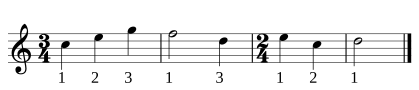
The beat goes on as it was; only the number of beats before the next bar line changes: 3/4 to 2/4, 4/4 to 3/4, 9/8 to 6/8. Folk-song settings (Bartók's For Children) and Romantic pieces change this way to fit a phrase, and so do sections written in a new time for a new tune.
How to play it: Keep the beat going through the bar line and change only the count: after a change from 3/4 to 2/4 you count "1 2, 1 2" at the same speed. The first beat of each bar is still the strongest; it simply comes round sooner or later.
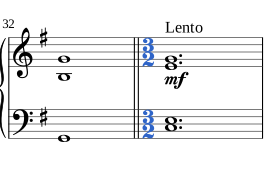
From Study in G, Op. 17 No. 11 (Couppey, level 3), bars 32 to 33, as its edition prints them; the new signatures in blue pencil.
10 of the 844 pieces change time this way, 23 times in all. The easiest of them: Study in G, Op. 17 No. 11 (Couppey, level 3), Andante in C, K. 1a (Mozart, level 3) and Evening in Transylvania (Bartók, level 3).
A new beat the beat itself changes: a quarter to a dotted quarter, or to a half

The bar keeps its feel of two, three or four, but each beat is now a different note: 2/4 to 6/8 splits each beat in three instead of two, 4/4 to 2/2 (cut time) counts the half note, and 12/8 to 4/4 straightens a lilt. A new section in a new mood is often printed this way.
How to play it: Decide what stays the same. Usually it is the beat: the quarter of 2/4 becomes the dotted quarter of 6/8, so the bar lasts as long as before and the eighths get faster, three to a beat. Where the score prints a note equal to a note over the change, or "l'istesso tempo" (the same speed), it says so; where it doesn't, the tempo word over the new section tells you.
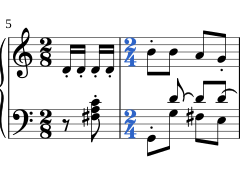
From For Children No. 19 (Bartók, level 4), bars 5 to 6, as its edition prints them; the new signatures in blue pencil.
7 of the 844 pieces change time this way, 11 times in all. The easiest of them: For Children No. 19 (Bartók, level 4), Sicilienne, Op. 68 No. 11 (Schumann, level 4) and Prelude and Fugue in E, BWV 854 (Bach, level 4).
One bar in another time a single bar longer or shorter, then back

One bar is printed in a different time and the next goes back: a 2/4 bar in a piece in 4/4, a bar of 3/8 among bars of 9/8. Composers write it where a phrase needs a beat or two more or less (Debussy's Rêverie, Ravel's Pavane), and some editions print the short bar before a repeat or at the very end this way.
How to play it: Count that bar to its own number and come straight back: "1 2 3 4, 1 2, 1 2 3 4". It is easy to play the short bar long out of habit, so look for the two signatures, the one that leaves and the one that comes back, before you start.
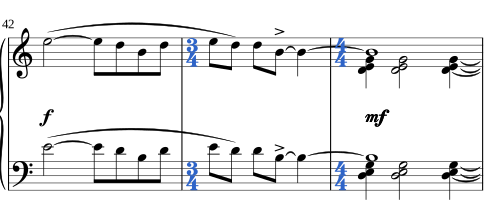
From Evening in Transylvania (Bartók, level 3), bars 42 to 44, as its edition prints them; the new signatures in blue pencil.
10 of the 844 pieces change time this way, 17 times in all. The easiest of them: Christian! Seek Not Yet Repose (Havergal, level 3), Evening in Transylvania (Bartók, level 3) and In the Fields, Op. 123 No. 10 (Gretchaninov, level 3).
Times a file sets without printing
11 more of the library's pieces have a bar that is shorter or longer than its time signature says without a new one printed: most often the short bar before a repeat, which the bar after the repeat fills out, or a cadenza of many small notes in one long bar. Nothing changes on the page, so they aren't counted here. Read such a bar by its notes and count on from the next full bar.
Time signature changes level by level
How many of the library's pieces at each level print a new time signature partway through. Few pieces change time at all; the easiest that do are folk-song settings and pieces in sections.
The easiest pieces that change time
The library's easiest pieces with a time signature change, each with its signatures in order and the bar each new one starts in, counted from the first bar of the score.
| Piece | Time signatures |
|---|---|
| Christian! Seek Not Yet Repose (Havergal, level 3) | 2/2 → 6/4 bar 15 |
| Study in G, Op. 17 No. 11 (Couppey, level 3) | 2/2 → 3/2 bar 33 |
| Andante in C, K. 1a (Mozart, level 3) | 3/4 → 2/4 bar 5 |
| Evening in Transylvania (Bartók, level 3) | 4/4 → 3/4 bar 8 → 4/4 bar 10 → 3/4 bar 21 → 4/4 bar 30 → 3/4 bar 43 → 4/4 bar 44 → 3/4 bar 46 → 4/4 bar 47 → 3/4 bar 49 → 4/4 bar 50 → 2/4 bar 52 → 3/4 bar 53 |
| In the Fields, Op. 123 No. 10 (Gretchaninov, level 3) | 2/4 → 3/4 bar 26 → 2/4 bar 29 → 3/4 bar 30 → 2/4 bar 33 → 3/4 bar 46 → 2/4 bar 49 |
| For Children No. 14 (Bartók, level 4) | 2/4 → 3/4 bar 5 → 2/4 bar 6 → 3/4 bar 9 → 2/4 bar 11 |
| Lullaby (Wiegenlied), Op. 49 No. 4 (Brahms, level 4) | 3/4 → 2/4 bar 17 |
| For Children No. 19 (Bartók, level 4) | 2/8 → 4/8 bar 2 → 2/8 bar 5 → 2/4 bar 6 → 2/8 bar 12 → 4/8 bar 13 |
| June: Barcarolle, Op. 37a No. 6 (Tchaikovsky, level 4) | 4/4 → 3/4 bar 40 → 4/4 bar 52 |
| Arabesque No. 1 (Debussy, level 4) | 4/4 → 2/4 bar 94 → 4/4 bar 95 |
| Sicilienne, Op. 68 No. 11 (Schumann, level 4) | 6/8 → 2/4 bar 28 |
| William Tell Overture: the finale (Rossini, level 4) | 4/4 → 2/4 bar 46 → 4/4 bar 47 → 2/4 bar 50 → 4/4 bar 51 → 2/4 bar 76 → 4/4 bar 77 |
What Clefsight does at a time signature change
The count-in counts the bar a take starts in: from the top, the opening time; looping a section from the ledge, the time of that section's first bar. So to practise the bars after a change, loop the section they are in and the count-in counts the new time.
Through the take the click keeps the beat it started with and stresses one click in every bar's worth of the opening time, so after a change its stressed click may no longer fall on the bar line: keep the beat and let the count change. A take is graded note by note against your own steady beat, not against the bar lines, so a new time signature changes nothing in how it is marked; a short bar played long shows as the notes after it marked late.
Know the time at a glance. A change is quick to count when each time is: a short drill of rhythms in each time signature, tapped at a MIDI keyboard or on the keys on screen.
Drill time signaturesMore on counting: time signatures, how to read rhythm, the pickup measure, key changes and the metronome.