Learn to read music · Key signatures
Key changes in piano music: how to read a new key signature
A key change is a new key signature partway through a piece, after a double bar: from there on, the new sharps or flats hold on every note of their letter. Of the 844 pieces in Clefsight's library, 60 change key at least once, and 42 of them come back to the key they started in. Each way a key changes is below with four bars of our own, what to look for and what your hand does, and two real bars where a library piece changes key that way, the new signature in blue pencil.
How to read a key change
A key change is printed as a new key signature in the middle of the music, almost always just after a double bar line. From that point, read every note with the new signature: its sharps or flats apply to every note of those letters, in every octave, until the piece ends or the signature changes again. Sharps or flats the old signature had and the new one drops are often printed as naturals, so you can see what has gone.
Look ahead for it. At the end of a line before a change, editions print the new signature again after the last bar line as a warning, and the double bar itself is a sign that something new is coming. Before you play on, name the new key, find its tonic on the keyboard and say which notes have changed: often it is only one.
Mind the trap after it: a signature is easy to forget halfway down the page. Where you slip, pencil the changed note's sharp or flat in front of the first few notes that need it, as many players do.
One sharp more one sharp added, or one flat taken away

The music moves to the key a fifth higher: C major to G major, F major to C major, D minor to A minor. It is the most common change of all, and often comes back: a minuet's second half, a sonatina's middle.
How to play it: Find the one note that changes and keep it in mind: going from C to G, every F is now F♯. The hand stays where it is; only that one key moves.
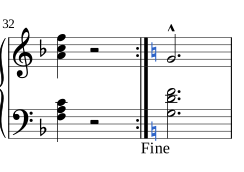
From La Violette (Gobbaerts, level 3), bars 32 to 33, as its edition prints them; the new signature in blue pencil.
13 of the 844 pieces change key this way, 13 times in all. The easiest of them: La Violette (Gobbaerts, level 3), The brave Soldier, Op. 117 No. 25 (Gurlitt, level 3) and Minuet and Trio in G, K. 1 (Mozart, level 3).
One flat more one flat added, or one sharp taken away

The music moves to the key a fifth lower: C major to F major, G major to C major. The trio of a march or a minuet often sits there, and it often comes back before the end.
How to play it: Again one note changes: going from C to F, every B is now B♭. A sharp taken away is printed as a natural in the new signature; read it as the end of that sharp.
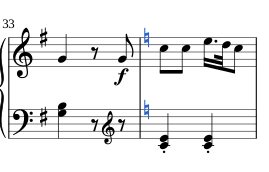
From The brave Soldier, Op. 117 No. 25 (Gurlitt, level 3), bars 33 to 34, as its edition prints them; the new signature in blue pencil.
24 of the 844 pieces change key this way, 24 times in all. The easiest of them: The brave Soldier, Op. 117 No. 25 (Gurlitt, level 3), Children's Study, Op. 37 No. 25 (Lemoine, level 3) and Minuet and Trio in G, K. 1 (Mozart, level 3).
Three sharps or flats apart three accidentals added or taken away at once

Most often the same tonic in its other mode: C minor (three flats) to C major (no sharps or flats), or A major to A minor. A trio in the major after a dance in the minor, or the reverse, is printed this way, and the three cancelled flats or sharps are shown as naturals.
How to play it: The tonic stays the same, so the hand can stay where it is; only the third, sixth and seventh notes of the scale move by a half step. Play the new key's scale or its broken chord once before you read on.
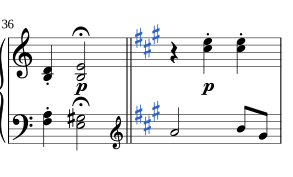
From Waltz, Op. 12 No. 2 (Grieg, level 3), bars 36 to 37, as its edition prints them; the new signature in blue pencil.
32 of the 844 pieces change key this way, 60 times in all. The easiest of them: Waltz, Op. 12 No. 2 (Grieg, level 3), Tarantella, Op. 100 No. 20 (Burgmüller, level 3) and Little Canon, Op. 68 No. 27 (Schumann, level 3).
Further round the circle two, four or more sharps or flats changed at once

A leap to a key further away, such as C major to A♭ major (four flats) or to E major (four sharps): the Romantic composers' change of colour, often a third away from the old tonic. Some scores print the same key two ways, five flats for four sharps, when a section is easier to read in one spelling.
How to play it: Stop at the double bar and read the new signature as if it were the start of a new piece: name its key, find the tonic on the keyboard and play its scale or chord before you read the notes.
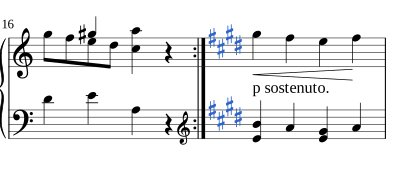
From Gavotte, Op. 117 No. 31 (Gurlitt, level 3), bars 16 to 17, as its edition prints them; the new signature in blue pencil.
9 of the 844 pieces change key this way, 19 times in all. The easiest of them: Gavotte, Op. 117 No. 31 (Gurlitt, level 3), Bethena (Joplin, level 4) and Arabesque No. 1 (Debussy, level 4).
Key changes without a new signature
Not every change of key is printed. Music moves to the relative minor or major (C major and A minor, say) with the same signature, so nothing changes on the page but the chords and the raised seventh: in A minor, G♯ appears as an accidental again and again. Short visits to a new key are written with accidentals too, rather than a new signature for a few bars.
So the same accidental turning up bar after bar is a key change in all but name. Read it as one: name the key it points to (a run of F♯s in C major points to G) and expect that sharp until the music turns back. The counts on this page are only the changes a score prints as a new signature.
Key changes level by level
How many of the library's pieces at each level print a new key signature partway through. The easiest pieces stay in one key; from the middle levels on, dances with a trio and pieces in sections often change key and come back.
The easiest pieces that change key
The library's easiest pieces with a key change, each with its signatures in order and the bar each new one starts in, counted from the first bar of the score.
| Piece | Key signatures |
|---|---|
| Waltz, Op. 12 No. 2 (Grieg, level 3) | no sharps or flats → 3♯ bar 37 → no sharps or flats bar 53 → 3♯ bar 71 |
| La Violette (Gobbaerts, level 3) | 1♭ → no sharps or flats bar 33 |
| Tarantella, Op. 100 No. 20 (Burgmüller, level 3) | 1♭ → 2♯ bar 36 → 1♭ bar 53 |
| The brave Soldier, Op. 117 No. 25 (Gurlitt, level 3) | no sharps or flats → 1♯ bar 19 → no sharps or flats bar 35 |
| Children's Study, Op. 37 No. 25 (Lemoine, level 3) | 1♭ → 2♭ bar 39 |
| Little Canon, Op. 68 No. 27 (Schumann, level 3) | no sharps or flats → 3♯ bar 12 → no sharps or flats bar 24 |
| Minuet and Trio in G, K. 1 (Mozart, level 3) | 1♯ → no sharps or flats bar 34 → 1♯ bar 66 |
| La Styrienne, Op. 100 No. 14 (Burgmüller, level 3) | 1♯ → no sharps or flats bar 31 |
| Sonatina in C, Op. 55 No. 1: II (Kuhlau, level 3) | no sharps or flats → 1♭ bar 54 → no sharps or flats bar 70 |
| Sonatina in G, Op. 20 No. 1: II (Dussek, level 3) | 1♯ → 2♭ bar 40 → 1♯ bar 80 |
| Gavotte, Op. 117 No. 31 (Gurlitt, level 3) | no sharps or flats → 4♯ bar 17 → no sharps or flats bar 33 |
| Sonata in G minor, Op. 49 No. 1: II (Beethoven, level 3) | 1♯ → 2♭ bar 21 → 1♯ bar 82 |
What Clefsight does at a key change
Nothing needs setting: Clefsight reads each note as the score means it, so after a new signature it waits for the new keys. Play the old key's note out of habit and the take marks it as a wrong note in red at that place, which is often the first sign that the signature was missed.
Know the new key at a glance. A key change is quick to read when the signature is: a short drill of key signatures, at a MIDI keyboard or on the keys on screen.
Drill key signaturesMore on keys: how to read key signatures, the key signatures chart, the circle of fifths, sharps, flats and naturals and the key signature quiz.