Sharps, flats and naturals on the piano
An accidental is a sharp, flat or natural written beside one note, changing it from what the key signature says. Of the 842 pieces in Clefsight's library, 681 print accidentals, 30,832 of them between them. Each kind is below with the key it sends you to and two real bars where it is printed, the sign in blue pencil.
Every key's names
Each black key has two names: the white key to its left with a sharp, or the white key to its right with a flat. C♯ and D♭ are one key. Two white keys have no black key between them, E and F, and B and C, so a sharp or flat there lands on a white key.
Which name a score uses depends on the key and on where the melody is going: a note on its way up is usually written sharp, on its way down flat. Names for the same key are called enharmonic.
Sharp ♯ before the note head
Raises the note a half step: play the very next key to the right, black or white. F♯ is the black key just right of F; E♯ is the white key F, as there is no black key between E and F.
At the keyboard: Find the written note first, then move one key right. Don't skip a key: a half step is the nearest key, whatever its colour.
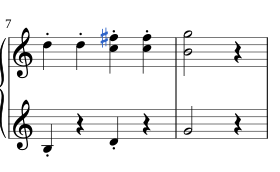
From Exercise Piece in C, Op. 190 No. 18 (Köhler, level 2), bars 7 to 8, as its edition prints them; the sign in blue pencil.
Printed in 630 of the 842 pieces, 14,519 times in all. The easiest of them: Exercise Piece in C, Op. 190 No. 18 (Köhler, level 2), Lamentation, Op. 117 No. 16 (Gurlitt, level 2) and Exercise Piece in C, Op. 190 No. 17 (Köhler, level 2).
Flat ♭ before the note head
Lowers the note a half step: play the very next key to the left. B♭ is the black key just left of B; C♭ is the white key B.
At the keyboard: Find the written note, then move one key left. A flat on a black-key letter that has none, like F♭, lands on a white key: F♭ is E.
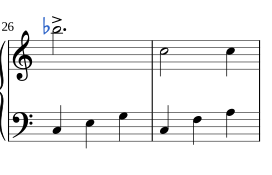
From Exercise Piece in C, Op. 190 No. 24 (Köhler, level 2), bars 26 to 27, as its edition prints them; the sign in blue pencil.
Printed in 335 of the 842 pieces, 5,284 times in all. The easiest of them: Exercise Piece in C, Op. 190 No. 24 (Köhler, level 2), Papageno's Aria, from The Magic Flute (Mozart, level 2) and For Children No. 8 (Bartók, level 2).
Natural ♮ before the note head
Cancels a sharp or flat, from the key signature or from earlier in the bar: play the plain white key of that letter.
At the keyboard: A natural in a piece with sharps or flats in the key is the sign most often missed, since the hand is used to the key's black key. Read it as a white key every time.
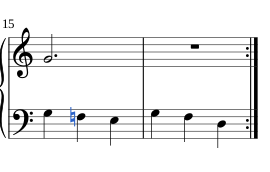
From Exercise Piece in C, Op. 190 No. 24 (Köhler, level 2), bars 15 to 16, as its edition prints them; the sign in blue pencil.
Printed in 539 of the 842 pieces, 10,567 times in all. The easiest of them: Exercise Piece in C, Op. 190 No. 24 (Köhler, level 2), Piece in C, Op. 117 No. 9 (Gurlitt, level 2) and Elementary Study, Op. 176 No. 2 (Duvernoy, level 2).
Double sharp 𝄪, a small x before the note head
Raises the note two half steps, a whole step: F𝄪 is the white key G. It appears where the music needs a note a half step above one that is already sharp, mostly in sharp minor keys.
At the keyboard: Count two keys right of the written letter. In a bar that follows, a single sharp brings it back down to the sharp.
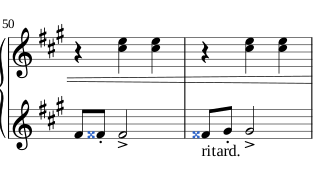
From Waltz, Op. 12 No. 2 (Grieg, level 3), bars 50 to 51, as its edition prints them; the sign in blue pencil.
Printed in 35 of the 842 pieces, 365 times in all. The easiest of them: Waltz, Op. 12 No. 2 (Grieg, level 3), Elfin Dance, Op. 12 No. 4 (Grieg, level 3) and Study in E, Op. 17 No. 20 (Couppey, level 3).
Double flat 𝄫, two flats before the note head
Lowers the note two half steps: B𝄫 is the white key A. It appears in flat keys, where a note a half step below a flat is needed.
At the keyboard: Count two keys left of the written letter.
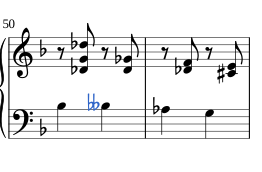
From Melody in F, Op. 3 No. 1 (Rubinstein, level 4), bars 50 to 51, as its edition prints them; the sign in blue pencil.
Printed in 11 of the 842 pieces, 33 times in all. The easiest of them: Melody in F, Op. 3 No. 1 (Rubinstein, level 4), Humoresque, Op. 101 No. 7 (Dvořák, level 4) and Étude in C sharp minor, Op. 2 No. 1 (Scriabin, level 5).
Courtesy accidental an accidental in brackets, or one the bar line already cancelled
A reminder, not a change: it says what the note already is, usually after a bar line has cancelled an accidental from the bar before.
At the keyboard: Play the note as the sign says, as you would anyway. Courtesy signs are there because a reader's hand remembers the last bar.
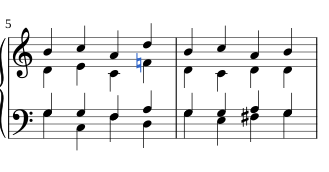
From O God, Our Help in Ages Past (Croft, level 3), bars 5 to 6, as its edition prints them; the sign in blue pencil.
Printed in 30 of the 842 pieces, 64 times in all. The easiest of them: O God, Our Help in Ages Past (Croft, level 3), O Worship the King (Haydn, level 3) and Minuet in G, BWV Anh. 116 (Anonymous, level 3).
How long does an accidental last?
- To the end of the bar. An accidental changes its note and every later note on the same line or space in that bar. The bar line cancels it.
- Only on its own line or space. A sharp on the F at the top of the treble staff doesn't sharpen the F an octave lower, and a sign in one hand's staff doesn't change the other's.
- Across a tie. A note tied over the bar line keeps its accidental, but only for the tied note: the next note of that letter in the new bar is back to the key.
- A key signature lasts the whole piece, until a new one is printed: it is a sharp or flat on every note of that letter, in every octave. See the key signatures chart.
Accidentals as the music gets harder
In the library's level 2 pieces, about 2.5 notes in a hundred carry an accidental; in its level 7 pieces, about 14 in a hundred. Reading them quickly is a large part of what makes harder music harder.
Read them without stopping to think. A short drill of notes with sharps, flats and naturals, at a MIDI keyboard or on the keys on screen. Or print the key signatures and accidentals worksheet.
Drill accidentalsMore: piano note names, every key in letters and do re mi, the key signatures guide, and music symbols and what they mean.