Learn to read music · Time signatures
The pickup measure (anacrusis): how to count in and play an upbeat
A pickup measure, also called an anacrusis or upbeat, is a short first bar: the music starts before bar 1, on the last beat or two of an otherwise silent bar. Of the 844 pieces in Clefsight's library, 191 (23%) open on one, most often 1 beat in 3/4 (41 pieces). Each kind is below as printed, as it sounds against the count, and in the first bars of a real piece, the pickup in blue pencil.
What a pickup measure is
A pickup measure is an incomplete first bar: it holds only the last beat or beats of a bar, so the music begins just before the first strong beat. Bar 1 is the first full bar; the pickup is numbered 0, or not numbered at all.
You can see one by adding up the first bar's notes: in 3/4, a first bar holding one quarter note is a pickup of one beat. The time signature still counts for it. The missing beats come before the first note, and you count them to yourself before you play.
Music opens this way because many tunes, and the words sung to them, start on a weak beat: "Happy birthday" begins "Hap-py" before the strong "birth". The pickup leads into bar 1, so it is lighter than the note it leads to.
The commonest openings among the library's 191 pieces that start on a pickup:
- 1 beat in 3/4: 41 pieces
- 1 beat in 4/4: 37 pieces
- half a beat in 2/4: 28 pieces
- 1 eighth in 6/8: 15 pieces
- 1 beat in 2/4: 11 pieces
A one-beat pickup
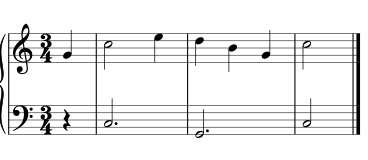
The music starts on the last beat of the bar: one quarter note before bar 1 in 3/4 or 4/4, one half note in 2/2. It is the commonest pickup by far, the note that leads into the first strong beat.
What to count: Count the whole bar before it to yourself and play on its last beat: in 3/4 "1, 2," and the note on "3"; in 4/4 "1, 2, 3," and the note on "4". The next note is "1", the first full bar.
How to play it: Play it a little lighter than the note it leads to: the weight belongs on the downbeat of bar 1. Don't hold the pickup longer than a beat while you look ahead; the beat after it has already begun.
In Clefsight's player: the count-in gives 5 clicks, counted 1, 2, 3, 1, 2, and you come in on the next click, "3".
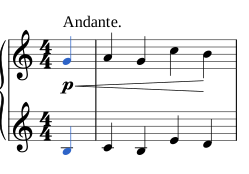
From Evening Song, Op. 101 No. 58 (Beyer, level 2), the upbeat and bar 1, as its edition prints them: in 4/4, a pickup of 1 beat, its notes in blue pencil.
98 of the 844 pieces open this way. The easiest of them: Evening Song, Op. 101 No. 58 (Beyer, level 2), Exercise Piece in C, Op. 190 No. 18 (Köhler, level 2) and The Chase, Op. 117 No. 15 (Gurlitt, level 2).
Part of a beat
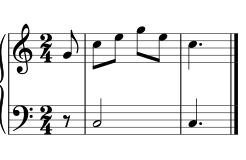
The music starts between the beats: one eighth note, or a dotted eighth and a sixteenth, just before bar 1. It sounds as a quick lift into the first beat.
What to count: Count in beats and halves, "1 & 2 &", and play on the last "&": in 2/4, "1 & 2" to yourself and the note on "&". The first full bar starts on the next "1".
How to play it: Make it short and light, like a breath before the word. The usual slip is to start it on the beat, which makes it too long and pulls bar 1 late; say the "&" out loud until it sits between the beats.
In Clefsight's player: the count-in gives 4 clicks, counted 1, 2, 1, 2, and you come in between the last click and where the next would fall.
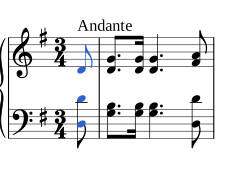
From O Christmas Tree (O Tannenbaum) (Traditional, level 3), the upbeat and bar 1, as its edition prints them: in 3/4, a pickup of half a beat, its notes in blue pencil.
41 of the 844 pieces open this way. The easiest of them: Allegro in F, K. 1c (Mozart, level 3), O Christmas Tree (O Tannenbaum) (Traditional, level 3) and Old French Song, Op. 39 No. 16 (Tchaikovsky, level 3).
Two beats or more
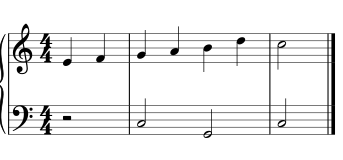
A longer opening, two or three beats or a beat and a half, often a whole phrase start: in 4/4, two quarter notes before bar 1 come on beats 3 and 4.
What to count: Count the bar from "1" and come in on the beat where the pickup starts: in 4/4 with two beats, "1, 2," to yourself and play on "3, 4". Read how long the pickup bar is before you start, by adding up its notes.
How to play it: Keep the pickup's notes steady and even, all on their beats; a long pickup is easy to rush because it feels like an introduction. Bar 1's first beat is still the strongest.
In Clefsight's player: the count-in gives 6 clicks, counted 1, 2, 3, 4, 1, 2, and you come in on the next click, "3".
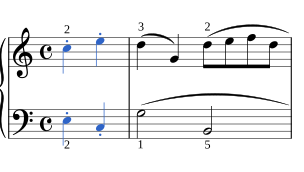
From Gavotte (Telemann, level 2), the upbeat and bar 1, as its edition prints them: in 4/4, a pickup of 2 beats, its notes in blue pencil.
18 of the 844 pieces open this way. The easiest of them: Gavotte (Telemann, level 2), Elementary Study, Op. 176 No. 2 (Duvernoy, level 2) and Brindisi, from La traviata (Verdi, level 3).
In 6/8 and compound time
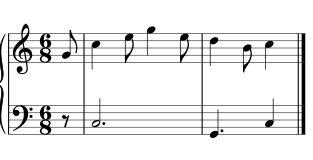
In 6/8, 9/8, 12/8 and 3/8 the pickup is usually one eighth note, the last of the three eighths in a beat, leading into bar 1 the way a skip leads into a step.
What to count: Count the eighths, "1 2 3 4 5 6", and play on "6"; once it moves, count the two beats of the bar, "1 2", with the pickup as the last eighth before "1". In 3/8, count "1 2 3" and play on "3".
How to play it: Let it lilt: the pickup eighth is light and leads to a longer, stronger note on the beat. Keep the long-short pattern of compound time even; a quarter followed by an eighth is two thirds and one third of the beat.
In Clefsight's player: the count-in gives 4 clicks, counted 1, 2, 1, 2, and you come in between the last click and where the next would fall.
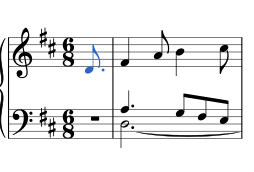
From As Joseph Was A-Walking (Traditional, level 3), the upbeat and bar 2, as its edition prints them: in 6/8, a pickup of 1.5 eighths, its notes in blue pencil.
34 of the 844 pieces open this way. The easiest of them: As Joseph Was A-Walking (Traditional, level 3), Komm, lieber Mai (Mozart, level 3) and Study in C, Op. 17 No. 6 (Couppey, level 3).
Why the last bar is short
Of the library's 191 pieces that open on a pickup, 119 (62%) end on a short last bar that holds exactly the beats the pickup left out. The rest end on a full bar, or on a bar whose length the repeats or a later time signature decide.
The pickup and the last bar together make one full bar. A piece in 3/4 with a one-beat pickup usually ends on a bar of two beats, so the whole piece is a whole number of bars. The same holds at a repeat: when a section opens on a pickup, the bar before the repeat sign is short by as much, and the pickup comes again after it.
Pickups level by level
How many of the library's pieces at each level open on a pickup, and the commonest kind there.
What Clefsight does with a pickup
The player reads the first bar the same way, as a pickup when it is shorter than the time signature, and counts you in to it: the clicks count the bars before and then the silent beats of the pickup's bar, so the next click (or the half-click after it) is where you start. Bar numbers on the page count the pickup as bar 0, and the marks after a take say "the pickup" for a slip there. Its notes are graded like any others, on time within a tenth of your own beat.
Fresh sight-reading writes pickups from the G position and moving the hand lesson on, level 3: about half the pieces then open on one beat (an eighth in 6/8), and end on a short bar.
Read pickups at sight. From level 3, sight-reading exercises can open on one, printed or played at a MIDI keyboard or on the keys on screen.
Level 3 exercisesMore on counting: time signatures, how to read rhythm, repeat signs for where a repeated pickup goes, and the metronome.