Repeat signs in music
Repeat signs let a page print music once and have you play it twice, or jump back to the start. Of the 842 pieces in Clefsight's library, 350 are played in another order than they are printed, and between them they play 9,343 more bars than they print. Each sign is below with two real bars and the order its whole piece is played in, written out as Clefsight's player follows it.
How to find your way
Look ahead before you play. Find every repeat sign, bracket and D.C. or D.S. on the page first, and know where each one sends you. A pencil arrow from a closing sign to its opening one helps.
Repeats are played once after a jump. When a D.C. or D.S. sends you back, play straight through: skip the repeats you played before, and take only the last ending.
Play every repeat. Clefsight's player follows the order written out below, so a repeat's notes are expected twice, and a repeat left out reads as missed notes.
Repeat bar lines ‖: and :‖, a thick and a thin line with two dots
Play to the closing sign, the dots on its left, then go back to the opening sign, the dots on its right, and play the passage again. With no opening sign, go back to the start of the piece. Then go on past the closing sign.
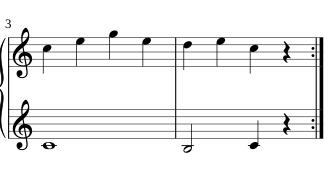
From Piece in C, Op. 117 No. 2 (Gurlitt, level 2), bars 3 to 4, as its edition prints them.
Printed in 322 of the 842 pieces. The easiest of them: Piece in C, Op. 117 No. 4 (Gurlitt, level 2), Piece in C, Op. 117 No. 2 (Gurlitt, level 2) and Study, Op. 101 No. 38 (Beyer, level 2).
- 1–4
- 1–12
- 5–12
Printed bars, first to last: play each row left to right, then the next. A row edged in blue goes back.
The whole piece, as played: bars 1–4, 1–12, 5–12. It prints 12 bars and plays 24.
First and second endings brackets over the bars, numbered 1. and 2.
The repeated passage ends two ways. The first time, play the bars under the 1. bracket and repeat. The second time, skip them and play the bars under the 2. bracket instead.
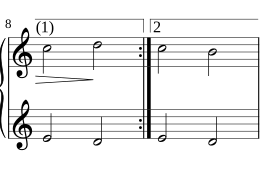
From Piece in C, Op. 117 No. 4 (Gurlitt, level 2), bars 8 to 9, as its edition prints them.
Printed in 69 of the 842 pieces. The easiest of them: Piece in C, Op. 117 No. 4 (Gurlitt, level 2), Study in C, Op. 101 No. 52 (Beyer, level 2) and Study in C, Op. 101 No. 51 (Beyer, level 2).
- 1–8
- 1–7
- 9–10
Printed bars, first to last: play each row left to right, then the next. A row edged in blue goes back.
The whole piece, as played: bars 1–8, 1–7, 9–10. It prints 10 bars and plays 17.
D.C. al Fine D.C. al Fine, and Fine where the piece ends
Da capo al fine, from the head to the end: at D.C., go back to the very first bar and play again until the word Fine. On the way through, skip the repeats: play each passage once, and only the last of its endings.
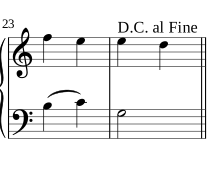
From Allegro in C (Reinagle, level 2), bars 23 to 24, as its edition prints them.
Printed in 41 of the 842 pieces. The easiest of them: Allegro in C (Reinagle, level 2), Exercise Piece in C, Op. 190 No. 17 (Köhler, level 2) and La Violette (Gobbaerts, level 3).
- 1–24
- 1–8
Printed bars, first to last: play each row left to right, then the next. A row edged in blue goes back.
The whole piece, as played: bars 1–24, 1–8. It prints 24 bars and plays 32.
D.S., dal segno D.S., and the sign 𝄋 (segno) where to go back to
Dal segno, from the sign: at D.S., go back to the 𝄋 sign, not to the start, and play on to Fine or, in D.S. al Coda, to the coda sign.
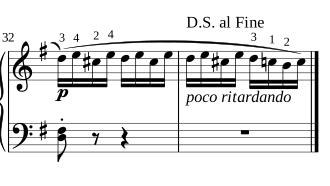
From Children's Study, Op. 37 No. 36 (Lemoine, level 3), bars 32 to 33, as its edition prints them.
Printed in 4 of the 842 pieces. The easiest of them: Children's Study, Op. 37 No. 25 (Lemoine, level 3), Children's Study, Op. 37 No. 36 (Lemoine, level 3) and Children's Study, Op. 37 No. 26 (Lemoine, level 3).
- 0–33
- 1–16
Printed bars, first to last: play each row left to right, then the next. A row edged in blue goes back.
The whole piece, as played: bars 0–33, 1–16. It prints 34 bars and plays 50.
Coda To Coda and the sign 𝄌
A coda, the tail, is an ending set apart. After a D.C. or D.S., play until To Coda, then jump to the 𝄌 sign and play the coda to the end.
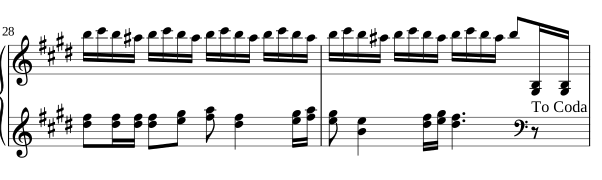
From William Tell Overture: the finale (Rossini, level 4), bars 28 to 29, as its edition prints them.
Printed in 1 of the 842 pieces. The easiest of them: William Tell Overture: the finale (Rossini, level 4).
- 1–68
- 18–29
- 69–102
Printed bars, first to last: play each row left to right, then the next. A row edged in blue goes back.
The whole piece, as played: bars 1–68, 18–29, 69–102. It prints 102 bars and plays 114.
Play one through. Open a piece with repeats in the library: the player expects its bars in the order written out on this page.
Open the libraryMore on the page: music symbols and what they mean, musical terms for words like da capo, and time signatures.