Dotted rhythms: how to count dotted notes on the piano
A dot after a note adds half its length again, so the note runs past the beat and a short note fills the gap. Of the 844 pieces in Clefsight's library, 588 (70%) print a dotted note, and 404 a long-short dotted rhythm. Each figure is below as printed, as it sounds against the count, and in two real bars where it is printed, its notes in blue pencil.
- Dotted quarter and eighth292
- The dotted half note269
- Dotted eighth and sixteenth226
- The dotted beat in 6/8114
- The Scotch snap24
- The double dot14
What a dot does
A dot after a note makes it half as long again: a dotted half note is a half and a quarter (three beats in 4/4), a dotted quarter a quarter and an eighth, a dotted eighth an eighth and a sixteenth. A dotted rest works the same way.
The dotted note almost always runs past a beat or a half-beat, and the short note after it fills the rest, so the two together make a whole beat or two. That long-short pair is the dotted rhythm: you read it as one shape, the way you read a word, not as two lengths to add up.
Counted here, a figure is a dotted note as its score prints it (a chord once per staff), named by its value and the time it is in; a sixteenth on the beat just before a dotted eighth makes it a Scotch snap. Triplets' dots are left out.
The dotted half note
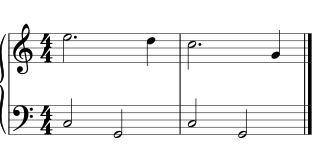
A half note is two beats; the dot adds one more, so a dotted half note lasts three. In 3/4 it fills the bar; in 4/4 a quarter note usually follows it on beat 4.
What to count: Count quarters, "1 2 3 4", and play on "1": keep the key down through "2" and "3", then play the next note on "4".
How to play it: Hold it the full three beats, with the counting carrying on in your head. The usual slip is to let go on "3" and arrive early on the next note.
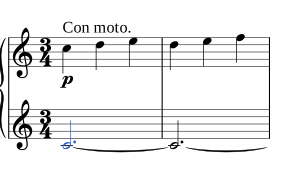
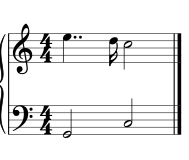
From Piece in C, Op. 117 No. 3 (Gurlitt, level 2), bars 1 to 2, as its edition prints them; the figure's notes in blue pencil.
Printed in 269 of the 844 pieces. The easiest of them: Theme from the Sonata in A, K. 331 (Mozart, level 2), Piece in C, Op. 117 No. 3 (Gurlitt, level 2) and Evening Song, Op. 101 No. 58 (Beyer, level 2).
Dotted quarter and eighth
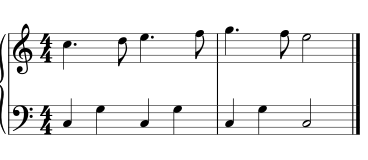
A dotted quarter is a beat and a half, so it is held through the next beat and the eighth after it falls on that beat's "&". It is the long-short step of countless tunes: "Auld Lang Syne" opens with one.
What to count: Count eighths, "1 & 2 & 3 & 4 &", and play on "1", "2 &", "3" and "4 &". Say "2" out loud even though nothing is played on it: the dotted note covers it.
How to play it: Feel the beat the dotted note covers: let the left hand play it, or tap it with your foot. Then the eighth comes late and light, just before the next beat, and leads into it.
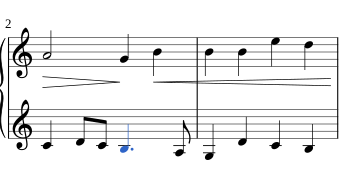
From Evening Song, Op. 101 No. 58 (Beyer, level 2), bars 2 to 3, as its edition prints them; the figure's notes in blue pencil.
Printed in 292 of the 844 pieces. The easiest of them: Evening Song, Op. 101 No. 58 (Beyer, level 2), Ode to Joy (Beethoven, level 2) and Study, Op. 101 No. 61 (Beyer, level 2).
Dotted eighth and sixteenth
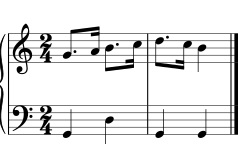
The same long-short at half the size, inside one beat: a dotted eighth is three sixteenths, and the sixteenth after it takes the last quarter of the beat. "Happy Birthday" opens with one, and marches and jigs are full of it; it is the figure most often played wrong.
What to count: Count sixteenths, "1 e & a", and play on "1" and "a": the dotted eighth covers "e" and "&". The short note belongs to the beat after it, so think "a-1", "a-2".
How to play it: Play the short note late and close to the next beat, never halfway: halfway is two even eighths, and the dance goes flat. Practise it slowly, saying all four sixteenths, before you speed up.
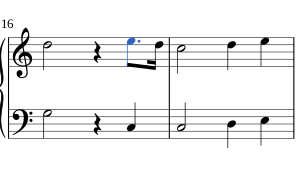
From The Spirit of God (Traditional, level 2), bars 16 to 17, as its edition prints them; the figure's notes in blue pencil.
Printed in 226 of the 844 pieces. The easiest of them: The Spirit of God (Traditional, level 2), I Saw Three Ships (Traditional, level 2) and Polska from Småland (Traditional, level 2).
The Scotch snap
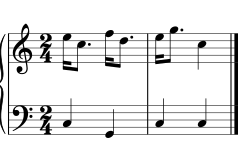
The dotted figure turned round: a sixteenth on the beat, then a dotted eighth on its "e". The short note takes the accent, so it sounds snapped. Scottish songs and dances are full of it, hence the name; it is also called the Lombard rhythm.
What to count: Count sixteenths, "1 e & a", and play on "1" and "e": the dotted eighth covers "&" and "a". The beat is on the short note, not the long one.
How to play it: Play the sixteenth on the beat with a little weight, and the long note straight after it, lighter. Don't let the beat drift onto the long note; the left hand on the beat keeps you honest.
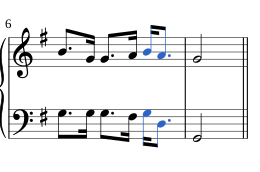
From I Saw Three Ships (Traditional, level 2), bars 6 to 7, as its edition prints them; the figure's notes in blue pencil.
Printed in 24 of the 844 pieces. The easiest of them: I Saw Three Ships (Traditional, level 2), Battle Hymn of the Republic (Traditional, level 3) and For Children No. 13 (Bartók, level 3).
The double dot
A second dot adds half of what the first added: a double-dotted quarter is a quarter, an eighth and a sixteenth, three quarters of a beat more than the quarter alone. The note after it is shorter still, a sixteenth, so the figure sounds sharper than a single dot.
What to count: Count sixteenths, "1 e & a 2 e & a", and play on "1", the "a" of 2 and "3": the long note covers everything between.
How to play it: Hold the long note through the second beat and play the short one at the very last moment, almost on the next beat. Baroque overtures and slow introductions print it, and expect it crisp.
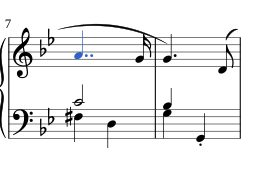
From Old French Song, Op. 39 No. 16 (Tchaikovsky, level 3), bars 7 to 8, as its edition prints them; the figure's notes in blue pencil.
Printed in 14 of the 844 pieces. The easiest of them: Old French Song, Op. 39 No. 16 (Tchaikovsky, level 3), Study in F, Op. 47 No. 9 (Heller, level 3) and Study in G, Op. 47 No. 4 (Heller, level 3).
The dotted beat in 6/8
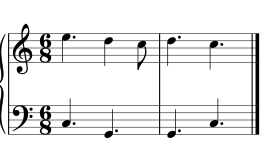
In 6/8, 9/8 and 12/8 the beat itself is a dotted quarter, three eighths, so here the dot isn't a rhythm at all: a dotted quarter is one plain beat and a dotted half two. The long-short of these times is a quarter and an eighth inside the beat.
What to count: Count each beat in three, "1 & a 2 & a", and play the dotted quarters on "1" and "2". A quarter and an eighth are played on "1" and "a".
How to play it: Feel two beats in a bar of 6/8, not six: a slow swing with three eighths in each. Set a metronome to the dotted quarter, not the eighth.
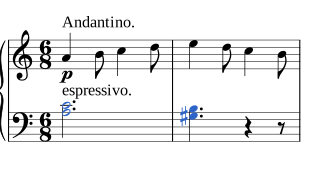
From Lamentation, Op. 117 No. 16 (Gurlitt, level 2), bars 1 to 2, as its edition prints them; the figure's notes in blue pencil.
Printed in 114 of the 844 pieces. The easiest of them: Lamentation, Op. 117 No. 16 (Gurlitt, level 2), Study in C, Op. 101 No. 52 (Beyer, level 2) and Row, Row, Row Your Boat (Traditional, level 2).
The library's most dotted pieces
The pieces with the largest share of their notes in a long-short dotted figure (a dotted quarter, eighth, snap or double dot), of those with at least ten, and that share in blue. In these the long-short step runs through nearly every line, so a piece near the top is good practice for reading it at sight.
- I Saw Three Ships (Traditional, level 2) 47%
- O Christmas Tree (O Tannenbaum) (Traditional, level 3) 34%
- Sonatina in G, Op. 36 No. 2: II (Clementi, level 3) 34%
- The Sick Doll, Op. 39 No. 6 (Tchaikovsky, level 3) 33%
- Aftenhvile i Leiren (Bergwitz-Goffeng, level 3) 31%
- Annie Laurie (Spottiswoode, level 2) 27%
- For Children No. 18 (Bartók, level 3) 26%
- Sonatina in C, Op. 36 No. 3: II (Clementi, level 3) 26%
Dotted rhythms level by level
How many of the library's pieces at each level play a long-short dotted figure, and the figures met there. Clefsight's reading course teaches the dotted half note in C position, both hands (level 1), the dotted quarter in Ledger lines (level 3) and the dotted eighth in 6ths to 10ths (level 6).
| Level | Pieces | Dotted rhythm | Figures |
|---|---|---|---|
| Level 2 | 105 | 13% | the dotted half note, a dotted quarter and an eighth, a dotted eighth and a sixteenth, the Scotch snap and the dotted quarter as the beat |
| Level 3 | 452 | 43% | the dotted half note, a dotted quarter and an eighth, a dotted eighth and a sixteenth, the Scotch snap, a double-dotted note and the dotted quarter as the beat |
| Level 4 | 207 | 68% | the dotted half note, a dotted quarter and an eighth, a dotted eighth and a sixteenth, the Scotch snap, a double-dotted note and the dotted quarter as the beat |
| Level 5 | 61 | 72% | the dotted half note, a dotted quarter and an eighth, a dotted eighth and a sixteenth, the Scotch snap and the dotted quarter as the beat |
| Level 6 | 15 | 73% | the dotted half note, a dotted quarter and an eighth, a dotted eighth and a sixteenth, the Scotch snap, a double-dotted note and the dotted quarter as the beat |
| Level 7 | 4 | 50% | the dotted half note, a dotted quarter and an eighth, a dotted eighth and a sixteenth and the dotted quarter as the beat |
What Clefsight grades
Each note of a dotted figure is graded like any other: on time within a tenth of your own beat. The usual slip is to even it out. A dotted eighth and sixteenth played as two even eighths puts the sixteenth a quarter of a beat early, and it is marked early, in blue pencil; a dotted quarter cut short to a quarter puts the eighth half a beat early.
A lilt that leans the other way, the short note a little late as in a triplet, stays within the window, so play the figure as written and let your ear judge how sharp it should be. How long you hold the dotted note isn't graded, only when the next one starts.
Read dotted rhythms at sight. A short drill of rhythms with dotted half, quarter and eighth notes, at a MIDI keyboard or on the keys on screen. Or tap them in time in the rhythm reading game.
Drill dotted rhythmsMore on rhythm: how to read rhythm, the note values chart, syncopation, triplets and tuplets and time signatures for 6/8.