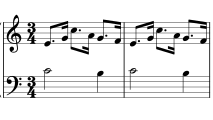
How hard is Sonatina in G, Op. 36 No. 2: II (Clementi)? Level 3 of 7 on our scale. Both hands busy, the hand moves around, a sharp or flat or two. G. Henle Verlag, whose scale runs 1 to 9, grades it 3 of 9 in its edition HN 848. How the two scales compare.
Op. 36 No. 2: its opus number, by which the composer's published works are numbered.
Plays on a MIDI keyboard in Chrome, Edge or Firefox on a computer, or Chrome on an Android phone or tablet, or on the keys on screen without one.
More about Sonatina in G, Op. 36 No. 2: II
No. 2 of 6 in Clementi's Six Sonatinas, Op. 36
More sonatinas: 16 in the library.
No speed is printed on this score. Clefsight plays it at 116 quarter notes a minute: the middle of the speeds usually given for Allegretto (fairly quick and light, a little under allegro). The “Plays in” time above is worked out at this speed.
What stands between you and this piece
Clefsight compares the notes of this piece with what you already read. Take the level test and this page will list what's left to learn, item by item.
Versions
Each simpler version only leaves notes out and adds none, so every note in it is the piece's own. Print any of them free.
- As written253 notes
- Melody and a simpler left hand230 notes
- Melody and left-hand roots153 notes
- Right-hand melody125 notes
To practise it on paper: a practice chart for this piece, a week of steps from each hand alone to full tempo, with their speeds.
What it asks of you
- Treble clef from B3 to C6, with ledger lines
- Bass clef from C2 to D4, with ledger lines
- No key signature to keep in mind
- Accidentals: sharps outside the key
- Rhythm: quarter notes, half notes, sixteenth notes, dotted eighth notes
- Intervals: 2nds (steps), 3rds (skips), 4ths, 5ths, 6ths, octaves
- Chords: inverted triads
- Hands playing together, one hand moving while the other holds, moving the hand to a new position, hands taking turns
The right hand opens with E G C A G F E G C A G F; the left hand with C B C B. The right hand first moves to a new position in bar 3, the left hand in bar 4. Its highest note is C6, in bar 14, and its lowest C2, in bar 8. It ends with E and C in the right hand over C in the left. From note to note it moves mostly by steps (34%), 3rds (28%), and 4ths (14%).
Sections
The piece in 4 sections, cut where its music breaks, each read at its own level. Tap one to loop it on the stand until it's clean, then the next.
- Bars 1–8level 2 of 7Right hand E4 G4 C5 A4 G4 F4 E4 G4…; left hand C4 B3 C4 B3 C4 F3 G3 E3…
- Bars 9–16level 3 of 7Right hand E4 E5 D5 B4 C5 A4 G♯4 B4…; left hand G♯3 A3 D4 C4 F♯3 G3 C4 B3…
- Bars 17–24level 3 of 7Right hand E4 G4 C5 A4 G4 F4 E4 G4…; left hand C3 B2 C3 B2 C3 F3 G3 E3…
- Bars 25–28level 2 of 7Right hand D4 and F4 together, C4 and E4 together, D4 and F4 together, C4 and E4 together, A3 D4 G3 C4…; left hand B2 D3 G2 B2 C3 E3 B2 D3…
Score typed for Clefsight from G. Schirmer, New York, 1904, ed. Louis Köhler, plate 17134 (scan on IMSLP), checked note for note, shared under CC0 1.0; the composition is public domain: Muzio Clementi died in 1832. Public domain in Canada and the United States. It may still be protected where you live. Credits
Checked against the edition. Typed from the scan, then compared bar by bar with 2 other copies shared on MuseScore; the one bar where they differed was settled against the scan. How we check