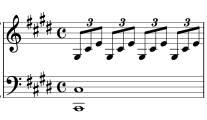
Play each note or chord as soon as you can read it. In three minutes at most, Clefsight finds the level you read at, and from then on picks your drills, writes your sight-reading and suggests pieces at it.
With a MIDI keyboard plugged in, or on keys on screen.
Connecting a keyboard needs Chrome or Edge on a computer or an Android phone or tablet, or Firefox on a computer. On an iPhone or iPad, take the test on the keys on screen. Help connecting a keyboard
What the test reads, in order
13 stages, up to 4 cards each, in the order Clefsight teaches them.
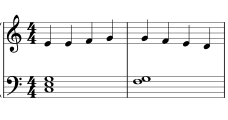
Middle C positionlevel 1, passed
C position, both handslevel 1, passed
Landmark noteslevel 2, passed
Notes around the landmarkslevel 2, passed
2nds and 3rds as shapeslevel 2, passed
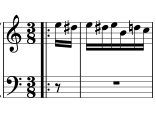
Ledger lines2 missedlevel 3, not passed: 2 of 2 cards missed
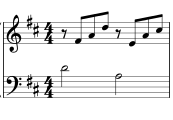
Key signatures, one at a time2 missedlevel 4, not passed: 2 of 2 cards missed
4ths and 5thslevel 4, not reached
Triadslevel 5, not reached
Inversionslevel 5, not reached
6ths to 10thslevel 6, not reached
Keys with 3 to 7 sharps or flatslevel 6, not reached
Far ledger lineslevel 7, not reached
Reading level 2
after 17 cards
An example run: every stage up to level 2 passes, then two in a row don't, so the test stops there.
What it measures
Reading the way you'll use it at the piano: how quickly you find each note on the keys. One card at a time shows a note on the treble or bass staff, a key signature, two notes to play together or a chord.
Time
3 min at most
Cards
up to 41
Stages
13
Levels it reads
1 to 7
A card counts when you play the right keys within 2 seconds for a note, 2.4 for a key signature or an accidental, 3 for two notes together and 4 for a chord. Wrong keys, or slower than that, count as not yet.
The cards climb through 13 stages in the order Clefsight teaches them, up to 4 from each. A stage passes on two thirds of its cards (3 of 4 and 2 of 3).
It stops when two stages in a row don't pass, or after three minutes.
Your level is the level of the last stage you pass before the first you don't. Every stage you pass, with the stages it builds on, counts as known, so your drills and sight-reading start beyond it. Your first real answers replace the test's guess.
It doesn't time rhythm or listen to a whole piece. The rhythms and hand skills of a stage you pass are taken as known until your playing shows otherwise; for rhythm on its own, try the rhythm reading game.
The five levels
Every piece in the library and every piece Clefsight writes has a level. The library's 378 pieces are at levels 2 to 5; level 1, your first weeks of reading, is music Clefsight writes for you.
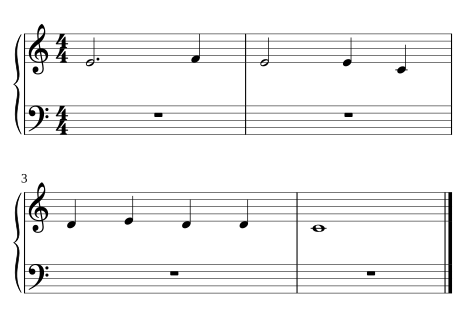
Level1
Middle C position · ; C position, both hands
Your first weeks: the notes from middle C up to G and down to the C below, one hand position at a time, in whole, half, dotted half and quarter notes.
No piece in the library reads at level 1: Clefsight writes level 1 music for you from your first note, and there are 6 level 1 sight-reading exercises to print or play.
Past level 5, the test keeps going, through 6ths to 10ths, keys with 3 to 7 sharps or flats and far ledger lines (levels 6 and 7), so a fluent reader isn't held at 5. The library's pieces stop at level 5; the sight-reading exercises go up to level 6.
How the levels compare with piano grades
Grades differ between publishers and exam boards. The one we check our levels against is Henle's: the music publisher G. Henle Verlag grades piano works from 1 to 9 on its edition pages. 41 pieces in the library are from 37 works Henle grades. Beside their grade, the level Clefsight gives them:
×9 means nine pieces at that level. Each movement of a sonata is a piece of its own here.
By our estimate each level is about one Henle grade, level 2 being about grade 1, so the library runs from about Henle 1 to 4. On the works Henle grades, our estimate is within one grade of theirs for 27 of these 41 pieces. The furthest apart is Mozart's Piano Sonata in C (facile), K. 545: Henle grade 5 for the whole work, about 3 by our estimate (level 4). Henle grades a work as a whole; ours comes from what the score asks you to read and play, note by note.
Exam boards such as ABRSM, Trinity and RCM set pieces, scales and listening tests for each grade. We haven't checked our levels against their lists, so we don't give an exam grade for a level.
Questions
How long does the piano level test take?
Three minutes at most, and often less, since it stops once two stages in a row don't pass. There are up to 41 cards, each a note, a key signature, two notes together or a chord to play as soon as you can read it.
Do I need a piano or a keyboard?
No. Without a MIDI keyboard the test shows keys on screen to tap, and on a computer the letter keys A to K play them too. A MIDI keyboard plugged in by USB is closest to reading at the piano: it works in Chrome or Edge on a computer or an Android phone or tablet, and in Firefox on a computer. On an iPhone or iPad, take the test on the keys on screen.
What grade am I at piano?
The test gives you a Clefsight reading level. To compare it with a grade you know: by our estimate, level 2 is about Henle grade 1 and each level adds about one grade, which we checked against the 37 works in our library that the publisher Henle grades. We don't match our levels to exam grades such as ABRSM's, Trinity's or RCM's, because we haven't checked them against those lists.
Is it a sight-reading level test?
It tests the first part of sight-reading: how quickly you read each note and shape and find it on the keys. Playing a whole piece at sight adds rhythm and both hands at once. Clefsight measures that next, from the first time you play each fresh piece it writes for you, and only those first plays move your reading level after the test.
Can I take it again?
Yes, whenever you like: start it again from this page. A new test sets your reading level again from its answers. Your level and everything you play stay in this browser, with no account to make.
What happens after the test?
Today's practice starts from your level: a warm-up on the notes you're slow to read, short fresh pieces written at your level, and a piece to learn. In the library, every piece says whether it's ready for you, a stretch or not yet, and what's still new in it.
Ready when you are. Three minutes at most, one card at a time, at your keyboard or on screen.