Triplets and tuplets: how to count and play them
A tuplet is a group of notes squeezed or stretched to fit a beat: a 3 over three eighth notes means three in the time of two. Of the 842 pieces in Clefsight's library, 127 print tuplets, and 116 of them print triplets, by far the commonest; 68% of the library's triplets are eighth-note triplets. Each kind is below as printed, as it sounds, what to count and two real bars where it is printed, its notes in blue pencil.
How to read a tuplet
The number over or under the group says how many notes it holds; the note values say what they replace. Three eighths with a 3 take the time of two ordinary eighths, one quarter-note beat. Where the notes are beamed together the number stands alone by the beam; where they aren't, a bracket shows which notes it covers.
Some editions write the full ratio, 3:2 or 6:4, and many leave the number off after the first few groups once the pattern is clear: if a bar's notes add up to too much, the rest are tuplets too.
Triplets come in every value. In the library's pieces, 25% of triplets are sixteenth-note triplets, three in half a beat, and 7% are quarter-note triplets, three across two beats, the hardest to feel because they cross the beat.
Triplet three notes with a 3 over or under them, often in a bracket
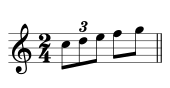
Three notes in the time of two of the same value: three triplet eighths fill one quarter-note beat, three triplet quarters fill two beats, three triplet sixteenths half a beat. The notes are even; none is longer than the others.
What to count: Say "trip-a-let" or "1-la-li" on each beat, three even syllables with the first on the beat: "1-trip-let, 2-trip-let". For quarter-note triplets, which cross the beat, count eighth triplets under them and play every other one.
How to play it: Aim for the next beat: the third note leads into it, so the group ends exactly where the beat lands. Clap the beat and say the syllables before you play. The usual slip is two quick notes and a long one; keep all three the same length.
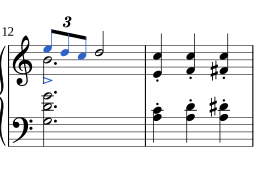
From Waltz, Op. 12 No. 2 (Grieg, level 3), bars 12 to 13, as its edition prints them; the tuplet's notes in blue pencil.
Printed in 116 of the 842 pieces, 5,525 groups in all. The easiest of them: Brindisi, from La traviata (Verdi, level 3), Waltz, Op. 12 No. 2 (Grieg, level 3) and Polonaise in D minor, BWV Anh. 128 (Anonymous, level 3).
Sextuplet six notes with a 6 over them
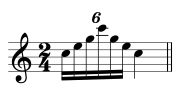
Six notes in the time of four: six sixteenths in one quarter-note beat. Most often it is two triplets joined, three and three, with an accent on the first of each; sometimes it is three pairs.
What to count: "1-la-li-&-la-li": two triplets in the beat, six even syllables. Where the music groups them in pairs, "1-e-&-e-a-e" as three pairs.
How to play it: Find the shape first: a broken chord in sixes usually falls into two threes. Practise it as two triplets, slowly, with a little weight on the first of each three, then lighten the weight until all six are even.
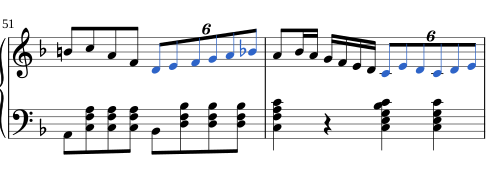
From Hino Nacional Brasileiro (Silva, level 4), bars 51 to 52, as its edition prints them; the tuplet's notes in blue pencil.
Printed in 3 of the 842 pieces, 218 groups in all. The easiest of them: Hino Nacional Brasileiro (Silva, level 4), Prelude in C, Op. 28 No. 1 (Chopin, level 6) and Fantaisie-impromptu, Op. 66 (Chopin, level 7).
Duplet two notes with a 2 over them, in 6/8 or another compound time
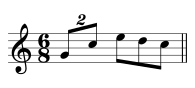
Two notes in the time of three: in 6/8, where a beat is three eighths, a duplet splits the beat into two even halves instead.
What to count: Count the beat in two, "1 &", not "1-2-3": the second note falls halfway through the dotted-quarter beat, between the second and third eighths.
How to play it: Feel the beat, not the eighths: a duplet sounds like two straight eighths in 2/4 against the lilt of 6/8. Tap the beat and say "1 &" against it; then play the bar, letting the three-eighth beats come back after it.
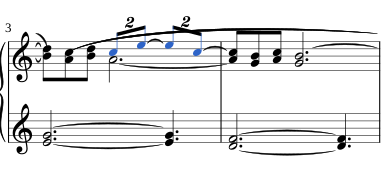
From Clair de lune (Debussy, level 3), bars 3 to 4, as its edition prints them; the tuplet's notes in blue pencil.
Printed in 1 of the 842 pieces, 2 groups in all.
Quadruplet four notes with a 4 over them, in compound time
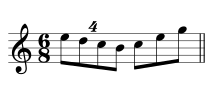
Four notes in the time of three: in 6/8, four even notes across one dotted-quarter beat.
What to count: "1-e-&-a" across the dotted-quarter beat, four even syllables, the first on the beat.
How to play it: Count the beat in two and fit four even notes into it, as sixteenths fill a quarter in 2/4. Aim for the next beat, as with every tuplet.
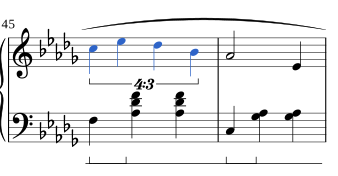
From Waltz in D flat, Op. 64 No. 1 (Chopin, level 6), bars 45 to 46, as its edition prints them; the tuplet's notes in blue pencil.
Printed in 1 of the 842 pieces, 1 group in all.
Quintuplet five notes with a 5 over them
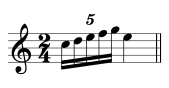
Five notes in the time of four: five sixteenths in one quarter-note beat, a little faster than ordinary sixteenths.
What to count: A five-syllable word on the beat, "hip-po-pot-a-mus" or "u-ni-ver-si-ty", or count "1-2-3-4-5" evenly and land on the next beat.
How to play it: Practise the beat and the word together until the fifth note leads straight into the next beat; there is no grouping to lean on, so evenness comes from slow practice.
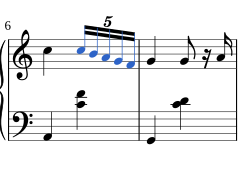
From Romanian Folk Dance No. 2 (Bartók, level 3), bars 6 to 7, as its edition prints them; the tuplet's notes in blue pencil.
Printed in 14 of the 842 pieces, 72 groups in all. The easiest of them: Romanian Folk Dance No. 2 (Bartók, level 3), Intermezzo, from Cavalleria rusticana (Mascagni, level 3) and Chinese Dance, from The Nutcracker (Tchaikovsky, level 3).
Septuplet seven notes with a 7 over them
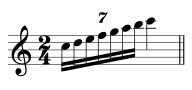
Seven notes in the time of four (or of six or eight): seven sixteenths in one quarter-note beat, usually a quick scale or turn leading somewhere.
What to count: Count seven evenly in the beat, or think of it as a group of four and a group of three (or three and four) and keep the join smooth.
How to play it: Know where it ends: practise from the last note back, then the whole run slowly in the time of the beat, until it fits without rushing at the end.
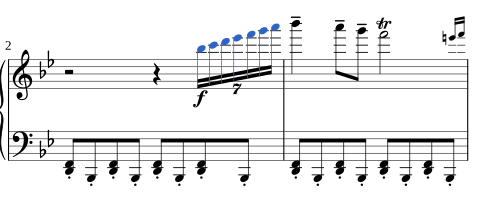
From Chinese Dance, from The Nutcracker (Tchaikovsky, level 3), bars 2 to 3, as its edition prints them; the tuplet's notes in blue pencil.
Printed in 8 of the 842 pieces, 32 groups in all. The easiest of them: Chinese Dance, from The Nutcracker (Tchaikovsky, level 3), Watchman's Song, Op. 12 No. 3 (Grieg, level 4) and Sonatina in G, Op. 20 No. 2: III (Kuhlau, level 4).
Longer groups a run of small notes with 9, 10, 11, 13 or more over it
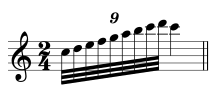
A long group in the time of a beat or a bar, mostly in Chopin and other music from the 19th century: a free, decorative run, not a pattern to count note by note.
What to count: Count the beats, not the notes. Split the run into smaller groups that land on the other hand's notes, such as three threes against three bass notes, and fit each in.
How to play it: Learn its notes slowly in the smaller groups, then speed up while keeping the other hand steady; it should sound flowing and even, finishing as the next beat arrives.
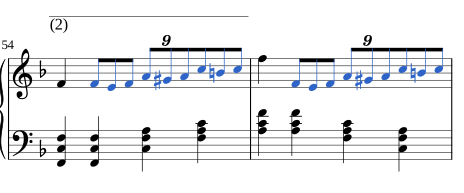
From Hino Nacional Brasileiro (Silva, level 4), bars 54 to 55, as its edition prints them; the tuplet's notes in blue pencil.
Printed in 6 of the 842 pieces, 12 groups in all. The easiest of them: Hino Nacional Brasileiro (Silva, level 4), Nocturne No. 2 in C minor (Field, level 4) and Waltz in A flat, Op. 69 No. 1 (Chopin, level 4).
Two notes against three
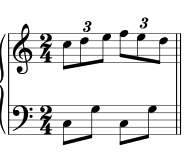
When one hand plays a triplet and the other plays two even notes in the same beat, the notes fall in this order: both hands together, the triplet's second note, the other hand's second note, the triplet's third note. Say "nice cup of tea": "nice" with both hands, "cup" and "tea" with the triplet hand, "of" with the other.
Practise it on a table first, the triplet hand tapping three to the beat and the other two, slowly, saying the words. Then play it at the keyboard on one note in each hand before the real notes. Three against four works the same way, with more notes between the beats.
Tuplets level by level
How many of the library's pieces at each level print a tuplet, how many print triplets, and the other kinds met at that level. Triplets arrive at the middle levels; the rarer kinds belong mostly to the harder pieces.
| Level | Pieces | Any tuplet | Triplets | Other kinds |
|---|---|---|---|---|
| Level 2 | 105 | – | – | – |
| Level 3 | 451 | 11% | 10% | duplet, quintuplet and septuplet |
| Level 4 | 206 | 23% | 20% | sextuplet, quintuplet, septuplet and longer groups |
| Level 5 | 61 | 34% | 31% | quintuplet, septuplet and longer groups |
| Level 6 | 15 | 60% | 60% | sextuplet, quadruplet, quintuplet, septuplet and longer groups |
| Level 7 | 4 | 50% | 50% | sextuplet and septuplet |
What Clefsight grades
A tuplet's notes are graded like any others: each on time within a tenth of your own beat. A triplet's notes are a third of a beat apart, so the usual slips show. Played as two sixteenths and an eighth, the third note comes a sixth of a beat early and is marked early; played as an eighth and two sixteenths, the second note is marked late.
The quick free runs of 9, 11 or more notes are graded as written too, so learn them in the smaller groups first. Clefsight keeps time with your beat, not a metronome's, so slowing a little for a hard group shows as a change of beat, not as a run of late notes.
Read triplets at sight. A short drill of rhythms with triplets, at a MIDI keyboard or on the keys on screen. Or tap them in time in the rhythm reading game.
Drill tripletsMore on rhythm: how to read rhythm, from note values to ties, the note values chart, time signatures for 6/8 and compound time, and playing with both hands.