Syncopation: how to count and play syncopated rhythms
Syncopation is a note that starts off the beat and is held across the next one, so the accent lands where the beat doesn't. Of the 844 pieces in Clefsight's library, 200 (24%) syncopate at least once, 3,009 notes between them. Each kind is below as printed, as it sounds against the count, and in two real bars where it is printed, its notes in blue pencil.
What syncopation is
Syncopation is a rhythm that puts a note's start between the beats and holds it through the next beat, so that beat is not played. The strong part of the bar moves off the beat, and the music sounds pushed or bouncing.
You find it by where the notes start and how long they last: an eighth, then a quarter on the "&", or a note tied over a beat or a bar line. The beat goes on underneath, in your counting or in the other hand; syncopation only works against a steady beat.
Counted here, a note is syncopated when it starts off the beat and is held across the next beat (or half-beat, or the bar line) without the same hand playing on it, so the held notes of a broken chord, struck under the next notes, aren't counted.
Across the beat
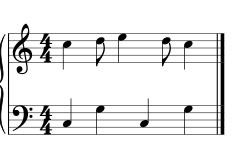
A note that starts on an "&" and is held through the next beat: an eighth, a quarter and an eighth, or a quarter tied to an eighth. The beat in the middle is not played; the note before it covers it.
What to count: Count eighths out loud, "1 & 2 & 3 & 4 &", and play where each note starts: here on "1", "2", "2 &", "3 &" and "4". Keep saying "3" even though no key goes down on it.
How to play it: Feel the beat you don't play: tap it with your foot or let the left hand play it. Give the syncopated note a little weight, since it takes the accent from the beat it covers, and hold it its full length, through the beat.
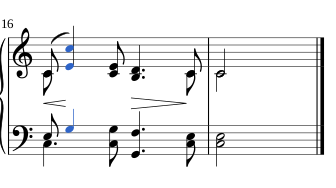
From Annie Laurie (Spottiswoode, level 2), bars 16 to 17, as its edition prints them; the syncopated notes in blue pencil.
Printed in 152 of the 844 pieces. The easiest of them: Papageno's Aria, from The Magic Flute (Mozart, level 2), Annie Laurie (Spottiswoode, level 2) and The Irish Rover (Traditional, level 3).
Within the beat
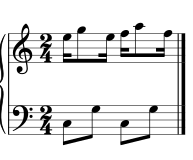
The same pattern at half the size: a sixteenth, an eighth and a sixteenth inside one beat, the eighth held across the beat's "&". It is the figure ragtime is built on, over a left hand that keeps strict time.
What to count: Count sixteenths, "1 e & a", and play on "1", "e" and "a": the eighth on "e" covers the "&". Say "syn-co-pa" on each beat if the syllables help.
How to play it: Play the left hand alone first, steady, then the right hand alone counting sixteenths, then together slowly. The eighth falls between the left hand's notes; it should sound late and bouncy, never rushed onto the beat.
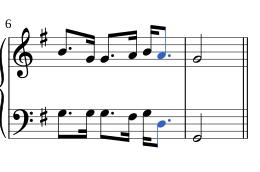
From I Saw Three Ships (Traditional, level 2), bars 6 to 7, as its edition prints them; the syncopated notes in blue pencil.
Printed in 44 of the 844 pieces. The easiest of them: I Saw Three Ships (Traditional, level 2), Polonaise in D minor, BWV Anh. 128 (Anonymous, level 3) and Battle Hymn of the Republic (Traditional, level 3).
Across the bar line
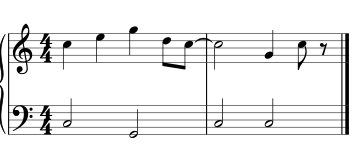
A note on the last half-beat of a bar, tied over the bar line: it arrives early, before the strong first beat it belongs to. Waltzes, songs and ragtime use it to push into a new phrase.
What to count: Count "4 &" at the end of the bar and play on the "&"; then say "1" without playing, since the tie holds the key down through it. Here the next note comes on "3".
How to play it: Hold the tied note through the bar line and don't strike it again on "1". Let the left hand play the downbeat, so you hear the beat the right hand anticipated.
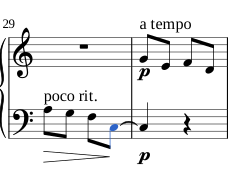
From For Children No. 4 (Bartók, level 2), bars 29 to 30, as its edition prints them; the syncopated notes in blue pencil.
Printed in 89 of the 844 pieces. The easiest of them: For Children No. 4 (Bartók, level 2), Study in G, Op. 17 No. 5 (Couppey, level 2) and The Entertainer (Joplin, level 3).
The library's most syncopated pieces
The pieces with the largest share of their notes syncopated, of those with at least ten syncopated notes, and that share in blue. Ragtime and the dances it grew from lead: a left hand on every beat under a right hand that keeps landing between them.
- For Children No. 13 (Bartók, level 3) 34%
- The Sick Doll, Op. 39 No. 6 (Tchaikovsky, level 3) 33%
- Fillmore (Ingalls, level 3) 22%
- Solace (Joplin, level 4) 20%
- Child Falling Asleep, from Kinderszenen (Schumann, level 5) 18%
- For Children No. 18 (Bartók, level 3) 18%
- Aftenhvile i Leiren (Bergwitz-Goffeng, level 3) 15%
- Come, Thou Almighty King (Giardini, level 3) 15%
Syncopation level by level
How many of the library's pieces at each level syncopate at least once, and the kinds met there. Clefsight's reading course teaches syncopation across the beat in Inversions, at level 5.
| Level | Pieces | Syncopate | Kinds |
|---|---|---|---|
| Level 2 | 105 | 5% | across the beat, within the beat and across the bar line |
| Level 3 | 452 | 13% | across the beat, within the beat and across the bar line |
| Level 4 | 207 | 46% | across the beat, within the beat and across the bar line |
| Level 5 | 61 | 52% | across the beat, within the beat and across the bar line |
| Level 6 | 15 | 40% | across the beat, within the beat and across the bar line |
| Level 7 | 4 | 25% | across the bar line |
What Clefsight grades
A syncopated note is graded like any other: on time within a tenth of your own beat. The usual slip is to play it on the beat it should cover. In an eighth, a quarter and an eighth, a quarter played on "3" instead of "2 &" comes half a beat late and is marked late, in blue pencil, and the notes after it follow your beat, not the slip.
How long you hold it isn't graded: Clefsight marks which keys you play and when, so let your ear judge the length. A note tied over the bar line is one note, and struck again on "1" it counts as an extra note. The rhythm game and the drill's rhythm cards grade the same starts when you tap them in time.
Read syncopation at sight. A short drill of rhythms with notes held across the beat, at a MIDI keyboard or on the keys on screen. Or tap them in time in the rhythm reading game.
Drill syncopationMore on rhythm: how to read rhythm, from note values to ties, triplets and tuplets, time signatures and articulation for ties and accents.