Piano ornaments
An ornament is a small sign that asks for a few quick extra notes around a written one. Each one below is printed as a sign, then written out note by note as you play it, then shown in a real piece. In the library's pieces, the appoggiatura is the one you will meet most.
Every example is one bar of 2/4 on the A above middle C. Under the bar written out, a strip shows its notes in time, one row for each key; press Slowly or At tempo to hear it.
Three things true of every ornament
The notes come from the key. The note above or below is the next one in the key signature: over an A in F major a trill goes to B♭, not B. A small sharp, flat or natural printed over or under the sign changes that note.
They take time from the written note, not from the one before or after, unless the music says otherwise. Keep the beat steady and fit the ornament inside it; if it doesn't fit, play fewer notes, never slow down.
Learn the notes first. Practise a piece without its ornaments until it is steady, then add them, slowly and written out as below. Clefsight grades the written notes: an ornament's quick notes never count as extra, and leaving one out costs nothing. An appoggiatura played as below, on the beat with its main note after it, counts the main note on time.
Trill tr, often with a wavy line after it
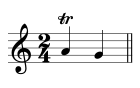
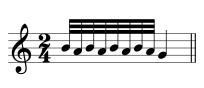
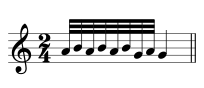
Alternate quickly and evenly between the written note and the note above it in the key, for the whole length of the note, and end on the written note. Play as many notes as you can keep even: four or eight to a beat at a slow tempo is plenty. A trill often ends with the note below and the written note, whether or not they are printed.
Fingers: Two strong fingers side by side: 1 and 3, or 2 and 4, in either hand. 3 and 4, or 4 and 5, tire quickly.
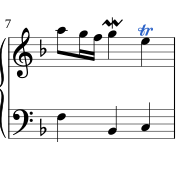
In the library, first in Polonaise in D minor, BWV Anh. 128 (Anonymous, level 3), bar 7, right hand: the ornament in blue, as its edition prints it.
In the library, easiest first: Polonaise in D minor, BWV Anh. 128 (Anonymous, level 3), Trumpet Tune, from The Indian Queen (Purcell, level 3) and The Prince of Denmark's March (Clarke, level 3).
Upper mordent a short zigzag
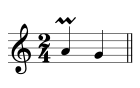
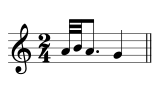
The written note, the note above, and the written note again, the first two as quick as you can, on the beat. In Bach's and Handel's music this sign is a short trill and is often started from the note above: B, A, B, A here.
Fingers: Two fingers side by side, such as 2 and 3, or 3 and 4: 3, 4, 3 for this A in the right hand.
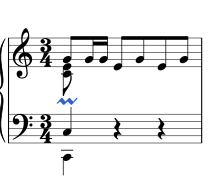
In the library, first in Trumpet Tune, from The Indian Queen (Purcell, level 3), bar 1, left hand: the ornament in blue, as its edition prints it.
In the library, easiest first: Trumpet Tune, from The Indian Queen (Purcell, level 3), Minuet in G, BWV Anh. 114 (Petzold, level 3) and Fantasia No. 8 of the second dozen, TWV 33:20 (Telemann, level 3).
Lower mordent a short zigzag with a line through it
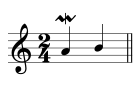
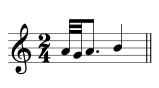
The written note, the note below, and the written note again, the first two quick and on the beat, so the main note sounds almost at once.
Fingers: Two fingers side by side: 3, 2, 3 for this A in the right hand.
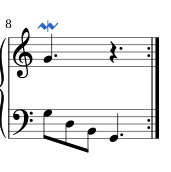
In the library, first in Giga (Arnold, level 3), bar 8, right hand: the ornament in blue, as its edition prints it.
In the library, easiest first: Giga (Arnold, level 3), Polonaise in D minor, BWV Anh. 128 (Anonymous, level 3) and Minuet in F, K. 1d (Mozart, level 3).
Turn a sideways S
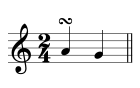
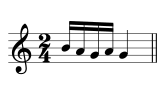
Four notes round the written one: the note above, the note, the note below, the note. Printed over a note, the turn starts at once; printed after a note, between it and the next, play the written note first and the turn at the end of it.
Fingers: Four fingers in a row, the middle one on the written note: 4, 3, 2, 3 for this A in the right hand.
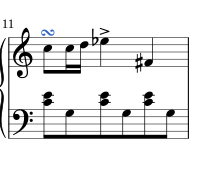
In the library, first in Sonatina in G, Op. 55 No. 2: II (Kuhlau, level 3), bar 11, right hand: the ornament in blue, as its edition prints it.
In the library, easiest first: Sonatina in G, Op. 55 No. 2: II (Kuhlau, level 3), Sonata in G, Op. 49 No. 2: II (Beethoven, level 3) and Sonatina in G, Op. 36 No. 5: II (Clementi, level 4).
Inverted turn a sideways S with a line through it, or turned upside down
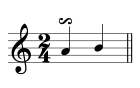
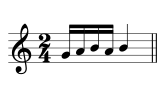
A turn the other way round: the note below, the note, the note above, the note.
Fingers: 2, 3, 4, 3 for this A in the right hand.
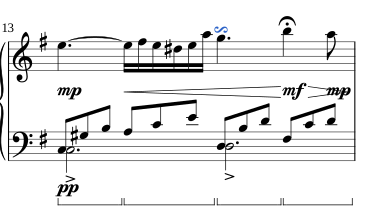
In the library, first in Nocturne No. 10 (Field, level 4), bar 13, right hand: the ornament in blue, as its edition prints it.
In the library, easiest first: Nocturne No. 10 (Field, level 4) and Nocturne No. 1 in E flat (Field, level 4).
Acciaccatura a small note with a slash through its stem
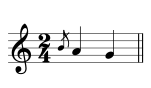
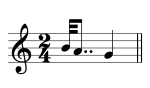
Crushed in: the small note as short as you can play it, almost with the main note, which takes the weight. In music up to Mozart's it falls on the beat; in later music it often goes just before.
Fingers: Any two fingers next to each other; the main note's finger stays where the hand would play it anyway.
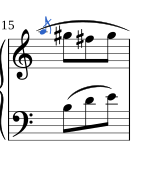
In the library, first in Song Without Words (Spindler, level 3), bar 15, right hand: the ornament in blue, as its edition prints it.
In the library, easiest first: Allegro in C, K. 1b (Mozart, level 2), Song Without Words (Spindler, level 3) and La Violette (Gobbaerts, level 3).
Appoggiatura a small note with no slash
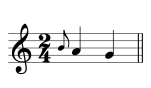
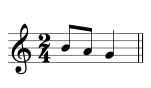
A leaning note: in music from Bach to Mozart it falls on the beat, a little louder than the main note, and takes half of its time (two thirds of a dotted note). Many editions print quick grace notes without the slash too, so when the small note is much shorter than half the main note, or the music is fast, play it short.
Fingers: Two fingers next to each other, lifting the first as the second plays, as in a slur.
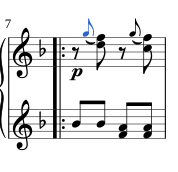
In the library, first in On the Accordion, Op. 123 No. 12 (Gretchaninov, level 2), bar 7, right hand: the ornament in blue, as its edition prints it.
In the library, easiest first: On the Accordion, Op. 123 No. 12 (Gretchaninov, level 2), German Dance in F (Beethoven, level 3) and Study in G, Op. 17 No. 14 (Couppey, level 3).
Grace notes in a group two or more small notes, beamed together
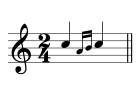
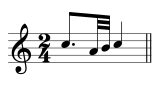
Quick and light, sliding into the main note. In music from the 19th century they usually go just before the beat, so the main note still lands on it, as written out here; in music up to Mozart's they often fall on the beat.
Fingers: One finger each, in a row, the last on the main note: 2, 3, 4 for A, B and C in the right hand.
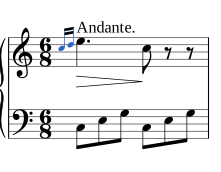
In the library, first in Study in C, Op. 63 No. 4 (Gobbaerts, level 3), bar 1, right hand: the ornament in blue, as its edition prints it.
In the library, easiest first: Study in C, Op. 63 No. 4 (Gobbaerts, level 3), Tarantella, Op. 100 No. 20 (Burgmüller, level 3) and Study in C, Op. 17 No. 13 (Couppey, level 3).
Pieces with ornaments
The library pieces that print an ornament, by level and easiest first, with the ones each prints. The ornaments are each score's source edition's, printed as it gives them.
Level 2
- Allegro in C, K. 1bMozart · acciaccatura
- On the Accordion, Op. 123 No. 12Gretchaninov · appoggiatura
Level 3
- German Dance in FBeethoven · appoggiatura
- GigaArnold · lower mordent
- Song Without WordsSpindler · acciaccatura
- Study in G, Op. 17 No. 14Couppey · appoggiatura
- Waltz, Op. 12 No. 2Grieg · appoggiatura
- La VioletteGobbaerts · acciaccatura
- Study in C, Op. 63 No. 4Gobbaerts · appoggiatura and grace notes in a group
- Tarantella, Op. 100 No. 20Burgmüller · appoggiatura and grace notes in a group
- Study in A minor, Op. 47 No. 3Heller · appoggiatura
- Polonaise in D minor, BWV Anh. 128Anonymous · trill, lower mordent and appoggiatura
- Trumpet Tune, from The Indian QueenPurcell · trill and upper mordent
- Sonatina in C, Op. 36 No. 3: IIClementi · appoggiatura
- Gnossienne No. 1Satie · acciaccatura
- Sonatina in G, Anh. 5 No. 1Beethoven · acciaccatura
- Study in C, Op. 17 No. 13Couppey · grace notes in a group
- Minuet in G, BWV Anh. 114Petzold · upper mordent
- Sonatina in GAttwood · acciaccatura
- Study in G, Op. 17 No. 24Couppey · appoggiatura
- The Departure, Op. 117 No. 23Gurlitt · grace notes in a group
- The Prince of Denmark's MarchClarke · trill
- Study in C, Op. 17 No. 4Couppey · appoggiatura
- Andante in C, K. 1aMozart · trill and acciaccatura
- Impertinence, HWV 494Handel · trill
- Study in F, Op. 17 No. 8Couppey · appoggiatura
- Ländler in B flatSchubert · appoggiatura
- Minuet in F, K. 1dMozart · trill, lower mordent and appoggiatura
- Short Exercise, Op. 821 No. 4Czerny · acciaccatura
- Funeral March, from the Sonata No. 2Chopin, arranged · acciaccatura, appoggiatura and grace notes in a group
- Allegro in B flat, K. 3Mozart · appoggiatura
- Pastorale, Op. 100 No. 3Burgmüller · appoggiatura and grace notes in a group
- March in G, BWV Anh. 124Bach · trill and appoggiatura
- Papageno and Papagena's Duet, from The Magic FluteMozart, arranged · trill
- Fantasia No. 8 of the second dozen, TWV 33:20Telemann · upper mordent
- Farewell, Op. 100 No. 12Burgmüller · appoggiatura
- Short Exercise, Op. 821 No. 5Czerny · grace notes in a group
- Album Leaf, Op. 12 No. 7Grieg · appoggiatura
- Polonaise in F, BWV Anh. 117bAnonymous · upper mordent, lower mordent, appoggiatura and grace notes in a group
- Trumpet Tune in DClarke · trill, upper mordent and grace notes in a group
- Italian Song, Op. 39 No. 15Tchaikovsky · grace notes in a group
- Sonatina in G, Op. 36 No. 2: IIIClementi · trill and grace notes in a group
- Minuet in A, Hob. IX:8 No. 6Haydn · appoggiatura
- La Styrienne, Op. 100 No. 14Burgmüller · appoggiatura and grace notes in a group
- Sonatina in G, Op. 55 No. 2: IKuhlau · appoggiatura
- Hunting Song, Op. 68 No. 7Schumann · acciaccatura
- Minuet in F, BWV Anh. 113Anonymous · trill and appoggiatura
- Study in C, Op. 47 No. 2Heller · appoggiatura
- Halling, Op. 47 No. 4Grieg · appoggiatura
- Sonatina in G, Op. 55 No. 2: IIKuhlau · turn
- Children's Study, Op. 37 No. 29Lemoine · acciaccatura
- Sonatina in C, Op. 36 No. 1: IIClementi · trill and grace notes in a group
- Little Prelude in C, BWV 939Bach · lower mordent
- Study in F, Op. 17 No. 10Couppey · appoggiatura
- Tender Flower, Op. 100 No. 10Burgmüller · grace notes in a group
- Minuet in B flat, BWV Anh. 118Anonymous · trill and appoggiatura
- Sonata in G, Hob. XVI:8Haydn · trill, lower mordent, appoggiatura and grace notes in a group
- Sonatina in G, Op. 20 No. 1: IIDussek · appoggiatura
- Minuet in A minor, BWV Anh. 120Anonymous · trill
- Gavotte, Op. 117 No. 31Gurlitt · appoggiatura
- Polska from NorrbottenTraditional · appoggiatura
- Little Prelude in D minor, BWV 926Bach · upper mordent and lower mordent
- Minuet in F, K. 5Mozart · acciaccatura
- Sonata in G minor, Op. 49 No. 1: IIBeethoven · appoggiatura and grace notes in a group
- Sonatina in G, Op. 20 No. 1: IDussek · appoggiatura
- O Holy NightAdam, arranged · appoggiatura
- Polonaise in G, BWV Anh. 130Hasse · trill, upper mordent, lower mordent and appoggiatura
- Menuet, from the Premier livreRameau · trill, upper mordent and appoggiatura
- Sonatina in C, Op. 36 No. 3: IClementi · trill, appoggiatura and grace notes in a group
- Waltz, Op. 32 No. 1Czerny · trill, upper mordent and acciaccatura
- Elegy, Op. 38 No. 6Grieg · grace notes in a group
- Minuet in C minor, BWV Anh. 121Anonymous · trill
- Invention No. 4 in D minor, BWV 775Bach · upper mordent
- Rondo alla turca (Turkish March)Mozart, arranged · grace notes in a group
- Sonatina in C, Op. 55 No. 3: IIKuhlau · appoggiatura and grace notes in a group
- Harvest Song, Op. 68 No. 24Schumann · upper mordent, appoggiatura and grace notes in a group
- Elfin Dance, Op. 12 No. 4Grieg · grace notes in a group
- La Chevaleresque, Op. 100 No. 25Burgmüller · appoggiatura and grace notes in a group
- Sonatina in F, Anh. 5 No. 2Beethoven · acciaccatura
- German Dance in ASchubert · acciaccatura
- Sonata in G, Op. 49 No. 2: IIBeethoven · turn and appoggiatura
- March in E flat, BWV Anh. 127Anonymous · trill
- Children's Study, Op. 37 No. 7Lemoine · acciaccatura
- Folk Song, Op. 68 No. 9Schumann · appoggiatura
- Folk Song, Op. 12 No. 5Grieg · grace notes in a group
- Invention No. 1 in C, BWV 772Bach · upper mordent and lower mordent
- Rustic Song, Op. 68 No. 20Schumann · upper mordent
- Minuet in G minor, HWV 434Handel · upper mordent, lower mordent and grace notes in a group
- Chinese Dance, from The NutcrackerTchaikovsky, arranged · trill and grace notes in a group
- Sonata in G, Op. 49 No. 2: IBeethoven · trill, appoggiatura and grace notes in a group
- Little Prelude in E minor, BWV 941Bach · upper mordent
- Untitled, Op. 68 No. 26Schumann · appoggiatura
- La donna è mobile, from RigolettoVerdi, arranged · acciaccatura
- Rondo in F, K. 15hhMozart · trill and appoggiatura
Level 4
- Sonatina in G, Op. 36 No. 5: IIClementi · turn, appoggiatura and grace notes in a group
- The Reaper's Song, Op. 68 No. 18Schumann · acciaccatura
- Invention No. 10 in G, BWV 781Bach · upper mordent and lower mordent
- Song of the Lark, Op. 39 No. 22Tchaikovsky · appoggiatura
- Invention No. 7 in E minor, BWV 778Bach · upper mordent and lower mordent
- Prelude in A, Op. 28 No. 7Chopin · appoggiatura
- The Skaters' Waltz (Les Patineurs), Op. 183Waldteufel · grace notes in a group
- Italian Sailors' Song, Op. 68 No. 36Schumann · appoggiatura
- Song Without Words in F sharp minor, Op. 30 No. 6Mendelssohn · trill, upper mordent and grace notes in a group
- A Curious Story, from KinderszenenSchumann · grace notes in a group
- Waltz in A minor, B. 150Chopin · trill, upper mordent and grace notes in a group
- Prelude in B minor, Op. 28 No. 6Chopin · appoggiatura
- Short Exercise, Op. 821 No. 13Czerny · appoggiatura and grace notes in a group
- Sonata in D minor, K. 32Scarlatti · trill
- Sonatina in F, Op. 36 No. 4: IIClementi · turn
- GigueJacquet de La Guerre · upper mordent, lower mordent, turn and appoggiatura
- Sonatina in F, Op. 36 No. 4: IIIClementi · trill and turn
- Aria, from the Goldberg Variations, BWV 988Bach, arranged · upper mordent, lower mordent, turn and appoggiatura
- For Children No. 16Bartók · grace notes in a group
- CouranteJacquet de La Guerre · upper mordent, lower mordent, turn and appoggiatura
- Lament, Op. 123 No. 9Gretchaninov · appoggiatura
- Valses poéticos No. 7Granados · grace notes in a group
- Barcarolle, Op. 100 No. 22Burgmüller · appoggiatura
- Minuet in G minor, BWV 842Bach · lower mordent
- Bridal Chorus, from LohengrinWagner, arranged · appoggiatura and grace notes in a group
- Song Without Words in A, Op. 19 No. 4Mendelssohn · appoggiatura
- Berceuse in G, Op. 38 No. 1Grieg · appoggiatura and grace notes in a group
- March, from The NutcrackerTchaikovsky, arranged · appoggiatura and grace notes in a group
- Sonata in G minor, Op. 49 No. 1: IBeethoven · trill, appoggiatura and grace notes in a group
- Sonatina in D, Op. 36 No. 6: IClementi · appoggiatura
- Gigue, from the Suite in G minor, HWV 432Handel · trill and lower mordent
- March of the Trolls, Op. 54 No. 3Grieg · appoggiatura
- Sonatina in F, Op. 36 No. 4: IClementi · upper mordent
- Sonatina in G, Op. 36 No. 5: IClementi · trill, appoggiatura and grace notes in a group
- Sonata in G, K. 63Scarlatti · upper mordent
- Sonatina in G, Op. 55 No. 2: IIIKuhlau · appoggiatura
- Dill PicklesJohnson · acciaccatura and grace notes in a group
- Andante in B flat, K. 15iiMozart · appoggiatura
- June: Barcarolle, Op. 37a No. 6Tchaikovsky · grace notes in a group
- Sonata in D, K. 346Scarlatti · upper mordent
- Sonatina in G, Op. 20 No. 2: IKuhlau · grace notes in a group
- Funeral March of a MarionetteGounod · appoggiatura
- Für Elise, WoO 59Beethoven · appoggiatura and grace notes in a group
- Wedding March, from A Midsummer Night's DreamMendelssohn, arranged · trill and grace notes in a group
- Funeral March in C minor, Op. 72 No. 2Chopin · acciaccatura
- Once Upon a Time, Op. 71 No. 1Grieg · appoggiatura
- Invention No. 11 in G minor, BWV 782Bach · upper mordent, lower mordent and turn
- Sonatina in D, Op. 36 No. 6: IIClementi · trill, appoggiatura and grace notes in a group
- Andante in D, K. 15oMozart · trill
- Little Prelude in E minor, BWV 938Bach · upper mordent and lower mordent
- Nocturne No. 10Field · trill, inverted turn, acciaccatura and grace notes in a group
- Sonatina in G, Op. 20 No. 2: IIIKuhlau · trill, appoggiatura and grace notes in a group
- Nocturne No. 1 in E flatField · inverted turn, acciaccatura and grace notes in a group
- Gavotte, from the Premier livreRameau · trill, upper mordent and appoggiatura
- Fantasia in A minor, BWV 904Bach · upper mordent
- Allemande, BWV 836Bach · upper mordent
- Possum and TatersHunter · grace notes in a group
- Sicilienne, Op. 68 No. 11Schumann · grace notes in a group
- A New GroundPurcell · upper mordent
- Nocturne No. 5 in B flatField · appoggiatura
- Sonatina in G, Op. 20 No. 2: IIKuhlau · trill and appoggiatura
- Little Prelude in E, BWV 937Bach · upper mordent and turn
- Song Without Words in F sharp minor, Op. 19 No. 5Mendelssohn · appoggiatura
- Fugue in A minor, B. 144Chopin · trill
- Gnossienne No. 3Satie · acciaccatura
- Invention No. 15 in B minor, BWV 786Bach · upper mordent and lower mordent
- Little Prelude in D minor, BWV 940Bach · lower mordent
- Waltz of the Flowers, from The NutcrackerTchaikovsky, arranged · grace notes in a group
- Golliwogg's Cake-walk, from Children's CornerDebussy · appoggiatura
- Norse Song, Op. 68 No. 41Schumann · appoggiatura and grace notes in a group
- Fantasia, from the Partita No. 3 in A minor, BWV 827Bach · upper mordent
- Little Prelude in C minor, BWV 934Bach · lower mordent and appoggiatura
- Consolation No. 1Liszt · appoggiatura and grace notes in a group
- Little Prelude in F, BWV 928Bach · lower mordent
- Prelude in E minor, Op. 28 No. 4Chopin · turn and acciaccatura
- Salut d'amour, Op. 12Elgar · appoggiatura
- Untitled, Op. 68 No. 30Schumann · turn
- My First Ball, Op. 123 No. 8Gretchaninov · appoggiatura
- Nocturne No. 2 in C minorField · turn and appoggiatura
- Waltz in A flat, Op. 69 No. 1Chopin · appoggiatura
- Invention No. 2 in C minor, BWV 773Bach · trill
- Waltz, Op. 123 No. 6Gretchaninov · appoggiatura
- Pavane pour une infante défunteRavel · appoggiatura and grace notes in a group
- Invention No. 12 in A, BWV 783Bach · lower mordent
- Song of the Lark, from The SeasonsTchaikovsky · acciaccatura and grace notes in a group
- Theme, Op. 68 No. 34Schumann · turn
- Dance of the Reed Flutes, from The NutcrackerTchaikovsky, arranged · appoggiatura
- The School of Velocity, Op. 299 No. 10Czerny · trill and acciaccatura
- In the Hall of the Mountain King, Op. 46 No. 4Grieg · grace notes in a group
- Invention No. 5 in E flat, BWV 776Bach · upper mordent, lower mordent and appoggiatura
- Polka, Op. 39 No. 14Tchaikovsky · appoggiatura
- Remembrance, Op. 68 No. 28Schumann · turn and appoggiatura
- Erotik, Op. 43 No. 5Grieg · grace notes in a group
- Ständchen (Serenade)Schubert, arranged · grace notes in a group
- Miniature Overture, from The NutcrackerTchaikovsky, arranged · appoggiatura
- Impromptu in C minor, Op. 90 No. 1Schubert · upper mordent, appoggiatura and grace notes in a group
- Prelude and Fugue in E minor, BWV 855Bach · appoggiatura
- Humoresque, Op. 101 No. 7Dvořák · upper mordent and appoggiatura
- Prelude in A minor, BWV 807Bach · trill, lower mordent and appoggiatura
- Sonata in G minor, K. 111Scarlatti · trill and appoggiatura
Level 5
- Sonata in C, K. 545: IMozart · trill, acciaccatura and grace notes in a group
- Waltz in A minor, Op. 34 No. 2Chopin · trill, upper mordent, appoggiatura and grace notes in a group
- Sonata in E minor, Hob. XVI:34: IHaydn · trill, upper mordent and lower mordent
- October: Autumn Song, Op. 37a No. 10Tchaikovsky · acciaccatura and grace notes in a group
- Nocturne in C sharp minor, Op. posth.Chopin · trill, appoggiatura and grace notes in a group
- Prelude in D flat, Op. 28 No. 15Chopin · appoggiatura and grace notes in a group
- Mazurka in C minor, Op. 30 No. 1Chopin · upper mordent and acciaccatura
- May, Lovely May, Op. 68 No. 13Schumann · acciaccatura and grace notes in a group
- Moment musical in F minor, Op. 94 No. 3Schubert · acciaccatura and grace notes in a group
- Album Leaf, Op. 47 No. 2Grieg · appoggiatura
- Prelude in D, Op. 28 No. 5Chopin · appoggiatura
- Spinning Song, Op. 67 No. 4Mendelssohn · appoggiatura and grace notes in a group
- Arietta, Op. 12 No. 1Grieg · grace notes in a group
- Solo per il cembalo in E flat, BWV Anh. 129Bach · upper mordent
- Frog Legs RagScott · acciaccatura
- Étude in C sharp minor, Op. 2 No. 1Scriabin · acciaccatura
- Notturno, Op. 54 No. 4Grieg · trill, appoggiatura and grace notes in a group
- Fugue in E minor, BWV 914Bach · upper mordent and lower mordent
- Happy Enough, from KinderszenenSchumann · appoggiatura
- The Little Shepherd, from Children's CornerDebussy · acciaccatura and grace notes in a group
- Album LeafScriabin · acciaccatura
- To Spring, Op. 43 No. 6Grieg · appoggiatura and grace notes in a group
- Nocturne in B, Op. 32 No. 1Chopin · upper mordent, appoggiatura and grace notes in a group
- Summer's Eve, Op. 71 No. 2Grieg · grace notes in a group
- Sonata in E, K. 531Scarlatti · upper mordent, acciaccatura and appoggiatura
- Prelude to CarmenBizet, arranged · trill, acciaccatura and grace notes in a group
- Shepherd's Boy, Op. 54 No. 1Grieg · grace notes in a group
- Gone, Op. 71 No. 6Grieg · appoggiatura
- Prelude in A flat, Op. 28 No. 17Chopin · appoggiatura and grace notes in a group
Level 6
- Sonata in C, K. 330: IIIMozart · trill, acciaccatura, appoggiatura and grace notes in a group
- Waltz in G, Op. 39 No. 10Brahms · grace notes in a group
- Waltz in C sharp minor, Op. 64 No. 2Chopin · upper mordent, appoggiatura and grace notes in a group
- Waltz in D flat, Op. 64 No. 1Chopin · trill, upper mordent and acciaccatura
- Sonata in B flat, K. 570: IMozart · trill, acciaccatura and grace notes in a group
- Intermezzo in A minor, Op. 116 No. 2Brahms · acciaccatura
- Sonata in F minor, Op. 2 No. 1: IBeethoven · trill, lower mordent, acciaccatura and grace notes in a group
- Prelude in C minor, BWV 847Bach · lower mordent
- Sonata in C sharp minor, K. 247Scarlatti · trill, upper mordent and appoggiatura
- Pathétique Sonata: IIBeethoven · appoggiatura and grace notes in a group
- Prelude in F sharp minor, Op. 28 No. 8Chopin · appoggiatura
Level 7
- Song Without Words in C, Op. 102 No. 3Mendelssohn · acciaccatura
- Valse oubliée No. 1, S. 215/1Liszt · trill, acciaccatura and grace notes in a group
- Étude in F minor, Op. 25 No. 2Chopin · appoggiatura
- Fantaisie-impromptu, Op. 66Chopin · trill, acciaccatura and grace notes in a group
Play them on a real page. Every piece in the library has versions with fewer notes, and they print no ornaments, so you can learn the notes first and add the ornaments when you play it as written.
Open the libraryMore on the page: music symbols and what they mean, piano finger numbers, rolled chords, the wavy line before a chord, and tempo markings for how fast “at tempo” is.
How we counted
A piece counts once for each ornament it prints, however often. Of the 825 pieces in Clefsight's library, 238 print at least one: 56 have trills, 61 mordents and 191 small grace notes.
- Appoggiatura116
- Grace notes in a group85
- Trill56
- Upper mordent47
- Acciaccatura45
- Lower mordent30
- Turn15
- Inverted turn2
Each ornament, the pieces that print it and how often: Trill, 56 pieces, 281 times in all; Upper mordent, 47 pieces, 350 times in all; Lower mordent, 30 pieces, 217 times in all; Turn, 15 pieces, 36 times in all; Inverted turn, 2 pieces, 6 times in all; Acciaccatura, 45 pieces, 337 times in all; Appoggiatura, 116 pieces, 956 times in all; and Grace notes in a group, 85 pieces, 390 times in all.
The pieces that print an ornament, level by level: Level 2, 2 of 102, Level 3, 92 of 439, Level 4, 100 of 205, Level 5, 29 of 60, Level 6, 11 of 15 and Level 7, 4 of 4.