Learn to read music · Music symbols
Rolled chords: how to play the wavy line
A wavy line just before a chord means roll it: play its notes one after another from the bottom up, quickly, instead of all at once. Of the 846 pieces in Clefsight's library, 64 roll a chord somewhere, 835 rolled chords between them. Each way a score prints a roll is below as printed, as it sounds and in two real bars, the wavy line in blue pencil.
How to read the wavy line
The line stands just left of the chord and runs from its lowest note to its highest. Its name in Italian is arpeggio, "like a harp", which is also why a written-out broken chord is called an arpeggio; a score's "arpeggiando" or "arp." asks the same.
A roll takes no time from the beat: the chord still starts where it is written, and the notes follow so closely that they sound as one spread chord, not as a run. How spread is a matter of taste and speed; in a quick piece it is barely a ripple.
Rolled chord a wavy line just before a chord
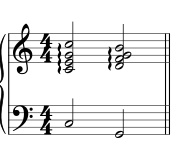
Spread the chord: play its notes one after another from the lowest up, quickly, and hold each one as the next sounds, so the whole chord rings at the end. It is the same chord, only spread, like a harp's.
How to play it: Start the roll on the beat with the lowest note and let the top note arrive just after; keep the fingers over their keys before you begin, so the roll is one quick movement of the wrist, not a search. A roll is a colour, not a slow arpeggio: the faster the music, the tighter the roll.
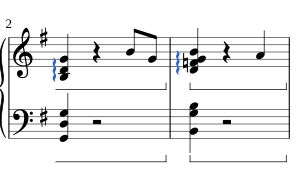
From Amazing Grace (Traditional, level 3), bars 2 to 3, as its edition prints them; the sign in blue pencil.
Printed in 64 of the 846 pieces, 835 chords in all. The easiest of them: Jingle Bells (Pierpont, level 3), Amazing Grace (Traditional, level 3) and Little Canon, Op. 68 No. 27 (Schumann, level 3).
A chord too wide for the hand a wavy line before a chord more than an octave wide
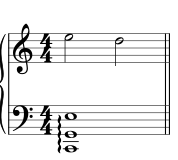
A chord spread wider than an octave, such as a tenth in the left hand, is usually rolled because few hands can take it at once. The roll lets the hand reach it: the low note first, then the hand moves up to the rest.
How to play it: Play the lowest note on the beat, hold it with the pedal (or the finger, if the hand can stretch), and swing the hand up to the other notes without a gap. If your hand can take the tenth at once, the roll is still what the edition asks: it is part of the sound.
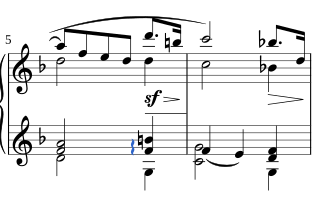
From Intermezzo, from Cavalleria rusticana (Mascagni, level 3), bars 5 to 6, as its edition prints them; the sign in blue pencil.
Printed in 28 of the 846 pieces, 178 chords in all. The easiest of them: Intermezzo, from Cavalleria rusticana (Mascagni, level 3), Russian Dance (Trepak), from The Nutcracker (Tchaikovsky, level 4) and Bridal Chorus, from Lohengrin (Wagner, level 4).
Both hands rolled a wavy line before the chord on each staff, or one line through both
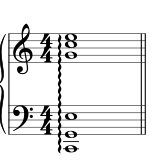
Chords in both hands rolled at the same moment. One unbroken line through both staves is one roll, from the left hand's lowest note to the right hand's highest. A line on each staff means each hand rolls its own chord, both starting together.
How to play it: For one long roll, start with the left hand's lowest note and pass straight on into the right hand, as one sweep up the keyboard. For a line on each staff, start both hands together, each from its own lowest note. Either way, hold every note to the end of the chord.
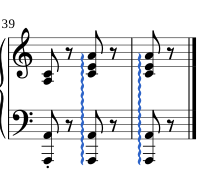
From Little Canon, Op. 68 No. 27 (Schumann, level 3), bars 39 to 40, as its edition prints them; the sign in blue pencil.
Printed in 26 of the 846 pieces, 113 chords in all. The easiest of them: Jingle Bells (Pierpont, level 3), Little Canon, Op. 68 No. 27 (Schumann, level 3) and Invention No. 1 in C, BWV 772 (Bach, level 3).
A roll with an arrow an arrowhead at the top or the bottom of the wavy line
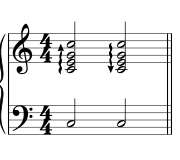
An arrowhead says which way to roll. Pointing up, it is the usual roll, from the lowest note to the highest. Pointing down, roll from the top note down to the lowest, which lands the bass last.
How to play it: With the arrow down, put the top finger on the beat and fall through the chord to the thumb or the fifth finger, the opposite movement to an ordinary roll. Practise it slowly: the hand's habit is to roll upwards.
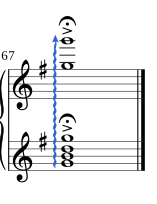
From Jingle Bells (Pierpont, level 3), bar 67, as its edition prints them; the sign in blue pencil.
Printed in 2 of the 846 pieces, 3 chords in all. The easiest of them: Jingle Bells (Pierpont, level 3) and Little Prelude in C, BWV 924 (Bach, level 4).
Not rolled a square bracket before a chord
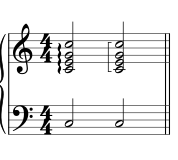
A bracket instead of a wavy line means the opposite: play the chord's notes exactly together, not rolled. Editions print it where the chords around it are rolled, or where a player might roll it by habit.
How to play it: Strike every note of the chord at once, with the fingers already on the keys and the hand dropping as one. If the chord is too wide to take, the edition is asking for it anyway: leave out a middle note before you roll it.
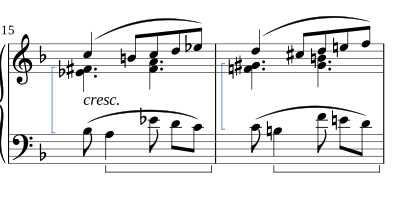
From Prelude, Op. 40 No. 3 (Lyadov, level 4), bars 15 to 16, as its edition prints them; the sign in blue pencil.
Printed in 1 of the 846 pieces, 4 chords in all.
What Clefsight grades
Notes played within 64 ms of each other count as one chord, so a quick roll of an ordinary chord is graded as the chord. Where the score prints a wavy line, each note may follow the one before by up to 160 ms and the chord is still one chord, on time if its first note is. Roll slower than that and the last notes are marked late. Which way you roll, and a roll where the score asks for none, aren't marked.
The library piece that rolls the most chords is Waltz of the Flowers, from The Nutcracker (Tchaikovsky, level 4), with 159.
Roll a real chord. Open a piece that prints the wavy line and Clefsight follows you through it as you play from the page on a MIDI keyboard.
Open the libraryMore on the page: piano ornaments, the other signs that decorate a note, music symbols and what they mean, the piano arpeggios chart for chords broken all the way, and piano pedal marks for holding a wide roll.