Piano pedal marks and how to read them
A piano has pedals for the feet, and the score says when to use them. Of the 842 pieces in Clefsight's library, 48 mark the sustain pedal, 1,957 presses between them. Each way a score marks the pedals is below with what it asks, how to play it and two real bars where it is printed, the mark in blue pencil.
The three pedals
The right pedal is the sustain pedal, also called the damper pedal. Pressed, it lifts every damper off the strings, so notes keep sounding after you let go of the keys, and the strings you aren't playing ring along. Nearly every pedal mark in a score is for this one.
The left pedal is the soft pedal, marked una corda. It makes the sound softer and more veiled.
The middle pedal, on grand pianos and some uprights, holds only the notes already down when it is pressed (the sostenuto pedal); on many uprights it mutes the piano for practice. Most digital keyboards have a sustain pedal only, and that is all the music below needs.
Ped. and the star Ped. under the bass staff, and ✱ where to lift
Press the right pedal, the sustain pedal, at Ped. and keep it down until the star, then lift it. While it is down, every note keeps sounding after you let go of its key.
How to play it: Rest your right heel on the floor and press with the ball of the foot, all the way down. Lift it fully at the star, not halfway, so the sound clears.
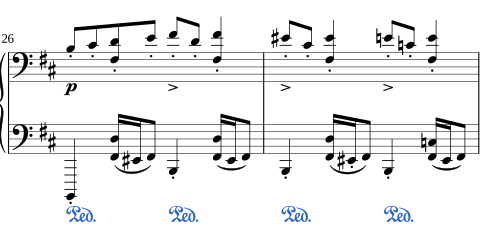
From In the Hall of the Mountain King, Op. 46 No. 4 (Grieg, level 4), bars 26 to 27, as its edition prints them; the mark in blue pencil.
Printed in 2 of the 842 pieces. The easiest of them: Brindisi, from La traviata (Verdi, level 3) and In the Hall of the Mountain King, Op. 46 No. 4 (Grieg, level 4).
Pedal bracket a line under the bass staff, from a hook up at the start to a hook up at the end
The same as Ped. and the star, drawn as a line: the pedal is down for as long as the line runs, and comes up where it ends. Modern editions print it because it shows exactly where to press and lift.
How to play it: Follow the line with your foot: down where it starts, up where it ends. The line is easier to read than the star, as it never leaves you guessing where the lift falls.
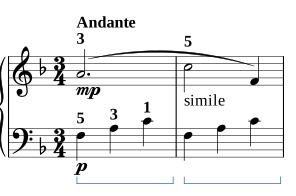
From Andante in F, Op. 82 (Gurlitt, level 2), bars 1 to 2, as its edition prints them; the mark in blue pencil.
Printed in 46 of the 842 pieces. The easiest of them: Andante in F, Op. 82 (Gurlitt, level 2), Spring, from The Four Seasons (Vivaldi, level 3) and The Coventry Carol (Traditional, level 3).
Pedal change a notch in the bracket line, ∧, or a star and Ped. together
Lift the pedal and press it again at once, so the old harmony clears and the new one is held. It is how a piece stays connected under the pedal without blurring one chord into the next.
How to play it: Legato pedalling: play the new note or chord first, then lift the pedal and press it again straight after, while the fingers hold the keys. Lift too early and there is a gap; too late and the old chord smudges into the new.
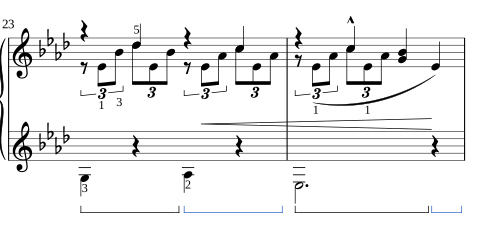
From Children's Study, Op. 37 No. 44 (Lemoine, level 4), bars 23 to 24, as its edition prints them; the mark in blue pencil.
Printed in 15 of the 842 pieces. The easiest of them: The Coventry Carol (Traditional, level 3), Amazing Grace (Traditional, level 3) and Nimrod, from the Enigma Variations (Elgar, level 4).
Pedal words con Ped., senza Ped., Ped. simile
Words for the pedal over a whole passage: con pedale (with the pedal) leaves where to change it to you, senza pedale means without it, and simile means go on pedalling as marked before.
How to play it: With con Ped. and no marks, change the pedal with each new harmony, usually once or twice a bar, and listen: if it blurs, change more often.
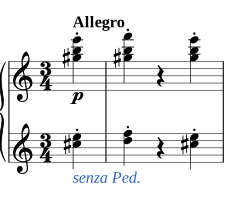
From Valse oubliée No. 1, S. 215/1 (Liszt, level 7), the upbeat and bar 1, as its edition prints them; the mark in blue pencil.
Printed in 1 of the 842 pieces. The easiest of them: Valse oubliée No. 1, S. 215/1 (Liszt, level 7).
Una corda and tre corde una corda, then tre corde (or tutte le corde)
Una corda, one string, means press the left pedal, the soft pedal, which makes the sound softer and veiled. Tre corde, three strings, means let it up again.
How to play it: Press the left pedal with your left foot and hold it down until tre corde. It changes the colour as much as the loudness, so play softly too.
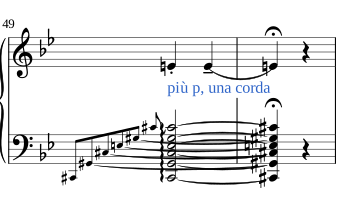
From Berceuse in G, Op. 38 No. 1 (Grieg, level 4), bars 49 to 50, as its edition prints them; the mark in blue pencil.
Printed in 4 of the 842 pieces. The easiest of them: Berceuse in G, Op. 38 No. 1 (Grieg, level 4), March of the Trolls, Op. 54 No. 3 (Grieg, level 4) and Spring Song, Op. 68 No. 15 (Schumann, level 4).
When there are no marks
Many editions leave the pedal to the player, especially in music by Bach, Haydn and Mozart, whose instruments had no sustain pedal as we know it: play those clean, with the fingers holding what must be held. In Romantic music with no marks, the pedal is usually expected: change it with each new harmony and let your ear decide.
A rule that works almost everywhere: never hold the pedal through a change of harmony, and change it after the new chord sounds, not before. The library piece with the most pedal presses marked is Fantaisie-impromptu, Op. 66 (Chopin, level 7), with 232.
On a MIDI keyboard
A sustain pedal plugs into the keyboard's sustain or damper socket, a quarter-inch jack, and it sends its own MIDI signal, controller 64, down or up. A square foot-switch works; a piano-style pedal feels closer to the real thing, and some keyboards read half-pedalling from one.
Clefsight hears the sustain pedal from a MIDI keyboard: a key let go while it is down keeps sounding, so a note held by the pedal counts as held. Where you press and lift it is yours to judge by ear: the pedal marks in the library's pieces are printed for you to follow, not graded.
Pedal a real page. Open a piece that marks the pedal, plug the pedal into your keyboard, and Clefsight follows you through it as you play from the page.
Open the libraryMore on the page: music symbols and what they mean, musical terms for words like con pedale, and which keyboard to buy, with what to look for in a pedal.