Friedrich Burgmüller (1806–1874)
Pastorale, Op. 100 No. 3
From 25 Easy and Progressive Studies, Op. 100
How hard is Pastorale, Op. 100 No. 3 (Burgmüller)? Level 3 of 7 on our scale. Both hands busy, the hand moves around, a sharp or flat or two. G. Henle Verlag, whose scale runs 1 to 9, grades it 1 of 9 in its edition HN 1726. How the two scales compare.
Op. 100 No. 3: its opus number, by which the composer's published works are numbered.
Plays on a MIDI keyboard in Chrome, Edge or Firefox on a computer, or Chrome on an Android phone or tablet, or on the keys on screen without one.
More about Pastorale, Op. 100 No. 3
No. 3 of 25 in Burgmüller's 25 Easy Studies, Op. 100
In Calm pieces
What stands between you and this piece
Clefsight compares the notes of this piece with what you already read. Take the level test and this page will list what's left to learn, item by item.
Versions
Each simpler version only leaves notes out and adds none, so every note in it is the piece's own. Print any of them free.
- As written459 notes
- Melody and a simpler left hand375 notes
- Melody and left-hand roots184 notes
- Right-hand melody149 notes
To practise it on paper: a practice chart for this piece, a week of steps from each hand alone to full tempo, with their speeds.
What it asks of you
- Treble clef from E4 to G6, with ledger lines
- Bass clef from G2 to G4, with ledger lines
- Key signature: 1 sharp (G major or E minor)
- Accidentals: sharps outside the key, naturals
- Rhythm: quarter notes, dotted half notes, rests, eighth notes, repeat signs, dotted quarter notes
- Intervals: 2nds (steps), 3rds (skips), 5ths, 4ths, octaves, 6ths
- Chords: triads, seventh chords, inverted triads
- Hands playing together, one hand moving while the other holds, moving the hand to a new position, hands taking turns
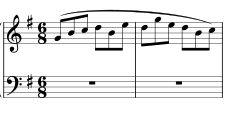
The right hand opens with G B C D B E D G E D B C on its own. The right hand first moves to a new position in bar 2, the left hand in bar 9. Its highest note is G6, in bar 29, and its lowest G2, in bar 29. It ends with G in the right hand over G in the left. From note to note it moves mostly by steps (44%), 3rds (31%), and 5ths (10%).
Sections
The piece in 5 sections, cut where its music breaks, each read at its own level. Tap one to loop it on the stand until it's clean, then the next.
- Bars 1–2level 3 of 7Right hand G4 B4 C5 D5 B4 E5 D5 G5…; the left hand waits
- Bars 3–10played twicelevel 3 of 7Right hand D5 B4 D5 E5 D5 G5 D5 B4…; left hand the chord G3 B3 D4 eight times…
- Bars 11–17level 4 of 7, the hardestRight hand A5 C5 E5 D5 B4 D5 C♯5 D5…; left hand F♯3 and C4 together, D4 three times, G3 and B3 together, D4 three times…
- Bars 18–23level 3 of 7Right hand B4 A4, D5 three times, B4 D5 E5…; left hand D4 G4 G4, D4 and F♯4 together, the chord G3 B3 D4 four times…
- Bars 24–29level 3 of 7Right hand D5 C5 E5 G5 G5 D5 B4 B4…; left hand the chord E3 G3 C4 four times, the chord D3 G3 B3, D3 D4 C4…
Score from a copy shared on MuseScore (CC0 1.0); the composition is public domain: Friedrich Burgmüller died in 1874. Public domain in Canada and the United States. It may still be protected where you live. Credits
Two sources agree. Two copies made by different people were compared bar by bar; the 4 bars where they differed were settled against the scan. Only those bars were looked up in a printed edition, F. Burgmüller, Twenty-five Easy and Progressive Studies, Op. 100, ed. Louis Oesterle (Schirmer’s Library of Musical Classics, G. Schirmer, New York, 1903; plate 14104); the rest hasn't been compared with it yet. How we check Heard a wrong note? Tell us