Calm piano pieces
Quiet, unhurried music to read at the keyboard, from level 2 to level 5: Bach's Air on the G String, Handel's Largo, Pachelbel's Canon, Clair de lune in an easy arrangement, Elgar's Nimrod, Liszt's first Consolation, Chopin's short Prelude in A and the slow movement of Mozart's Sonata in C, K. 545, with the gentlest pieces from the teaching books: Tchaikovsky's Morning Prayer and Sweet Dreams, Burgmüller's Pastorale, Gurlitt's Cradle Song and Schumann's Chorale. Each piece has easier versions made from the score itself, starting with the melody alone.
- Pieces
- 22
- Levels
- 2 to 5
- Key signatures
- 3 flats to 4 sharps
- Length
- 17 to 106 bars
Chosen from the library's own data, then read one by one: pieces at a slow or gentle pace, most of them in a major key, over a steady accompaniment. Lullabies have a page of their own. Under each piece are its key and the tempo word its score prints.
Playing calm music
Calm pieces are a good place to practise reading ahead. When the left hand keeps one pattern for bars at a time, read its first bar, then look only for where it changes, and give your eyes to the next bar of the melody while your hands play this one.
Keep the pulse even. A calm piece sounds anxious when the long notes are cut short or the tempo drifts faster, so count the held notes through and keep the accompaniment a little quieter than the tune.
These pieces suit a short session at the end of the day. Pick one at your level or just below, print the version that fits, and play it slowly enough that you never stop.
Level 2
A tune over a simple left hand, mostly in one hand position.
Level 3
Both hands busy, the hand moves around, a sharp or flat or two.
-
 Clair de lune
Claude Debussy no sharps or flats, 9/8, 17 bars
C major, Largo -
 Morning Prayer, Op. 39 No. 1
Pyotr Ilyich Tchaikovsky 1 sharp, 3/4, 24 bars
G major -
 Chorale, Op. 68 No. 4
Robert Schumann 1 sharp, 4/4, 32 bars
G major -
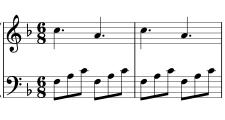 Cradle Song, Op. 117 No. 17
Cornelius Gurlitt 1 flat, 6/8, 32 bars
F major, Andantino -
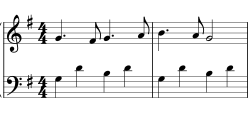 Sonatina in C, Op. 36 No. 3: II
Muzio Clementi 1 sharp, 4/4, 32 bars
G major, Un poco adagio -
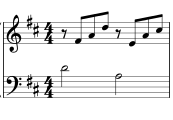 Canon in D
Johann Pachelbel 2 sharps, 4/4, 33 bars, shortened
D major -
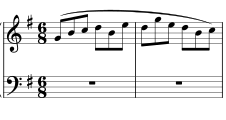 Pastorale, Op. 100 No. 3
Friedrich Burgmüller 1 sharp, 6/8, 37 bars
G major, Andantino -
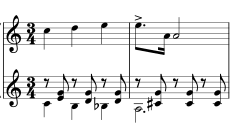 Sweet Dreams, Op. 39 No. 21
Pyotr Ilyich Tchaikovsky no sharps or flats, 3/4, 48 bars
no sharps or flats, Andante -
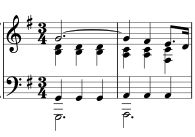 Largo (Ombra mai fu), from Serse
George Frideric Handel 1 sharp, 3/4, 52 bars
G major, Largo
Level 4
Real independence between the hands and more accidentals.
-
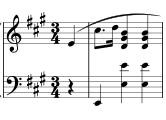 Prelude in A, Op. 28 No. 7
Frédéric Chopin 3 sharps, 3/4, 17 bars
A major, Andantino -
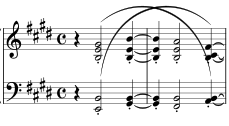 Consolation No. 1
Franz Liszt 4 sharps, 4/4, 25 bars
E major, Andante con moto -
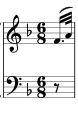 Sonatina in C, Op. 20 No. 1: Andante
Friedrich Kuhlau 1 flat, 6/8, 25 bars
F major -
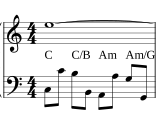 Air on the G String
Johann Sebastian Bach no sharps or flats, 4/4, 36 bars
C major -
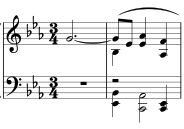 Nimrod, from the Enigma Variations
Edward Elgar 3 flats, 3/4, 44 bars
E♭ major, Adagio -
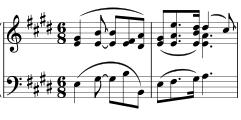 Spring Song, Op. 68 No. 15
Robert Schumann 4 sharps, 6/8, 46 bars
E major, Innig zu spielen -
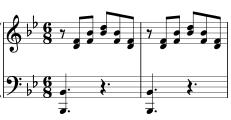 Ave Maria
Franz Schubert 2 flats, 6/8, 65 bars
B♭ major
Level 5
The edge of early intermediate: dense textures, fast passages and far keys.
-
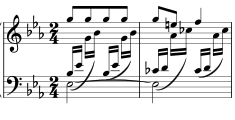 Arietta, Op. 12 No. 1
Edvard Grieg 3 flats, 2/4, 23 bars
3 flats, Poco andante e sostenuto -
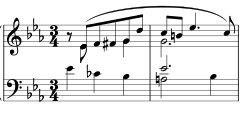 Album Leaf
Alexander Scriabin 3 flats, 3/4, 27 bars
3 flats, Andante piacevole -
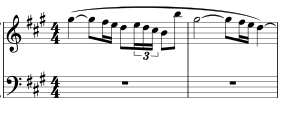 The Little Shepherd, from Children's Corner
Claude Debussy 3 sharps, 4/4, 31 bars
A major -
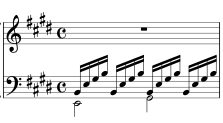 Song Without Words in E, Op. 19 No. 1
Felix Mendelssohn 4 sharps, 4/4, 62 bars
E major, Andante con moto -
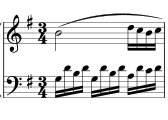 Sonata in C, K. 545: II
Wolfgang Amadeus Mozart 1 sharp, 3/4, 106 bars
G major
Open a piece to print any of its versions free, or to play it at your MIDI keyboard with every note marked. New to reading? The level 2 sight-reading exercises are a good warm-up.