Chord symbols: how to read and play them
Chord symbols are the letters printed over a tune, C, Am, G7 or C/E, each naming the chord to play under it: the root, then what kind of chord, then the bass if it isn't the root. Of the 849 pieces in Clefsight's library, 13 print them as chord symbols; in 11, the notes under them bear them out, 491 of the 640 symbols printed. Each kind is below over a short tune, with the chord in the left hand, and in two real bars where it is printed, the symbols in blue pencil.
- A letter alone: major201
- A slash chord: C/E133
- 7: the dominant seventh86
- m: minor47
- dim and °: diminished16
- m7: the minor seventh5
- aug and +: augmented3
- maj7: the major seventh0
- sus4 and sus2: suspended0
What a chord symbol says
A chord symbol names a chord in three parts. The capital letter is the root, the note the chord is built on, with a sharp or flat if it has one: F♯m is built on F♯. What follows the letter is the kind: nothing for major, m for minor, 7 for a seventh chord and so on. A letter after a slash is the bass, the lowest note.
It says which notes, not where: C is C, E and G in any octave and any order, in one hand or both. That is why lead sheets and pop and hymn books print them over a melody, leaving you to choose how to play the chord, and why classical piano music, which writes every note out, rarely does.
A letter alone: major written C
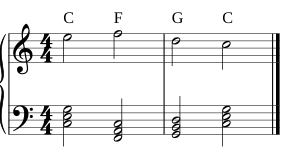
A capital letter on its own is the major chord on that note: C is C, E and G. It names the chord, not the octave or the order of its notes; how to lay them out is yours to choose.
At the keyboard: Put your thumb on the root and play every other white key up from it, root, third and fifth. On D, E and A the middle note is the black key just right of the white one.
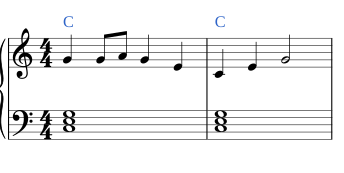
From Up on the Housetop (Hanby, level 2), bars 1 to 2, as its edition prints them with their chord symbols; the symbols of this kind in blue pencil.
Printed and borne out 201 times in 11 of the library's pieces. The easiest of them: Up on the Housetop (Hanby, level 2), Scarborough Fair (Traditional, level 3) and When the Saints Go Marching In (Traditional, level 3).
m: minor written Cm, Cmin, C-
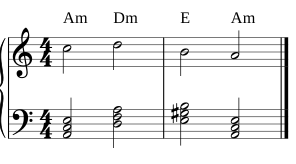
A small m after the letter makes the chord minor: the middle note a half step lower. Am is A, C and E. Some books print min or a minus sign; all mean the same.
At the keyboard: Find the major chord on the root and lower its middle note by one key. On A, D and E the minor chord is all white keys.
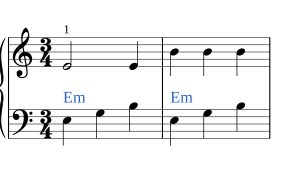
From Scarborough Fair (Traditional, level 3), bars 1 to 2, as its edition prints them with their chord symbols; the symbols of this kind in blue pencil.
Printed and borne out 47 times in 9 of the library's pieces. The easiest of them: Scarborough Fair (Traditional, level 3), Greensleeves (Traditional, level 3) and The School of Velocity, Op. 299 No. 1 (Czerny, level 3).
7: the dominant seventh written C7
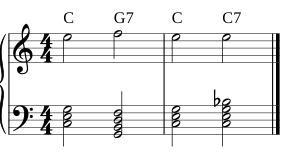
A 7 alone adds the note a whole step below the root's octave to the major chord: G7 is G, B, D and F. It is the dominant seventh, the chord that pulls a tune home, and the most common symbol after the plain letters.
At the keyboard: Play the major chord, then add the seventh: one whole step down from the root's octave. A three-note shortcut drops the fifth: root, third and seventh.
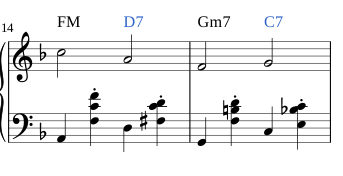
From When the Saints Go Marching In (Traditional, level 3), bars 14 to 15, as its edition prints them with their chord symbols; the symbols of this kind in blue pencil.
Printed and borne out 86 times in 8 of the library's pieces. The easiest of them: When the Saints Go Marching In (Traditional, level 3), The School of Velocity, Op. 299 No. 1 (Czerny, level 3) and Air on the G String (Bach, level 4).
maj7: the major seventh written Cmaj7, CM7, CΔ
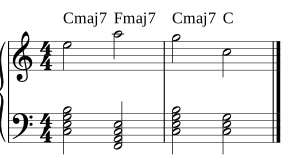
maj7 adds the note just a half step below the root's octave: Cmaj7 is C, E, G and B. The "maj" belongs to the seventh, not the chord. Some books write M7 or a small triangle.
At the keyboard: Play the major chord and add the note one key below the root's octave. A soft, open sound: it doesn't need to go anywhere.
None of the 11 library pieces whose chord symbols name their notes prints it.
m7: the minor seventh written Cm7, Cmin7, C-7
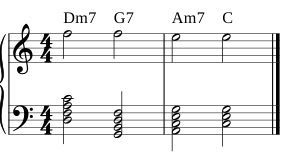
m7 is the minor chord with the note a whole step below the root's octave: Dm7 is D, F, A and C. It is the ii7 of the ii–V–I that jazz and pop lean on.
At the keyboard: Play the minor chord and add the seventh, a whole step down from the root's octave. On D, E and A it is all white keys.
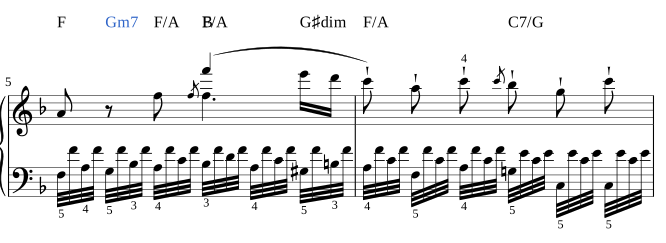
From The School of Velocity, Op. 299 No. 10 (Czerny, level 4), bars 5 to 6, as its edition prints them with their chord symbols; the symbols of this kind in blue pencil.
Printed and borne out 5 times in 1 of the library's pieces.
dim and °: diminished written Cdim, C°, C°7, Cø7
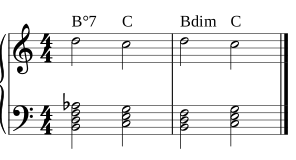
dim or a small circle makes both upper notes of the chord a half step lower than major: Bdim is B, D and F. °7 adds a fourth note a minor third higher still (B°7: B, D, F, A♭), and a circle with a slash, ø7, the minor seventh instead (Bø7: B, D, F, A).
At the keyboard: Stack two minor thirds: three keys up, then three more. The chord sits on the seventh step of a major key and leads up to the tonic.
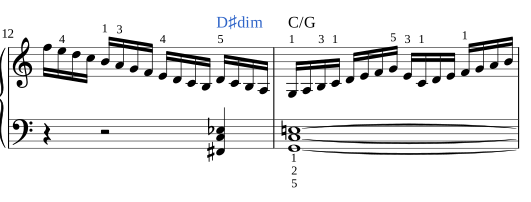
From The School of Velocity, Op. 299 No. 1 (Czerny, level 3), bars 12 to 13, as its edition prints them with their chord symbols; the symbols of this kind in blue pencil.
Printed and borne out 16 times in 6 of the library's pieces. The easiest of them: The School of Velocity, Op. 299 No. 1 (Czerny, level 3), The School of Velocity, Op. 299 No. 5 (Czerny, level 4) and The School of Velocity, Op. 299 No. 6 (Czerny, level 4).
aug and +: augmented written Caug, C+, C(#5)
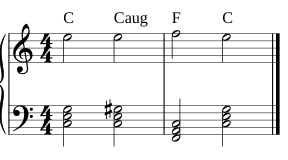
aug or a plus sign raises the top note of the major chord a half step: Caug is C, E and G♯. It sounds unsettled and stretched, and usually moves on at once, often by the raised note going up.
At the keyboard: Stack two major thirds: four keys up, then four more. Every augmented chord is made of three equal steps, so there are only four different ones.
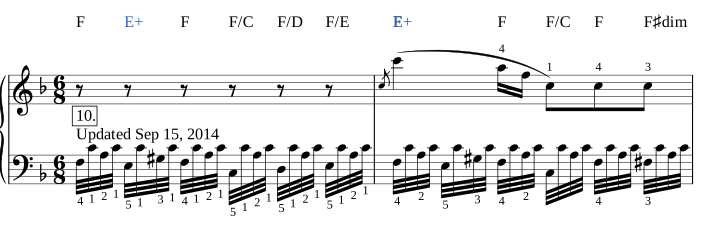
From The School of Velocity, Op. 299 No. 10 (Czerny, level 4), bars 1 to 2, as its edition prints them with their chord symbols; the symbols of this kind in blue pencil.
Printed and borne out 3 times in 1 of the library's pieces.
sus4 and sus2: suspended written Csus4, Csus2, Csus
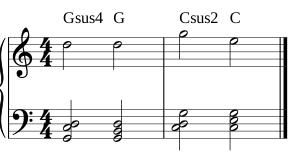
sus takes the third out and puts the fourth in its place (sus4: C, F, G) or the second (sus2: C, D, G). Without a third the chord is neither major nor minor, and a sus4 usually falls back to the plain chord.
At the keyboard: Play the major chord and move its middle note up one white key for sus4, or down a step for sus2. Then play the plain chord after it and hear the fourth resolve.
None of the 11 library pieces whose chord symbols name their notes prints it.
A slash chord: C/E written C/E, G/B, F/C
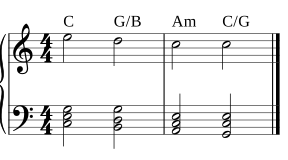
A letter after a slash is the bass note: C/E is the C chord over E, so the lowest note is E, not C. It is often an inversion of the chord, and sometimes a bass line moving under a chord that stays still.
At the keyboard: Play the slash's note low in the left hand and the chord before the slash above it, in either hand. C, C/B, Am, Am/G walks the bass down while the chord barely moves.
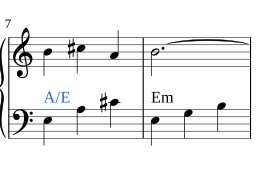
From Scarborough Fair (Traditional, level 3), bars 7 to 8, as its edition prints them with their chord symbols; the symbols of this kind in blue pencil.
Printed and borne out 133 times in 9 of the library's pieces. The easiest of them: Scarborough Fair (Traditional, level 3), When the Saints Go Marching In (Traditional, level 3) and The School of Velocity, Op. 299 No. 1 (Czerny, level 3).
How to play from a chord symbol
- Root position first. Play the chord with its root at the bottom, in the left hand under the tune: root, third and fifth, every other white key from the letter. It is the shape in every example on this page.
- Then the nearest shape. To move from one symbol to the next, keep the notes the two chords share and move the others the shortest way. C to F is C E G to C F A: one finger stays, two step up. That is an inversion, and the piano chord chart shows each.
- Or the bass alone. When the chord is too much at first, play only the root (or, for a slash chord, the note after the slash) low in the left hand on the first beat. The melody and the bass already outline the harmony.
- Then a pattern. Once the shapes come easily, break them: the root then the chord (the waltz bass in 3/4), or the notes one at a time. Every pattern is in left-hand patterns.
The library's pieces with chord symbols
13 of the library's pieces print chord symbols. A symbol is counted only where the notes sounding under it, until the next symbol or the bar line, hold its root and its third (a sus chord's second or fourth, and a slash chord's bass as the lowest note), since some uploads use chord symbols to spell out note names or words. 491 of the 640 symbols printed (77%) are borne out that way, in 11 pieces. A sixth, a ninth or another kind not on this page is printed but not counted. These are the pieces, easiest first, with how many of their symbols are borne out:
- Up on the Housetop (Hanby, level 2) 17 of 18
- Scarborough Fair (Traditional, level 3) 18 of 18
- When the Saints Go Marching In (Traditional, level 3) 7 of 14
- Greensleeves (Traditional, level 3) 19 of 19
- The School of Velocity, Op. 299 No. 1 (Czerny, level 3) 14 of 14
- Air on the G String (Bach, level 4) 37 of 84
- The School of Velocity, Op. 299 No. 5 (Czerny, level 4) 73 of 75
- The School of Velocity, Op. 299 No. 6 (Czerny, level 4) 34 of 36
- The School of Velocity, Op. 299 No. 9 (Czerny, level 4) 88 of 102
- The School of Velocity, Op. 299 No. 8 (Czerny, level 4) 92 of 106
- The School of Velocity, Op. 299 No. 10 (Czerny, level 4) 92 of 124
Why Clefsight leaves them off
Clefsight's stand prints every piece's notes and leaves its chord symbols off. Many uploads print chord symbols that spell out the melody's note names, and a page with the names written over it is read by the letters, not the notes. The pieces above play the chords the symbols name in their written notes, so you read the chord itself: its notes on the staff, which this page and the chord reading game teach you to name.
Name chords at sight. The chord reading game shows a triad on the staff and you name it, root and kind, the way a chord symbol would. At a MIDI keyboard or on the keys on screen.
Play the chord reading gameMore on chords: how to read chords, the piano chord chart, seventh chords for the 7, maj7 and m7, chord progressions for the runs of symbols music returns to, and left-hand patterns for how the left hand plays them.