Chord progressions: the chord patterns piano music is built on
A chord progression is a run of chords that music returns to again and again, so a reader who knows it can name the next chord before reaching it. Clefsight read the chords of its library's 788 pieces in a known key, beat by beat: 33% of them play at least one of the six progressions below, and ii–V–I is the most common, in 190 pieces. Each one is below in C major, as it sounds, and in real bars with its chords in blue pencil.
Why a reader learns them
Numerals name a chord by the step of the scale it is built on: I is the tonic chord, IV the chord on the fourth step, V the dominant, and a lower-case numeral (ii, iii, vi) a minor chord. Named that way, a progression is the same in every key: I–IV–V–I is C, F, G, C in C major and G, C, D, G in G major.
Reading music, you rarely have time to spell out a chord note by note. If you know which progression a phrase is following, the bass note is enough to tell you the whole chord, and your eyes are free to read ahead. In a minor key the same steps give minor chords where major ones stood, i–iv–V–i, written beside each example.
I–IV–V–I the three main chords of a key
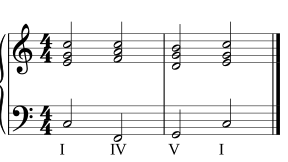
How it sounds: Home, a step away, tension, home again. The tonic, subdominant and dominant are the three chords that harmonise most simple tunes, and this order is the plainest way to say a key.
How to see it: In the bass, C, F, G, C in C major: up a fourth, up a step, then down a fifth home. The right hand barely moves: the tonic's top note stays for the IV chord, and the V chord sits a step lower.
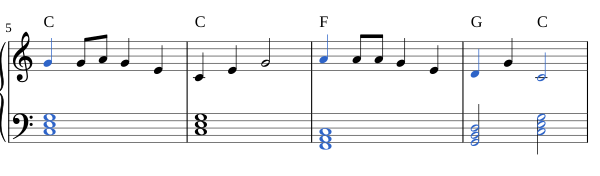
From Up on the Housetop (Hanby, level 2), bars 5 to 8, as its edition prints them; the chords in blue pencil.
Played 139 times in 87 pieces. Most often in For the Beauty of the Earth (Kocher, level 3), Jesu, Joy of Man's Desiring (Bach, level 4) and Gavotte, Op. 117 No. 31 (Gurlitt, level 3).
I–V–vi–IV the four chords of countless pop songs
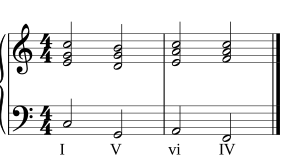
How it sounds: Bright, then a turn to the minor chord on the sixth step, then the warm IV that leads back to the start. Played over and over, it carries a whole song.
How to see it: In the bass, C, G, A, F in C major: down a fourth, up a step, down a third. The vi chord is the tonic chord with its top note raised a step, so the right hand moves one finger.
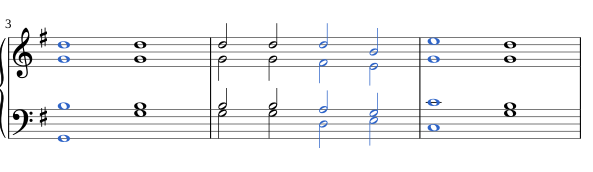
From Old Hundredth (Bourgeois, level 3), bars 3 to 5, as its edition prints them; the chords in blue pencil.
Played 18 times in 15 pieces. Most often in Jesus, Keep Me Near the Cross (Doane, level 3), Lo, How a Rose E'er Blooming (Traditional, level 3) and Song Without Words in E flat, Op. 30 No. 1 (Mendelssohn, level 5).
I–vi–IV–V the 1950s progression, the chords of Heart and Soul
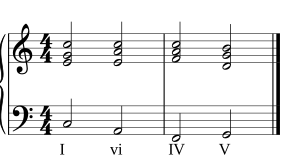
How it sounds: A loop that never settles: the last chord, V, pulls straight back to I, so it goes round again.
How to see it: In the bass, C, A, F, G in C major: down a third, down a third, up a step. Two falling thirds then a step up are the shape to look for.
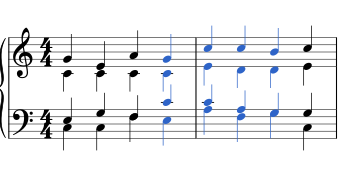
From O God, Our Help in Ages Past (Croft, level 3), bars 1 to 2, as its edition prints them; the chords in blue pencil.
Played 16 times in 12 pieces. Most often in Good King Wenceslas (Traditional, level 3), Hunting Song, Op. 68 No. 7 (Schumann, level 3) and Polka, Op. 39 No. 14 (Tchaikovsky, level 4).
ii–V–I the two-five-one
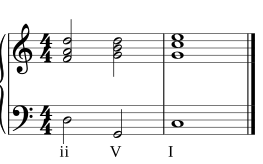
How it sounds: Arriving home with a run-up: the minor chord on the second step leads to the dominant, and the dominant to the tonic. Classical phrases end this way as often as jazz tunes do.
How to see it: In the bass, D, G, C in C major: each root a fifth below the last. The ii chord often comes with its third in the bass, F under A and D, so the bass climbs F, G, C instead.
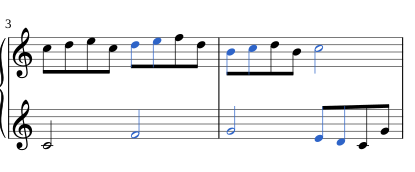
From Study in C, Op. 101 No. 51 (Beyer, level 2), bars 3 to 4, as its edition prints them; the chords in blue pencil.
Played 385 times in 190 pieces. Most often in Pathétique Sonata: II (Beethoven, level 6), Melody, Op. 68 No. 1 (Schumann, level 3) and Sonata in C, K. 330: III (Mozart, level 6).
vi–ii–V–I a circle-of-fifths progression
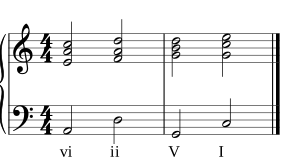
How it sounds: A chain of chords falling towards home, each one pulling to the next. It sounds inevitable, which is why so many pieces use it to close a phrase.
How to see it: In the bass, A, D, G, C in C major: each root a fifth below the last (or a fourth above it), round the circle of fifths. Once you see two such steps in the bass, the next chord can be read before you get there.
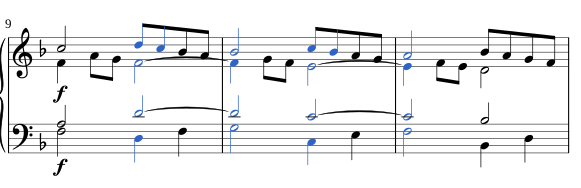
From Angels We Have Heard on High (Traditional, level 3), bars 9 to 11, as its edition prints them; the chords in blue pencil.
Played 68 times in 39 pieces. Most often in Sonata in C, K. 545: III (Mozart, level 5), The Virtuoso Pianist, No. 38 (Hanon, level 3) and An Important Event, from Kinderszenen (Schumann, level 4).
I–V–vi–iii–IV–I–IV–V the Canon progression, after Pachelbel's Canon in D
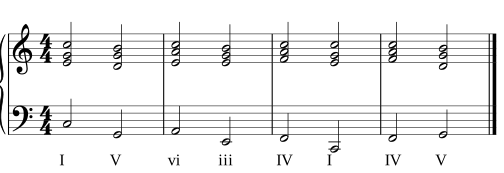
How it sounds: Eight chords over a bass that walks down and back: calm and endless, since its last chord leads straight back to its first. Pachelbel repeats it 28 times under his Canon.
How to see it: In the bass, C, G, A, E, F, C, F, G in C major: down a fourth, up a step, again down a fourth and up a step, then up to the dominant. The bass alone tells you the chords.
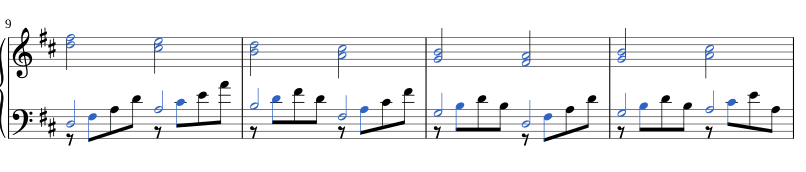
From Canon in D (Pachelbel, level 3), bars 9 to 12, as its edition prints them; the chords in blue pencil.
Played 3 times in 1 pieces.
How Clefsight read them
On each beat where the bass plays a new note, the chord is the notes sounding over that beat, named by the note whose third and fifth sound with it, then read in the piece's home key. A chord held over several beats counts once. A progression is counted where its chords follow one another in that order, each with the right root and the right major or minor third; the last chord of one can start the next.
That reads 43,786 chords in 788 pieces. It leaves out a piece whose key signature doesn't say whether it is major or minor, bars in another key signature, chords that change between the bass's notes, and beats with no third (a bare fifth, an octave or a single line), which break a run rather than join two. So a progression passed through a new key, or written in single lines, isn't counted.
Name the chords as fast as you see them. The chord reading game shows a triad on the staff and asks for its name, then its inversion: the reading these progressions rest on.
Play the chord reading gameMore on chords: how to read chords, the piano chord chart, cadences for the two chords that end a phrase, left-hand patterns for how the left hand plays them, the circle of fifths for the roots of vi–ii–V–I, seventh chords for the V7 and ii7 these runs often use, and chord symbols for the letters a lead sheet prints for them.