Learn to read music · Hands together
Left-hand piano patterns: Alberti bass, broken chords, waltz bass
Under most tunes the left hand repeats a shape: a chord struck together, the same chord broken into single notes, a bass note and two chords. Learn to see the shape and you read a bar of left hand at a glance instead of note by note. Clefsight read the left hand of all 844 pieces in its library bar by bar: 20,906 bars take one of the seven patterns below, and 165 pieces keep one pattern in three bars out of four or more. Each pattern has two bars of our own, how to read and practise it, and two real bars where a library piece plays it, the left hand in blue pencil.
- Block chords7,359
- A moving bass line3,473
- Broken chords3,447
- Octaves and open fifths2,061
- Waltz bass (oom-pah)2,011
- Long bass notes1,697
- Alberti bass858
How to read the left hand by its pattern
The left hand usually plays the harmony under the right hand's tune, and harmony comes in chords. So most left-hand bars are one chord, played in one of a few ways: held as a long note, struck together, spread out one note at a time, or split into a low bass note and the chord above it.
Read the first bar note by note, then look at the shape of the next: if the noteheads make the same pattern, only the chord has moved. Name the chord by its lowest note and read the rest as the shape. Most chord changes move a note or two by a step and leave the others where they were.
Practise a new pattern as block chords first: play each bar's notes together, so your hand learns the shapes and the moves between them. Then play the pattern as written, slowly, with the hand staying over the chord.
Long bass notes one or two long notes a bar, often the chord's root
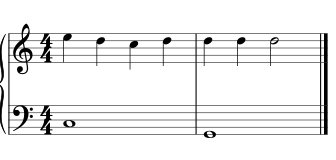
The left hand plays a single low note and holds it, a half or a whole note, while the right hand has the tune. It is where most first pieces start the left hand: one note to read a bar, usually the root of the chord the tune sits on.
How to play it: Find the note before the bar starts and keep it down for its whole value while the right hand moves. Read it as a landmark: C, F or G at the bottom of the bass staff, then the next one by its step or leap from it.
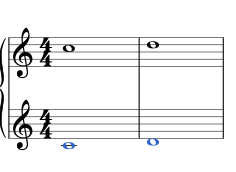
From Exercise Piece in C, Op. 190 No. 1 (Köhler, level 2), bars 1 to 2, as its edition prints them; the left hand in blue pencil.
361 of the 844 pieces play it, in 1,697 bars in all. The easiest of them: Exercise Piece in C, Op. 190 No. 1 (Köhler, level 2), Exercise Piece in C, Op. 190 No. 19 (Köhler, level 2) and Exercise Piece in C, Op. 190 No. 2 (Köhler, level 2).
Block chords two or more notes stacked on one stem, struck together
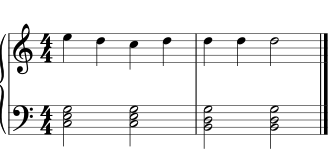
The left hand strikes the notes of a chord together, once or a few times a bar. Hymns, chorales, marches and many arrangements are written this way. The chord changes by the smallest move it can, so one or two notes often stay where they were.
How to play it: Read the chord from the bottom note up, by its shape: three notes on lines or three on spaces is a triad in root position. Then look for what stays: a note that is the same in the next chord is a finger that doesn't move.
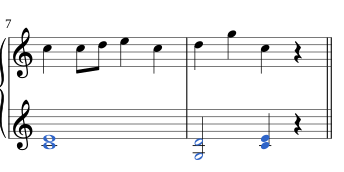
From Piece in C, Op. 117 No. 8 (Gurlitt, level 2), bars 7 to 8, as its edition prints them; the left hand in blue pencil.
563 of the 844 pieces play it, in 7,359 bars in all. The easiest of them: Exercise Piece in C, Op. 190 No. 7 (Köhler, level 2), Piece in C, Op. 117 No. 4 (Gurlitt, level 2) and Exercise Piece in C, Op. 190 No. 6 (Köhler, level 2).
Octaves and open fifths two notes struck together, eight or five notes apart
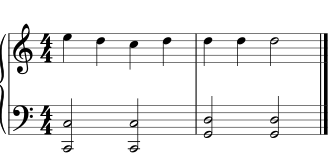
The left hand plays the bass with its octave, or the bass and the fifth above it, struck together. Octaves make the bass louder and fuller; an open fifth held or repeated is a drone, the sound of bagpipes and musettes.
How to play it: Keep the hand in the shape of the interval, thumb on the top note and fifth finger on the bottom, and move the whole hand from note to note. Read only the bottom note: the shape gives the top one.
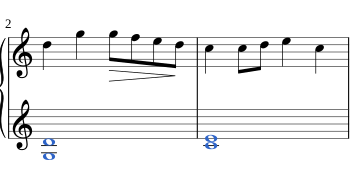
From Piece in C, Op. 117 No. 8 (Gurlitt, level 2), bars 2 to 3, as its edition prints them; the left hand in blue pencil.
341 of the 844 pieces play it, in 2,061 bars in all. The easiest of them: Exercise Piece in C, Op. 190 No. 21 (Köhler, level 2), Piece in C, Op. 117 No. 8 (Gurlitt, level 2) and Piece in C, Op. 117 No. 10 (Gurlitt, level 2).
A moving bass line single notes walking by step
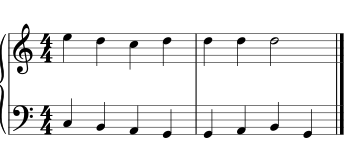
The left hand has a melody of its own, moving mostly by step under the tune: a walking bass in a minuet, the lower line of a Bach piece, a scale run in the bass. It is two tunes at once, one in each hand.
How to play it: Learn the bass line alone first, with its fingering, until it sings as a tune. Then put the hands together slowly and listen to both lines, not only the top one.
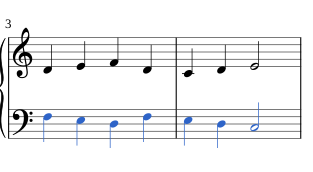
From Exercise Piece in C, Op. 190 No. 23 (Köhler, level 2), bars 3 to 4, as its edition prints them; the left hand in blue pencil.
401 of the 844 pieces play it, in 3,473 bars in all. The easiest of them: Exercise Piece in C, Op. 190 No. 23 (Köhler, level 2), Piece in C, Op. 117 No. 2 (Gurlitt, level 2) and Old German Dance (Praetorius, level 2).
Waltz bass (oom-pah) a low note on the beat, then chords above it
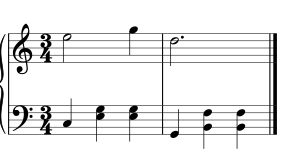
A single low note on the first beat and a chord above it on each of the other beats: oom-pah-pah in a waltz in 3/4, oom-pah in a march or polka in 2/4. The hand jumps down to the bass and back up to the chord every bar.
How to play it: Practise the jump alone: bass note, chord, chord, without looking down. The chord usually stays in one place for several bars while the bass note changes, so keep the upper fingers over it and let the fifth finger reach.
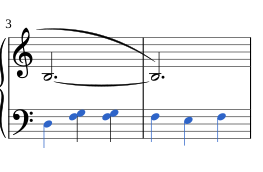
From Carousel Waltz (Gobbaerts, level 2), bars 3 to 4, as its edition prints them; the left hand in blue pencil.
114 of the 844 pieces play it, in 2,011 bars in all. The easiest of them: The Blue Danube (theme) (Strauss, level 2), Carousel Waltz (Gobbaerts, level 2) and Happy Birthday to You (Hill, level 2).
Broken chords a chord's notes one at a time, leaping up or down
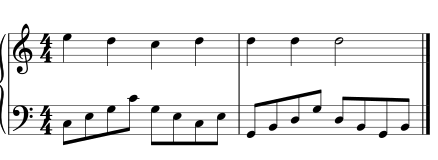
The notes of a chord played one after another instead of together, often in a steady run of eighths: up the chord and down again, or over two octaves. The page shows leaps between the notes, and the notes of a bar all belong to one chord.
How to play it: Read the bar as the chord it spells: find the block chord first, play it together, then play it broken. The hand's shape stays the same as the block chord; only the fingers take turns.
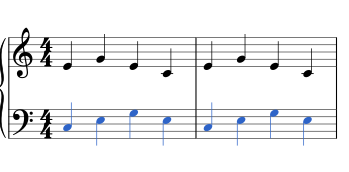
From Exercise Piece in C, Op. 190 No. 23 (Köhler, level 2), bars 1 to 2, as its edition prints them; the left hand in blue pencil.
369 of the 844 pieces play it, in 3,447 bars in all. The easiest of them: Exercise Piece in C, Op. 190 No. 23 (Köhler, level 2), Exercise Piece in C, Op. 190 No. 4 (Köhler, level 2) and Exercise Piece in C, Op. 190 No. 8 (Köhler, level 2).
Alberti bass low, high, middle, high, over and over
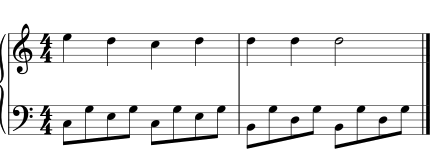
A broken chord in a fixed order, lowest note, highest, middle, highest, repeated in even notes: the bass of Classical sonatinas and sonatas, Clementi's, Mozart's and Haydn's. It is named after Domenico Alberti, who used it so often.
How to play it: Keep the hand still over the chord, fingers 5, 1, 3, 1 on C, G, E, G, and let the thumb's repeated note be the lightest. Practise it as a block chord first; when the chord changes, the hand changes shape all at once.
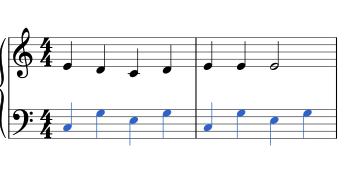
From Mary Had a Little Lamb (Traditional, level 2), bars 1 to 2, as its edition prints them; the left hand in blue pencil.
101 of the 844 pieces play it, in 858 bars in all. The easiest of them: Mary Had a Little Lamb (Traditional, level 2), Study, Op. 101 No. 38 (Beyer, level 2) and Study, Op. 101 No. 61 (Beyer, level 2).
Left-hand patterns level by level
Of each level's bars that take a pattern, the share in each one; the commonest at each level is in blue pencil. Long notes and block chords come first, then the hand starts to move.
| Level | Pieces | Long notes | Chords | Octaves | Bass line | Waltz bass | Broken | Alberti |
|---|---|---|---|---|---|---|---|---|
| Level 2 | 105 | 30% | 21% | 4% | 15% | 4% | 19% | 8% |
| Level 3 | 452 | 8% | 39% | 8% | 19% | 7% | 15% | 4% |
| Level 4 | 207 | 5% | 35% | 13% | 15% | 13% | 16% | 2% |
| Level 5 | 61 | 5% | 35% | 15% | 14% | 8% | 18% | 4% |
| Level 6 | 15 | 6% | 21% | 2% | 16% | 23% | 23% | 9% |
| Level 7 | 4 | 4% | 50% | 6% | 5% | 5% | 31% | – |
How Clefsight reads a bar
Every bar of the lower staff is read by the notes struck in it, all voices together, with tied notes counted once. Single notes in fours of low, high, middle, high are an Alberti bass; one low note and then two or more chords above it are a waltz bass; single notes that only leap, over a fifth or more on no more than four notes, are a broken chord; single notes that mostly move by step are a bass line. Every strike two notes an octave or a fifth apart are octaves and fifths, every strike two notes or more is block chords, and one or two single notes of half the bar or more are long bass notes.
A bar that mixes two patterns, or plays something else, such as a scale with a chord at its end, is left out. Clefsight grades every note of the left hand as it grades the right: the key and when you strike it, against your own steady beat.
Try the Alberti bass at the keyboard. The easiest library piece that plays it is Mary Had a Little Lamb (Traditional, level 2). Play the left hand alone first, then together in Wait.
Play itWhere a hand travels, the leaps and the crossings, and how to practise them: hand crossing and leaps.
More on the left hand: playing with both hands, the piano chord chart for the block chords, the piano arpeggios chart for the broken ones, reading the bass clef and two voices on one staff.