Learn to read music · Hands together
Hand crossing and leaps on the piano: how to read where a hand travels
A hand doesn't always stay in one place: it leaps to a note an octave or more away, crosses over the other hand, or plays notes printed on the other hand's staff. Of the 844 pieces in Clefsight's library, 668 have a leap of an octave or more in one hand and 51 cross the hands. Each way a hand travels is below with two bars of our own, how to read and practise it, and two real bars where a library piece asks it, the travelling notes in blue pencil.
- Leaps in the left hand619
- Leaps in the right hand491
- A hand on the other staff147
- The left hand crossing over the right38
- The right hand crossing over the left33
How to read where a hand travels
A leap is a jump of an octave or more between one note or chord and the next in the same hand; a crossing is one hand passing over the other to play above or below it. On the page a leap is a wide gap between notes, often with ledger lines at one end, and a crossing is a note printed on the other staff or far from the rest of its hand's notes, often marked l.h. or r.h. (in Italian m.s. and m.d.).
Look ahead for them. Before a bar with a leap, find the landing note first and work out its distance from where the hand is: an octave, an octave and a third. Before a crossing, read which hand takes each note from its stem and the marks over it, not only from the staff it is on.
Then practise the move on its own: the note before it and the note after it, slowly and without looking down, until the arm knows the distance. Most leaps are missed because the hand leaves too late, not because it goes the wrong way.
Leaps in the left hand an octave or more from one note or chord to the next
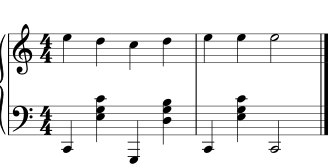
The left hand jumps from a low bass note to a chord in the middle of the keyboard and back, an octave or more each time: the waltz and march bass, and the stride bass of ragtime. On the page the bass note sits on or under the bass staff and the chord near the top of it, so the eye jumps as far as the hand.
How to play it: Practise the jump alone, slowly, without looking down: feel the distance with the arm, not the fingers. Move early: leave the bass note a little before the chord is due, and land on the chord's nearest finger first. Look at the music, not the keys, and let the ear tell you where you landed.
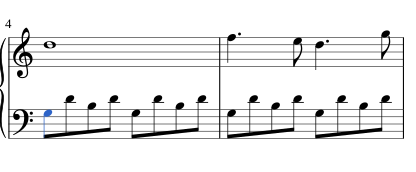
From Study in C, Op. 101 No. 55 (Beyer, level 2), bars 4 to 5, as its edition prints them; the notes that travel in blue pencil.
619 of the 844 pieces ask it, in 8,580 bars in all. The easiest of them: Twinkle, Twinkle, Little Star (Traditional, level 2), Study in C, Op. 101 No. 53 (Beyer, level 2) and Study in C, Op. 101 No. 54 (Beyer, level 2).
Leaps in the right hand the tune jumping an octave or more
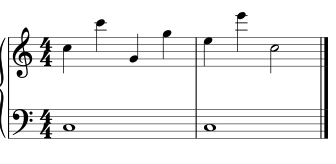
The right hand leaps an octave or more between notes: a tune that answers itself an octave higher, a run that ends on a high note, or a melody that skips between two registers. The notes sit far apart on the treble staff, often with ledger lines above.
How to play it: Read the leap as an interval, not two notes: count the octave from the note you are on, and find the landing note before you leave. Keep the hand loose and move it in one throw from the elbow; a leap played tight lands late.
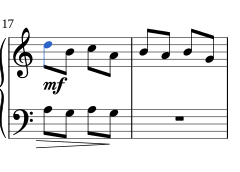
From For Children No. 4 (Bartók, level 2), bars 17 to 18, as its edition prints them; the notes that travel in blue pencil.
491 of the 844 pieces ask it, in 3,226 bars in all. The easiest of them: Study, Op. 101 No. 61 (Beyer, level 2), Study, Op. 101 No. 56 (Beyer, level 2) and Study in C, Op. 101 No. 54 (Beyer, level 2).
The left hand crossing over the right a left-hand note above everything the right hand is holding
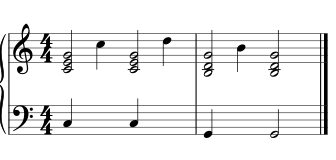
The right hand keeps a chord or a figure in the middle while the left hand crosses over it to play a note higher up, often a tune note or a bell. Editions print the crossing note on the treble staff, with its stem pointing down or with l.h. or m.s. (mano sinistra) over it.
How to play it: Let the right hand stay low and still, and bring the left hand over it in an arc, not across the keys. Read the stem and the l.h. mark before the bar starts, so you know which hand takes each note. Practise the crossing note on its own until the arm knows the distance.
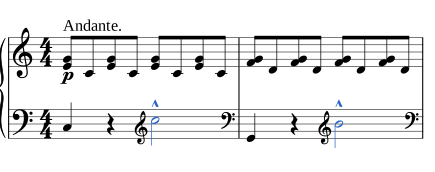
From Study in C, Op. 63 No. 6 (Gobbaerts, level 3), bars 1 to 2, as its edition prints them; the notes that travel in blue pencil.
38 of the 844 pieces ask it, in 157 bars in all. The easiest of them: Study in C, Op. 63 No. 6 (Gobbaerts, level 3), For Children No. 7 (Bartók, level 3) and Sailor's Song, Op. 68 No. 1 (Grieg, level 3).
The right hand crossing over the left a right-hand note below everything the left hand is holding
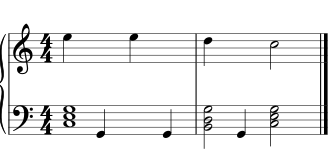
The left hand holds a chord or keeps a figure going while the right hand crosses over it into the bass, for a low note, a bass line answered from above, or a run that falls through both hands. The crossing note is printed on the bass staff, often with r.h. or m.d. (mano destra) over it.
How to play it: As in a crossing the other way: the hand underneath stays where it is and the crossing hand goes over it in an arc. Keep the left hand's fingers down and close to the keys so there is room above them, and look ahead for the r.h. mark.
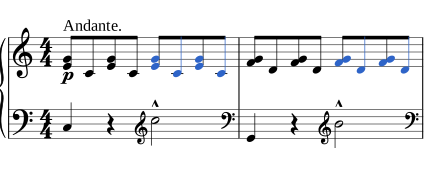
From Study in C, Op. 63 No. 6 (Gobbaerts, level 3), bars 1 to 2, as its edition prints them; the notes that travel in blue pencil.
33 of the 844 pieces ask it, in 155 bars in all. The easiest of them: Study in C, Op. 63 No. 6 (Gobbaerts, level 3), The Swallow, Op. 100 No. 24 (Burgmüller, level 3) and Harvest Song, Op. 68 No. 24 (Schumann, level 3).
A hand on the other staff notes printed on the staff the other hand usually reads
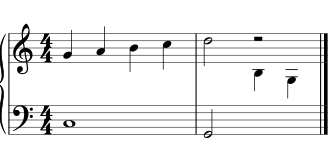
Not every note on the treble staff is for the right hand. Where one hand takes over the tune, fills in a chord or plays in the other hand's register, editions print its notes on the other staff so they read as one line, with the stems or l.h. and r.h. marks saying which hand plays them.
How to play it: Before you play a bar, read the stems and marks, not only the staff: notes stemmed down on the treble staff in a piece where the right hand's stems go up are often the left hand's. Pencil l.h. or r.h. over them the first time through.
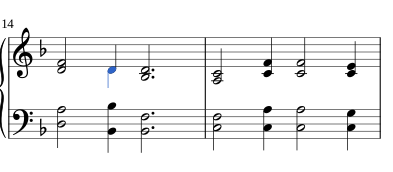
From Jesus, Keep Me Near the Cross (Doane, level 3), bars 14 to 15, as its edition prints them; the notes that travel in blue pencil.
147 of the 844 pieces ask it, in 1,924 bars in all. The easiest of them: Jesus, Keep Me Near the Cross (Doane, level 3), Morning Walk, Op. 123 No. 1 (Gretchaninov, level 3) and The Tin Soldiers Marching, Op. 98 No. 3 (Gretchaninov, level 3).
Leaps and crossings level by level
Of each level's bars, the share that ask each. Leaps come early, in the waltz and march basses of the first levels; crossings stay rare at every level.
| Level | Pieces | Left leaps | Right leaps | Left over | Right over | Other staff |
|---|---|---|---|---|---|---|
| Level 2 | 105 | 4% | 2% | – | – | – |
| Level 3 | 452 | 16% | 7% | – | – | 3% |
| Level 4 | 207 | 36% | 12% | 1% | 1% | 9% |
| Level 5 | 61 | 39% | 14% | 1% | 1% | 12% |
| Level 6 | 15 | 33% | 16% | – | 1% | 4% |
| Level 7 | 4 | 27% | 23% | 2% | 2% | 1% |
The widest leap the library's right hand makes is 46 half steps, in Notturno, Op. 54 No. 4 (Grieg, level 5); the left hand's is 56, in To Spring, Op. 43 No. 6 (Grieg, level 5). An octave is 12.
What Clefsight grades in a leap or a crossing
A MIDI keyboard says which key went down and when, not which hand pressed it, so Clefsight grades the notes and their timing and leaves the choice of hand to you. A leap that lands on the wrong key shows as a wrong note in red; one that lands late, as a late note in blue.
In the learning ladder's one-hand steps Clefsight takes each staff as a hand, so notes printed on the other staff come with the staff they are on. Practise a crossing with both hands together in Wait, where the music waits for each note, then at a slow steady tempo.
Try a crossing at the keyboard. The easiest library piece that crosses the hands is Study in C, Op. 63 No. 6 (Gobbaerts, level 3). Find the crossing bars first, then play them in Wait.
Play itMore on the hands: playing with both hands, left-hand patterns for the waltz and stride basses, piano finger numbers, ledger lines for the notes far above and below the staff, and 8va and clef changes.