Learn to read music · Ledger lines
8va, 8vb and clef changes: where the notes really are
Some signs move the notes away from where they are printed: an 8va line sends them an octave up, and a clef change puts one hand's staff in the other clef. Of the 842 pieces in Clefsight's library, 305 change clef in one hand and 43 print an 8va line; none prints 8vb, 15ma, 15mb and treble clef with an 8. Each sign is below printed with the sign and without it, where it sends your hand, and two real bars where it is printed, the sign in blue pencil.
- Treble clef in the left hand254
- Bass clef in the right hand103
- 8va43
- 8vb0
- 15ma0
- 15mb0
- Treble clef with an 80
Why music moves the notes
A staff holds about an octave and a half. Above or below it, notes need ledger lines, and past three or four they are slow to read. So editions either shift the notes an octave with an 8va or 8vb line, or switch the staff to the other clef, and the notes sit back on the staff where they are quick to read.
Neither changes the music: only how it is written. Read the sign first, then the notes, and put your hand where the notes sound.
8va 8va or 8 and a dotted line over the notes
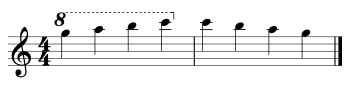
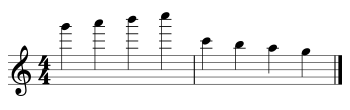
Play the notes under the dotted line an octave higher than written. It saves a run of ledger lines above the treble staff. Where the line ends, or at the word loco (in place), play where the notes are written again.
Where it sends you: an octave up: a G5 as printed is played as G6.
How to play it: Read the notes as you would, then move the hand up eight white keys before you play them. Look ahead to where the line ends: the hand comes back down as the line stops.
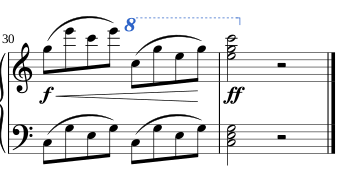
From Elementary Study, Op. 176 No. 4 (Duvernoy, level 2), bars 30 to 31, as its edition prints them; the sign in blue pencil.
Printed in 43 of the 842 pieces, 100 times in all. The easiest of them: Elementary Study, Op. 176 No. 4 (Duvernoy, level 2), Elementary Study, Op. 176 No. 10 (Duvernoy, level 3) and Elementary Study, Op. 176 No. 18 (Duvernoy, level 3).
8vb 8vb, 8va bassa or 8 and a dotted line under the notes
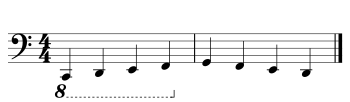
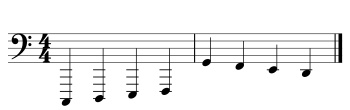
Play the notes over the dotted line an octave lower than written, deep in the bass. A line marked 8 alone under the bass staff, or the words con 8, can also ask for octaves: the written note and the one below together.
Where it sends you: an octave down: a C2 as printed is played as C1.
How to play it: Read the notes, then move the hand down eight white keys. The lowest A, B and C of the keyboard are often written this way.
None of the library's 842 pieces prints it.
15ma 15ma or 15 and a dotted line over the notes
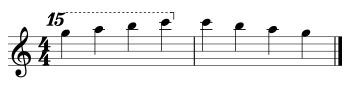
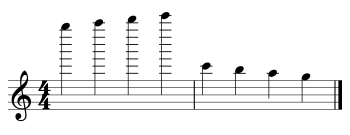
Play two octaves higher than written: the top of the keyboard, where even 8va would need ledger lines.
Where it sends you: two octaves up: a G5 as printed is played as G7.
How to play it: Move the hand up two octaves, fifteen white keys counting both ends. Find the top C first: the highest key of a full keyboard is a C.
None of the library's 842 pieces prints it.
15mb 15mb or 15 and a dotted line under the notes
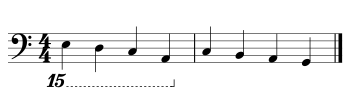
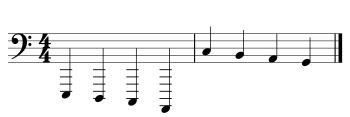
Play two octaves lower than written, at the very bottom of the keyboard. It is rare in piano music.
Where it sends you: two octaves down: a E3 as printed is played as E1.
How to play it: Move the hand down two octaves. The lowest key of a full keyboard is the A below the lowest C.
None of the library's 842 pieces prints it.
Treble clef with an 8 a treble clef with a small 8 below it
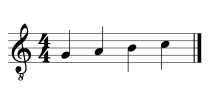
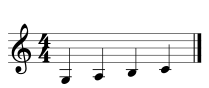
The treble clef an octave lower: every note sounds an octave below where the plain treble clef would put it. It is the tenor's clef in hymn books and vocal scores; in piano music, play it as written an octave down.
Where it sends you: an octave down: a G4 as printed is played as G3.
How to play it: Read the treble clef as usual and play each note an octave lower, around and below middle C.
None of the library's 842 pieces prints it.
Treble clef in the left hand a small treble clef in the lower staff
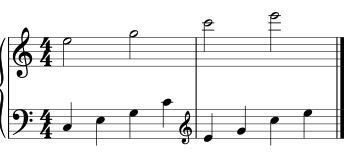
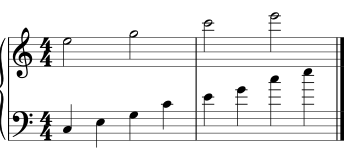
The left hand's music has climbed above middle C, so the lower staff switches to the treble clef rather than pile ledger lines above the bass staff. From the new clef on, read that staff as treble until the bass clef comes back.
How to play it: Watch the clef at the start of every line and every small clef in the bar: the notes on the lower staff now read like the right hand's. The left hand stays the left hand; only how its notes are written changes.
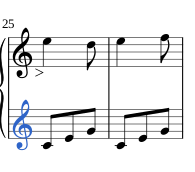
From Study in C, Op. 101 No. 59 (Beyer, level 2), bars 25 to 26, as its edition prints them; the sign in blue pencil.
Printed in 254 of the 842 pieces, 816 times in all. The easiest of them: Study in C, Op. 101 No. 59 (Beyer, level 2), Study in C, Op. 101 No. 55 (Beyer, level 2) and Study in C, Op. 101 No. 62 (Beyer, level 2).
Bass clef in the right hand a small bass clef in the upper staff
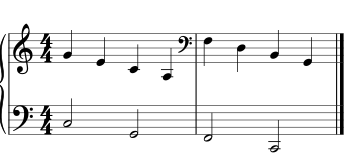
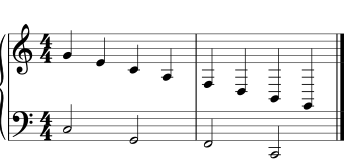
The right hand has gone below middle C, so the upper staff switches to the bass clef. Both staves then read in bass clef until the treble clef returns.
How to play it: Read the upper staff in bass clef from the change on. A small clef just before a bar line is a warning: the change is there for the bar after it.
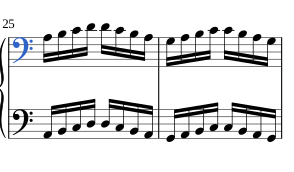
From The Virtuoso Pianist, No. 34 (Hanon, level 3), bars 25 to 26, as its edition prints them; the sign in blue pencil.
Printed in 103 of the 842 pieces, 234 times in all. The easiest of them: The Virtuoso Pianist, No. 34 (Hanon, level 3), Sonatina in G, Op. 36 No. 2: II (Clementi, level 3) and The Virtuoso Pianist, No. 13 (Hanon, level 3).
Octave signs and clef changes level by level
How many of the library's pieces at each level change clef in one hand, and how many print an 8va line. Clef changes grow level by level as the hands range further from middle C; octave lines stay rare until the hardest pieces.
What Clefsight plays and grades
Clefsight follows every note where it sounds. Under an 8va line it expects the keys an octave up, and after a clef change it reads the staff in its new clef, so the keys it waits for are the ones the music means, not the ones the notes would be without the sign.
Played where the note is printed, ignoring the sign, the note is an octave off: the take marks it as the right note in the wrong octave, so you can see what happened.
Read past the staff. The notes these signs replace are on ledger lines; a short drill of ledger-line notes makes both quicker to read, at a MIDI keyboard or on the keys on screen.
Drill ledger linesMore on the page: ledger lines, the grand staff and how both clefs meet at middle C, music symbols and what they mean, and the piano notes chart.