Ferdinand Beyer (1806–1863)
Study in C, Op. 101 No. 59
From Beyer's Vorschule im Klavierspiel, Op. 101 (1850), a first book for young beginners
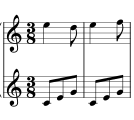
How hard is Study in C, Op. 101 No. 59 (Beyer)? Level 2 of 7 on our scale. A tune over a simple left hand, mostly in one hand position.
Op. 101 No. 59: its opus number, by which the composer's published works are numbered.
Plays on a MIDI keyboard in Chrome, Edge or Firefox on a computer, or Chrome on an Android phone or tablet, or on the keys on screen without one.
More about Study in C, Op. 101 No. 59
No. 59 in Beyer's Vorschule im Klavierspiel, Op. 101
No speed is printed on this score. Clefsight plays it at 77 dotted quarters a minute: the middle of the speeds usually given for Allegretto (fairly quick and light, a little under allegro), taken at two thirds of that speed, since those speeds count quarter notes and this piece is counted in dotted quarters, a longer beat. The “Plays in” time above is worked out at this speed.
What stands between you and this piece
Clefsight compares the notes of this piece with what you already read. Take the level test and this page will list what's left to learn, item by item.
Versions
Each simpler version only leaves notes out and adds none, so every note in it is the piece's own. Print any of them free.
- As written155 notes
- Melody and left-hand roots103 notes
- Right-hand melody71 notes
To practise it on paper: a practice chart for this piece, a week of steps from each hand alone to full tempo, with their speeds.
What it asks of you
- Treble clef from B3 to G5, with ledger lines
- Bass clef from G3 to G4, with ledger lines
- No key signature to keep in mind
- Rhythm: quarter notes, eighth notes, dotted quarter notes
- Intervals: 3rds (skips), 2nds (steps), 5ths, 4ths, 6ths, octaves
- Hands playing together, one hand moving while the other holds, moving the hand to a new position, hands taking turns
The right hand opens with E D E F; the left hand with C E G C E G. The left hand first moves to a new position in bar 17; the right hand keeps its first position all through. Its highest note is G5, in bar 3, and its lowest G3, in bar 17. It ends with C in the right hand over C in the left. From note to note it moves mostly by 3rds (39%), steps (35%), and 5ths (12%).
Sections
The piece in 4 sections, cut where its music breaks, each read at its own level. Tap one to loop it on the stand until it's clean, then the next.
- Bars 1–8level 2 of 7Right hand E5 D5 E5 F5 G5 F5 E5 C5…; left hand C4 E4 G4 C4 E4 G4 B3 D4…
- Bars 9–16level 2 of 7Right hand E5 D5 E5 F5 G5 F5 E5 C5…; left hand C4 E4 G4 C4 E4 G4 B3 D4…
- Bars 17–24level 2 of 7Right hand F5 D5 B4 C5 E5 F5 D5 B4…; left hand G3 B3 D4 G3 C4 E4 G3 B3…
- Bars 25–32level 2 of 7Right hand E5 D5 E5 F5 G5 F5 E5 C5…; left hand C4 E4 G4 C4 E4 G4 B3 D4…
Score typed for Clefsight from C. F. Peters, Leipzig, 1895, ed. Adolf Ruthardt, plate 8033 (scan on IMSLP), checked note for note, shared under CC0 1.0; the composition is public domain: Ferdinand Beyer died in 1863. Public domain in Canada and the United States. It may still be protected where you live. Credits
Checked against the edition. Typed twice from the scan, each time without seeing the other, then compared bar by bar; the two agreed in every bar. How we check