Seventh chords: how to read and play them
A seventh chord is a triad with one more third stacked on top: four notes, and a sound that leans towards the next chord. Clefsight read every piece in its library for sevenths struck with both hands on a beat: 3,505 of them in 423 of its 849 pieces. The dominant seventh is 55% of them, and by level 3 sevenths are in 48% of the pieces. Each kind is below as it sounds, with the chord it usually goes to, and in real bars with the chord in blue pencil.
How to read one on the staff
In root position a seventh chord looks like a triad's snowman with one more ball: four notes on four lines in a row, or in four spaces in a row. Read its bottom note, then count the shape: the top note is a 7th above the bottom, one step short of the octave.
Turned round into an inversion, the chord shows two notes side by side, a 2nd apart, with stems shared. The upper of those two is the root. The kind comes from its thirds: which are major and which minor, and whether the top note is a whole or a half step below the root's octave.
Dominant seventh written G7
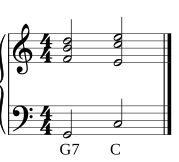
How it sounds: Restless and bright: a major chord with a minor seventh on top that wants to move. Built on the fifth step of a key, it pulls home to the tonic: the V7 of most perfect cadences.
How to find it: Play the major triad, then add the note a whole step below the root's octave: on G, G B D and F. In C major that is the chord on G with only white keys.
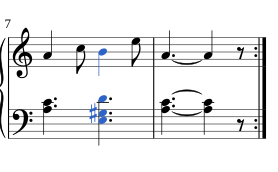
From Lamentation, Op. 117 No. 16 (Gurlitt, level 2), bars 7 to 8, as its edition prints them; the chord in blue pencil.
Struck 1,921 times in 356 pieces. The easiest of them: Lamentation, Op. 117 No. 16 (Gurlitt, level 2), Study, Op. 139 No. 2 (Czerny, level 2) and Bingo (Traditional, level 2).
Major seventh written Cmaj7
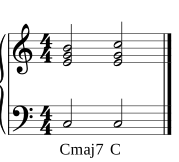
How it sounds: Soft and open, a little dreamy: a major chord with the note just below its octave added. It doesn't need to go anywhere, so pieces often rest on it.
How to find it: Play the major triad, then add the note a half step below the root's octave: on C, C E G and B. On the white keys only C and F make one.
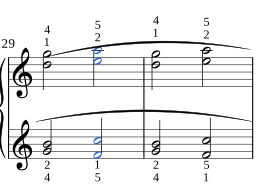
From Berceuse, from Enfantillages pittoresques (Satie, level 2), bars 29 to 30, as its edition prints them; the chord in blue pencil.
Struck 284 times in 81 pieces. The easiest of them: Berceuse, from Enfantillages pittoresques (Satie, level 2), If Thou But Suffer God to Guide Thee (Neumark, level 2) and Elementary Study, Op. 176 No. 1 (Duvernoy, level 2).
Minor seventh written Dm7
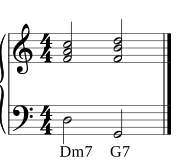
How it sounds: Mellow and warm, less sad than a plain minor chord. On the second step of a key it is the ii7 that leads to the dominant.
How to find it: Play the minor triad, then add the note a whole step below the root's octave: on D, D F A and C. D, E and A make one on the white keys.
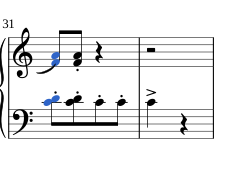
From March of the Grand Staircase, from Enfantillages pittoresques (Satie, level 2), bars 31 to 32, as its edition prints them; the chord in blue pencil.
Struck 583 times in 158 pieces. The easiest of them: March of the Grand Staircase, from Enfantillages pittoresques (Satie, level 2), The Blue Danube (theme) (Strauss, level 2) and If Thou But Suffer God to Guide Thee (Neumark, level 2).
Half-diminished seventh written Bø7, also called the minor seventh flat five, m7♭5
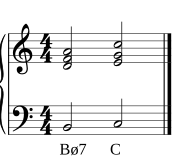
How it sounds: Dark and searching: a diminished triad with a minor seventh. In major keys it sits on the seventh step and leads to the tonic; in minor keys on the second step, before the dominant.
How to find it: Play the diminished triad (two minor thirds), then add the note a whole step below the root's octave: on B, B D F and A, all white keys.
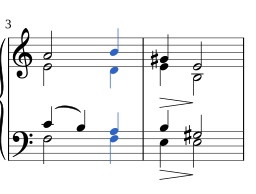
From If Thou But Suffer God to Guide Thee (Neumark, level 2), bars 3 to 4, as its edition prints them; the chord in blue pencil.
Struck 422 times in 114 pieces. The easiest of them: If Thou But Suffer God to Guide Thee (Neumark, level 2), For Children No. 8 (Bartók, level 2) and Waltz, Op. 12 No. 2 (Grieg, level 3).
Diminished seventh written B°7
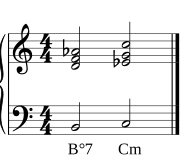
How it sounds: Tense and dramatic, the chord of storms and villains: four notes each a minor third apart, so it divides the octave evenly and could lead to any of four keys.
How to find it: Stack three minor thirds: on B, B D F and A♭. Since the notes are evenly spaced, any of them can be read as the root, and there are only three different diminished sevenths in all.
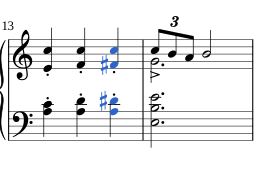
From Waltz, Op. 12 No. 2 (Grieg, level 3), bars 13 to 14, as its edition prints them; the chord in blue pencil.
Struck 295 times in 74 pieces. The easiest of them: Waltz, Op. 12 No. 2 (Grieg, level 3), Study in A minor, Op. 47 No. 3 (Heller, level 3) and O Canada (Lavallée, level 3).
The four positions
A seventh chord has four notes, so it has four positions: the root at the bottom, then the third, the fifth or the seventh. Harmony books name each by the intervals above the bass, its figures.
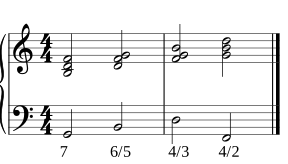
- Root position, 7: the root in the bass, the snowman of four. 47%
- First inversion, 6/5: the third in the bass; the 2nd sits at the top. 19%
- Second inversion, 4/3: the fifth in the bass; the 2nd sits in the middle. 18%
- Third inversion, 4/2: the seventh in the bass, with the root a step above it; the bass then usually falls a step. 16%
The pencilled shares are of the 3,210 sevenths in the library whose root can be told; a diminished seventh's notes are evenly spaced, so it has no single root and no position.
When sevenths start to matter
- Level 2: 15 of 105 pieces strike one (14%)
- Level 3: 216 of 452 pieces strike one (48%)
- Level 4: 141 of 212 pieces strike one (67%)
- Level 5: 37 of 61 pieces strike one (61%)
- Level 6: 12 of 15 pieces strike one (80%)
- Level 7: 2 of 4 pieces strike one (50%)
At level 2 only 14% of the pieces strike a seventh. From level 3, 48% or more of each level's pieces do, and the dominant seventh is the one met most.
How Clefsight read them
On every beat of every piece, the notes struck together in both hands are a seventh when they make exactly four different notes (in any octave, any one doubled) that stack in thirds as one of the five kinds. That finds 3,505 in 423 pieces. It leaves out sevenths spread across a beat as broken chords or an Alberti bass, notes struck off the beat (a melody's passing note over a triad would read as a seventh there), and chords with a fifth note added.
Read the triad first. Every seventh is a triad with a note on top: name triads against the clock in the chord reading game, then look for the fourth note.
Play the chord reading gameMore on chords: how to read chords, the piano chord chart, chord progressions for the ii7 and V7 in a run of chords, cadences for where a dominant seventh resolves, and chord symbols for how G7, Cmaj7 and Dm7 are printed over a tune.