How to read chords: triads, inversions and sevenths
A chord is three or more notes played at once. Most chords in piano music are built from 3rds stacked on each other, so on the staff they look like a snowman: three lines in a row, or three spaces in a row. Read the shape and the bottom note, not every note one by one.
Triads by shape
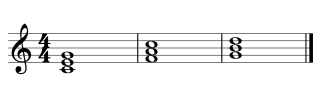
A triad is a note, the 3rd above it and the 5th above it. Because a 3rd goes line to line or space to space, a triad in root position has every note on a line or every note in a space.
- C: C4, E4, G4, all on lines
- F: F4, A4, C5, all in spaces
- G: G4, B4, D5, all on lines
Inversions
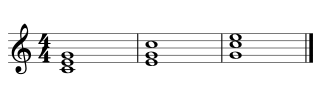
The same three notes can be stacked in another order. Move the bottom note up an octave and you get an inversion: the same chord, with a 4th in it where the snowman had a 3rd.
- root position: C4, E4, G4, two 3rds from the bottom up
- first inversion: E4, G4, C5, 3rd and 4th from the bottom up
- second inversion: G4, C5, E5, 4th and 3rd from the bottom up
Seventh chords
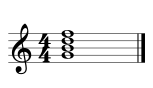
Stack one more 3rd and you have a seventh chord: four notes, all on lines or all in spaces. On G it is G4, B4, D5, F5, the chord that most often leads home to C.
The trap
Reading a chord from the top down, note by note, is slow and invites a wrong letter. Read the bottom note, then the shape. If the notes aren't evenly stacked, look for the gap: in an inverted triad the note just above the 4th is the root, the note the chord is named after (E G C is C, G C E is C).
Now read them. A drill of the 4 chords and shapes in this guide: play each card on a MIDI keyboard or the keys on screen as soon as you can read it. Every answer is timed and goes on your reading map.
Start the drillReady for real music? Level 2 pieces start in one hand position.