Chord inversions: how to read them on the piano
A triad's three notes can be stacked with any of them at the bottom, and each order is a position. Clefsight read every piece in its library for triads struck as one chord: 27,664 of them in 653 of its 851 pieces. 46% are turned round into an inversion, 25% in first inversion and 22% in second, so a reader who knows only root position has to work those out note by note. Each position is below in C major as it sounds, then in real bars with the chord in blue pencil.
- Root position52%
- First inversion25%
- Second inversion22%
- Augmented1%
How to tell the three positions apart
An inversion is the same chord with another of its notes at the bottom. C major is C, E and G whichever is lowest; what changes is the bottom note, and with it the shape on the staff. Read the lowest note first, then the shape above it.
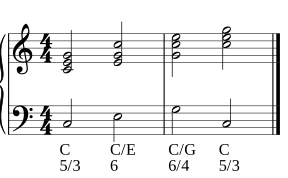
| Position | Lowest note | Shape | Figures | On C | Share |
|---|---|---|---|---|---|
| Root position | the root | a stack of 3rds | 5/3 | C | 52% |
| First inversion | the third | a 4th at the top | 6 | C/E | 25% |
| Second inversion | the fifth | a 4th at the bottom | 6/4 | C/G | 22% |
The figures are the intervals above the bass that harmony books print under a bass line: a 5th and a 3rd for root position, a 6th (and a 3rd) for first inversion, a 6th and a 4th for second. A chord symbol says the same with a slash: C/E is C major over E. When the three notes sit close together, the root is the upper note of the 4th wherever the 4th sits; in root position there is no 4th, and the root is at the bottom.
Root position figures 5/3, usually left out; on C, C
How to see it: Three notes stacked in 3rds, all on lines or all in spaces, like a snowman. The lowest note is the root, the note the chord is named after: C E G is C major.
The bass: the root is the lowest note, so on C the chord is written C.
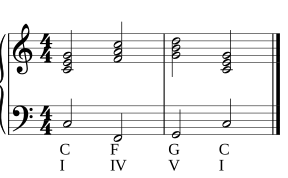
Why hands use it: The steadiest sound a triad has, so pieces open and end on it. In root position the bass leaps from root to root, as in I–IV–V–I, and every chord sounds planted.
The library strikes 14,505 triads in root position, 52% of all the triads it strikes. The easiest piece striking each kind:
Major triads in root position
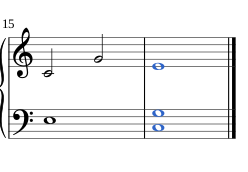
From Exercise Piece in C, Op. 190 No. 21 (Köhler, level 2), bars 15 to 16, as its edition prints them; the chord in blue pencil.
Struck 10,169 times in 594 pieces, 37% of the library's triads. The easiest of them: Exercise Piece in C, Op. 190 No. 21 (Köhler, level 2), Ode to Joy (Beethoven, level 2) and Berceuse, from Enfantillages pittoresques (Satie, level 2).
Minor triads in root position
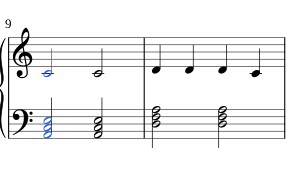
From Bingo (Traditional, level 2), bars 9 to 10, as its edition prints them; the chord in blue pencil.
Struck 3,499 times in 399 pieces, 13% of the library's triads. The easiest of them: Berceuse, from Enfantillages pittoresques (Satie, level 2), Bingo (Traditional, level 2) and We Wish You a Merry Christmas (Traditional, level 2).
Diminished triads in root position
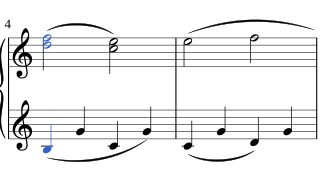
From Study, Op. 139 No. 1 (Czerny, level 2), bars 4 to 5, as its edition prints them; the chord in blue pencil.
Struck 837 times in 180 pieces, 3% of the library's triads. The easiest of them: Study, Op. 139 No. 1 (Czerny, level 2), Brindisi, from La traviata (Verdi, level 3) and For Children No. 2 (Bartók, level 3).
First inversion figures 6, short for 6/3; a six chord; on C, C/E
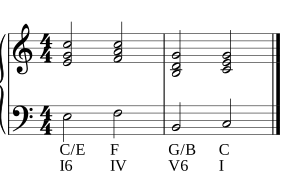
How to see it: A 4th at the top: the lower two notes are a 3rd apart and the upper two a 4th. The root is the top note of the 4th, so E G C is C major with its third, E, in the bass.
The bass: the third is the lowest note, so on C the chord is written C/E.
Why hands use it: Lighter than root position, it lets the bass move by step instead of leaping. V6 to I (G/B to C) lifts the bass a half step into the key's home note, and I6 puts a note between I and IV.
The library strikes 6,876 triads in first inversion, 25% of all the triads it strikes. The easiest piece striking each kind:
Major triads in first inversion
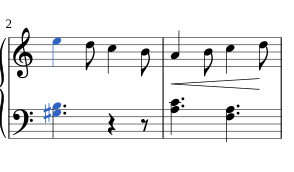
From Lamentation, Op. 117 No. 16 (Gurlitt, level 2), bars 2 to 3, as its edition prints them; the chord in blue pencil.
Struck 3,641 times in 412 pieces, 13% of the library's triads. The easiest of them: Exercise Piece in C, Op. 190 No. 22 (Köhler, level 2), Lamentation, Op. 117 No. 16 (Gurlitt, level 2) and Study, Op. 139 No. 2 (Czerny, level 2).
Minor triads in first inversion
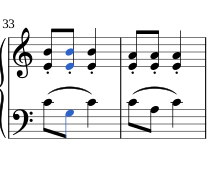
From March of the Grand Staircase, from Enfantillages pittoresques (Satie, level 2), bars 33 to 34, as its edition prints them; the chord in blue pencil.
Struck 2,053 times in 355 pieces, 7% of the library's triads. The easiest of them: Berceuse, from Enfantillages pittoresques (Satie, level 2), March of the Grand Staircase, from Enfantillages pittoresques (Satie, level 2) and Exercise Piece in C, Op. 190 No. 17 (Köhler, level 2).
Diminished triads in first inversion
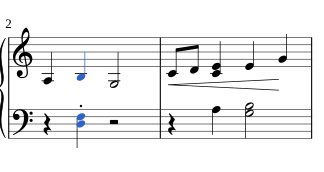
From The Little Traveller, Op. 98 No. 14 (Gretchaninov, level 2), bars 2 to 3, as its edition prints them; the chord in blue pencil.
Struck 1,182 times in 239 pieces, 4% of the library's triads. The easiest of them: The Blue Danube (theme) (Strauss, level 2), The Little Traveller, Op. 98 No. 14 (Gretchaninov, level 2) and Soldiers' March, Op. 68 No. 2 (Schumann, level 3).
Second inversion figures 6/4; a six-four chord; on C, C/G
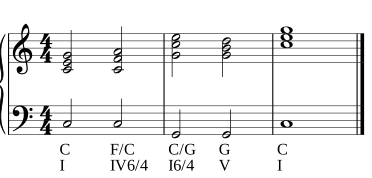
How to see it: A 4th at the bottom: the lower two notes are a 4th apart and the upper two a 3rd. The root is the top note of the 4th, so G C E is C major with its fifth, G, in the bass.
The bass: the fifth is the lowest note, so on C the chord is written C/G.
Why hands use it: The least settled position, so it is used where something holds it up. Over a held bass, I–IV6/4–I (C, F/C, C) moves the hand while the bass stays; before a cadence, I6/4 over the dominant's bass resolves to V and then I.
The library strikes 5,960 triads in second inversion, 22% of all the triads it strikes. The easiest piece striking each kind:
Major triads in second inversion
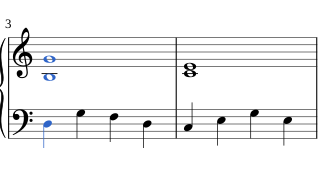
From Exercise Piece in C, Op. 190 No. 22 (Köhler, level 2), bars 3 to 4, as its edition prints them; the chord in blue pencil.
Struck 3,782 times in 410 pieces, 14% of the library's triads. The easiest of them: Exercise Piece in C, Op. 190 No. 22 (Köhler, level 2), Exercise Piece in C, Op. 190 No. 16 (Köhler, level 2) and Study, Op. 139 No. 2 (Czerny, level 2).
Minor triads in second inversion
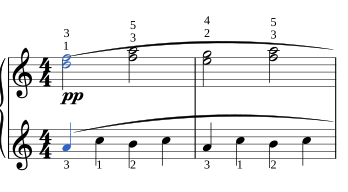
From Berceuse, from Enfantillages pittoresques (Satie, level 2), bars 1 to 2, as its edition prints them; the chord in blue pencil.
Struck 1,565 times in 234 pieces, 6% of the library's triads. The easiest of them: Berceuse, from Enfantillages pittoresques (Satie, level 2), March of the Grand Staircase, from Enfantillages pittoresques (Satie, level 2) and Study in G, Op. 63 No. 3 (Gobbaerts, level 2).
Diminished triads in second inversion
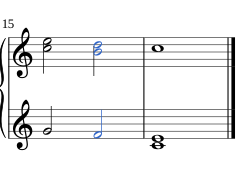
From Exercise Piece in C, Op. 190 No. 16 (Köhler, level 2), bars 15 to 16, as its edition prints them; the chord in blue pencil.
Struck 613 times in 131 pieces, 2% of the library's triads. The easiest of them: Exercise Piece in C, Op. 190 No. 16 (Köhler, level 2), Study, Op. 139 No. 1 (Czerny, level 2) and Annie Laurie (Spottiswoode, level 2).
When inversions start to matter
| Level | Pieces striking a triad | Triads struck | Inverted |
|---|---|---|---|
| Level 2 | 39 / 105 | 560 | 34% |
| Level 3 | 350 / 453 | 11,051 | 39% |
| Level 4 | 190 / 213 | 11,691 | 50% |
| Level 5 | 58 / 61 | 3,414 | 57% |
| Level 6 | 12 / 15 | 743 | 55% |
| Level 7 | 4 / 4 | 205 | 58% |
At level 2, 34% of the triads its pieces strike are inversions. From level 4 on, half or more of every level's are (50% at level 4, 58% at level 7), so from there a reader meets an inverted chord about as often as one in root position.
How Clefsight read them
Wherever three different notes, in either hand or both, start at the same moment and make a major, minor, diminished or augmented triad, in any octave and with any note doubled, a triad is struck; the lowest of the three decides its position. This is the count the chord reading game shows, and it finds 27,664 in 653 pieces, with repeats played as written. It leaves out chords spread over a beat as broken chords or an Alberti bass, notes held over from before the moment, and chords of four or more different notes. The 323 augmented triads are counted but have no position: their notes split the octave into three equal parts, so any of them could be the root.
Find the root inside the shape. The chord reading game's Inversions level shows triads in all three positions and asks for each one's name against the clock.
Play the chord reading gameMore on chords: how to read chords, the piano chord chart, seventh chords and their four positions, chord symbols for slash chords like C/E printed over a tune, cadences for where a phrase comes to rest, and left-hand patterns for how the left hand spreads a chord.