Cadences: how a phrase ends, and how to see it coming
A cadence is the pair of chords that ends a phrase, the music's punctuation: a full stop, a softer close, a comma or a surprise. Clefsight read the end of every section of its library's 784 pieces in a known key, 3,821 in all: 27% end with a perfect cadence and 17% with an imperfect one. Each cadence is below in C major, as it sounds, and in two real bars, its chords in blue pencil.
- Perfect cadence27%
- Imperfect cadence17%
- Plagal cadence4%
- Interrupted cadence1%
- None of the four51%
Why a reader looks for them
Music is written in phrases, usually four or eight bars long, and each ends with a cadence. Knowing the two chords that end a phrase, you can see the end coming: the bass moves to the fifth note of the key, the leading tone appears, and the next bar is where the phrase resolves. That is where your eyes can leave the bar you are playing and read ahead.
A cadence is also where to stop when practising a passage: Clefsight's player cuts each piece into its sections at the same places, and the Section choice on the player's ledge loops one of them.
Perfect cadence V–I, also called an authentic cadence or a full close
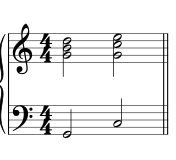
How it sounds: Finished. The dominant chord pulls towards home and the tonic arrives: the ear hears a full stop. Most pieces end with one.
How to see it: In the bass, a leap down a fifth or up a fourth, G to C in C major, under a chord with the leading tone, B in C major, rising to the tonic. Pieces in minor raise that note, so a sharp or natural just before the end is the sign.
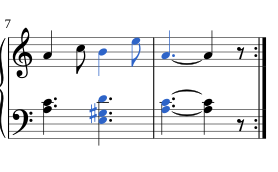
From Lamentation, Op. 117 No. 16 (Gurlitt, level 2), bars 7 to 8, as its edition prints them; the two chords in blue pencil.
1,018 section ends in 577 pieces, 27% of those read. The easiest of them: Exercise Piece in C, Op. 190 No. 7 (Köhler, level 2), Exercise Piece in C, Op. 190 No. 15 (Köhler, level 2) and Exercise Piece in C, Op. 190 No. 11 (Köhler, level 2).
Plagal cadence IV–I, also called the Amen cadence
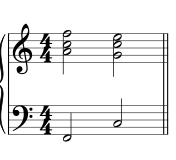
How it sounds: Finished, but softer than a perfect cadence: the "Amen" at the end of a hymn. It often comes just after a perfect cadence, as an extra close.
How to see it: In the bass, the fourth note of the scale falling to the tonic, F to C in C major, and the tonic note held over in the right hand from one chord to the next.
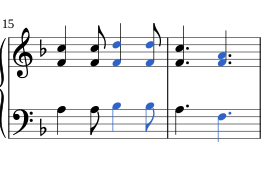
From Sinterklaas Kapoentje (Traditional, level 2), bars 15 to 16, as its edition prints them; the two chords in blue pencil.
152 section ends in 111 pieces, 4% of those read. The easiest of them: March of the Grand Staircase, from Enfantillages pittoresques (Satie, level 2), For Children No. 4 (Bartók, level 2) and Oh! Susanna (Foster, level 2).
Imperfect cadence I–V, or any chord to V, also called a half cadence or a half close
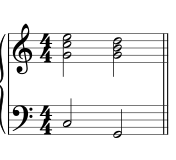
How it sounds: A comma, not a full stop: the phrase stops on the dominant chord and waits for more. Usually the next phrase starts the same way and ends with a perfect cadence, a question and its answer.
How to see it: The phrase's last chord is built on the fifth note of the scale, G in C major, often longer than the notes before it, and the bar after it starts the tune again.
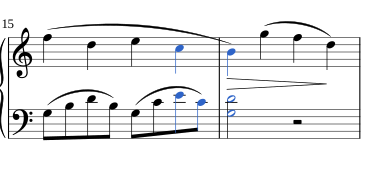
From Elementary Study, Op. 176 No. 3 (Duvernoy, level 2), bars 15 to 16, as its edition prints them; the two chords in blue pencil.
652 section ends in 353 pieces, 17% of those read. The easiest of them: Piece in C, Op. 117 No. 5 (Gurlitt, level 2), In May (Behr, level 2) and Exercise Piece in C, Op. 190 No. 16 (Köhler, level 2).
Interrupted cadence V–vi, also called a deceptive cadence
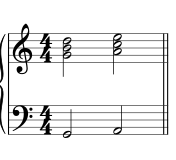
How it sounds: A surprise: the dominant chord promises home, and a minor chord arrives instead. The phrase has to go on, and a perfect cadence usually follows a few bars later.
How to see it: The same approach as a perfect cadence, but the bass steps up one note instead of leaping, G to A in C major.
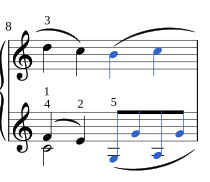
From Little Piece, Op. 68 No. 5 (Schumann, level 3), bar 8, as its edition prints them; the two chords in blue pencil.
46 section ends in 42 pieces, 1% of those read. The easiest of them: Brindisi, from La traviata (Verdi, level 3), The Tin Soldiers in Camp, Op. 98 No. 2 (Gretchaninov, level 3) and Little Piece, Op. 68 No. 5 (Schumann, level 3).
How pieces end
Of the 784 pieces, 58% end with a perfect cadence, 5% with a plagal one (hymns and carols among them) and 2% on the dominant, about half of those because the score jumps back (D.C. or D.S.) and the music ends earlier on the page. The other 34% end in a way the rule below doesn't name: a long tonic held over several bars, a single line in both hands, or a key it can't tell.
How Clefsight read them
For each section, the arrival is the chord on the last beat of its last bar where the bass strikes a new note; the approach is the chord on the beat before, or, if that is the same chord, the latest beat before it with another chord, at most two bars back. Each chord is named by the note whose third and fifth sound with it, and where a beat sounds only a bass and one note, by the bass. The names are read in the piece's home key.
That reads 3,821 of the 4,220 section ends. It leaves out a piece whose key signature doesn't say whether it is major or minor, a section in another key signature, and an approach that is one line, since one note doesn't say which chord it stands for. A perfect cadence into a new key, the dominant's for example, is read as none of the four, not as an imperfect cadence in the home key.
Hear the phrases in a real piece. Open a piece, loop one of its sections, and watch for the cadence coming as you play from the page on a MIDI keyboard.
Open the libraryMore on chords: how to read chords, the piano chord chart, major or minor for the key a cadence ends in, the circle of fifths for the dominant of every key, chord progressions for the runs of chords that lead to a cadence, and seventh chords for the dominant seventh most perfect cadences use.