Learn to read music · Key signatures
Major or minor: how to tell which key a piece is in
Every key signature names two keys: a major key and the minor key that shares its notes. To know which one a piece is in, you look past the signature to the music. Of the 844 pieces in Clefsight's library, 790 are told this way, 168 of them (21%) minor; 54 keep only their signature, since their clues don't settle it.
One signature, two keys
C major and A minor both have no sharps or flats; G major and E minor both have one sharp, F♯. The minor key, the relative minor, starts on the major key's 6th note (three semitones below its tonic), and uses the same notes, so the signature alone can't say which you are in. The two tunes below share a signature:
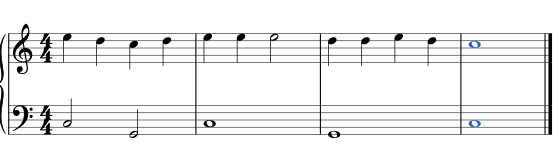
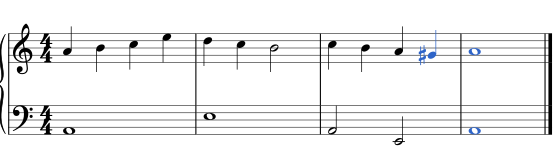
Both use the same seven white keys, but the first circles round C and ends there over a C in the bass, and the second circles round A, ends there, and raises G to G♯ just before the end. Those notes, in blue, are the clues.
How to tell, clue by clue
- The title. If the title names a key (Minuet in G minor, Sonatina in C), that settles it, as long as the signature agrees. Many pieces were named by their key for exactly this reason.
- The last bass note. Look at the lowest note of the last chord. Most pieces end on their home note, the tonic: with no sharps or flats, a last bass note of C says C major and an A says A minor. The first bass note often agrees, but the last is the surer clue.
- The raised 7th. A minor piece almost always raises its 7th note to lead home, and the signature doesn't include it, so it is printed as an accidental again and again: G♯ in A minor, D♯ in E minor, F♯ in G minor. The same sharp or natural turning up all through a piece points to the minor key a step above it.
- The last chord. Read the last chord's notes: C, E and G is C major, A, C and E is A minor. If the bass is on another note of the chord, the chord still names the key.
- What the edition says. Some editions mark the mode in the file or the heading even where the title doesn't. A piece can also start in one key and end in another, or end on another note on purpose (a piece in a set that leads into the next), so when the clues disagree, trust the ending and the accidentals over the opening.
How the library's pieces were told
Clefsight names each piece's key by these clues, in this order. Of the 790 pieces it names: 307 by a title that names the key, 41 by the edition's own mark, and 442 by the music itself: the last bass note on the tonic (and for minor, the raised 7th at least once in seventy notes) or a last chord of the major key's tonic. 54 end somewhere else (on another chord, mid-phrase, in another key) and keep only their signature. By signature, with each key's page:
| Signature | Major | Minor | Not told |
|---|---|---|---|
| no sharps or flats | C major 231 | A minor 50 | 34 |
| 1 sharp | G major 115 | E minor 28 | 6 |
| 2 sharps | D major 59 | B minor 10 | 1 |
| 3 sharps | A major 34 | F♯ minor 5 | 0 |
| 4 sharps | E major 18 | C♯ minor 6 | 0 |
| 5 sharps | B major 2 | G♯ minor 0 | 0 |
| 6 sharps | F♯ major 2 | D♯ minor 0 | 0 |
| 1 flat | F major 85 | D minor 22 | 3 |
| 2 flats | B♭ major 31 | G minor 25 | 3 |
| 3 flats | E♭ major 27 | C minor 17 | 4 |
| 4 flats | A♭ major 10 | F minor 4 | 2 |
| 5 flats | D♭ major 7 | B♭ minor 0 | 1 |
| 6 flats | G♭ major 1 | E♭ minor 1 | 0 |
Minor keys level by level
The share in minor of the pieces whose key is told, at each level. Beginners' pieces stay mostly major; minor keys, with their raised 7th to read as an accidental, come in as the levels rise.
Know both keys at a glance. The key signature quiz shows a signature and asks for its major key, its minor key or both.
Key signature quizMore on keys: key signatures, the key signatures chart, the circle of fifths with every relative minor, key changes and sharps, flats and naturals.