Learn to read music · Music symbols
Musical phrases: how to see where a phrase starts and ends
Music moves in phrases, the way speech moves in sentences. Of the 851 pieces in Clefsight's library, 210 (25%) print phrase marks, 3,523 in all. Each kind of phrase is below as printed, as it sounds with each phrase arched over it, and in real bars from the library, its phrase marks in blue pencil.
- The phrase mark210
- Two-bar phrases169
- Question and answer111
- A phrase that starts before the bar line61
- The four-bar phrase47
- A long line14
What a phrase is
A phrase is a stretch of music that makes sense on its own, from where it sets off to where it comes to rest: often four bars, sometimes two or eight. It ends at a cadence, a long note or a rest, the music's comma or full stop, and the next phrase starts after it. The chords that end a phrase are on cadences.
Editions show phrases with a phrase mark, a long slur over the notes that belong together. A slur over two or three notes asks only for them to be joined (it is on articulation); one over a bar or more usually marks a phrase. Where nothing is printed, the phrase is still there: the long notes, rests and cadences show it.
Counted here, a phrase mark is a slur in the score over three notes or more and a bar long or more, measured from its first note's start to its last note's end in the bars of the time it starts in; a slur over more than 16 bars is set aside as one its file left open. Two-bar, four-bar and long phrases are phrase marks of about that many bars (six or more for a long line). A phrase starting before the bar line is one of a bar and a half or more that starts in its bar's last beat, or in a pickup bar. A question and answer is two phrase marks on one staff, of the same length and two bars or more, the second starting within a beat of where the first ends; the files don't say which ends away from home, so the pair is counted, not the cadence.
The phrase mark
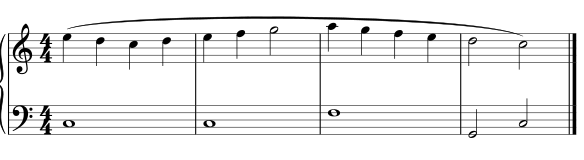
A phrase mark is a long slur, a curve over a whole phrase rather than over two or three notes. It says: these notes belong together, played as one line. Editions draw it over the notes, or under them when the stems point up.
How to read it: Find where the curve ends before you play its first note. That is where the phrase lands; the notes under it lead there.
How to play it: Join the notes under it, each key held until the next goes down, and shape it: a little louder towards its high point, softer as it lands. At the end of the curve lift the hand, just before the next phrase starts.
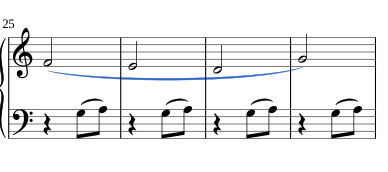
From Little Prelude to the Day, from Enfantillages pittoresques (Satie, level 2), bars 25 to 28, as its edition prints them; the phrase marks in blue pencil.
In 210 of the 851 pieces. The easiest of them: Old German Dance (Praetorius, level 2), Study, Op. 101 No. 38 (Beyer, level 2) and Berceuse, from Enfantillages pittoresques (Satie, level 2).
Two-bar phrases
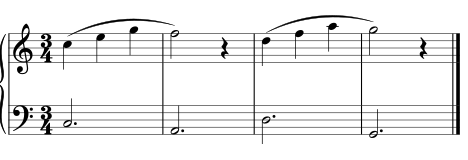
Many short pieces, dances and studies move in two-bar steps: a little figure, a breath, the figure again a step higher or turned round. Each two bars is a phrase of its own, though two of them often make a longer one.
How to read it: Read two bars at a time, not note by note: the second phrase is often the first moved up or down, so once you have read the first you know the shape of the second.
How to play it: Let each two-bar phrase finish before the next begins: lighten the last note and lift, briefly, on the bar line between them, without losing the beat.
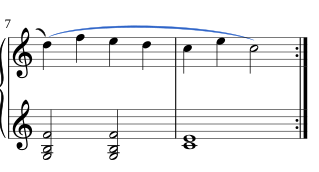
From Study, Op. 139 No. 2 (Czerny, level 2), bars 7 to 8, as its edition prints them; the phrase marks in blue pencil.
In 169 of the 851 pieces. The easiest of them: Old German Dance (Praetorius, level 2), Study, Op. 101 No. 38 (Beyer, level 2) and Berceuse, from Enfantillages pittoresques (Satie, level 2).
The four-bar phrase
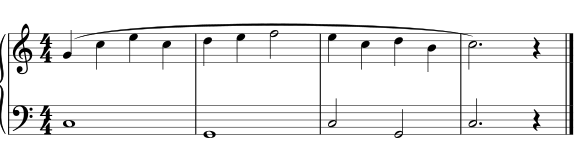
The commonest phrase in the music beginners play is four bars long: it sets off, rises or turns, and comes to rest on a longer note at the end of the fourth bar. Hymns, folk songs, minuets and marches are built from fours.
How to read it: Look for the long note, the rest or the cadence at the end of bar four; that is the phrase's full stop. Counting bars in fours tells you where the next phrase begins.
How to play it: Play towards the end of the phrase rather than from note to note, and let the long note at its end sound its full length before the next phrase.
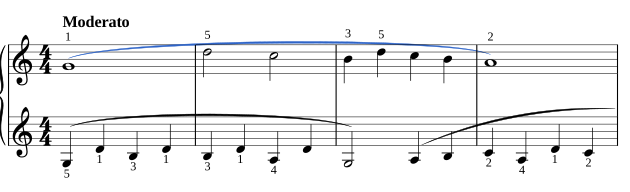
From Study, Op. 101 No. 38 (Beyer, level 2), bars 1 to 4, as its edition prints them; the phrase marks in blue pencil.
In 47 of the 851 pieces. The easiest of them: Study, Op. 101 No. 38 (Beyer, level 2), Berceuse, from Enfantillages pittoresques (Satie, level 2) and Little Prelude to the Day, from Enfantillages pittoresques (Satie, level 2).
Question and answer
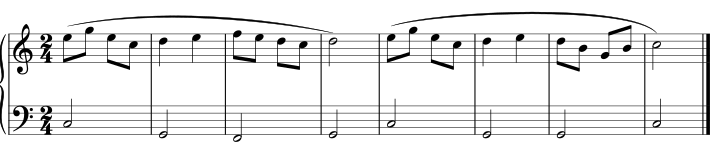
Two phrases of the same length, one straight after the other: the first stops away from home, often on the fifth note of the key over its V chord, like a question; the second starts the same way and ends on the key's home note, like the answer. Together they make an eight-bar period.
How to read it: When the second phrase starts as the first did, you have already read most of it: watch for the place it turns aside, near its end, to land on the home note.
How to play it: End the question lightly, as if it were waiting for a reply, and the answer more firmly. Keep the beat steady between them; the answer starts on time.
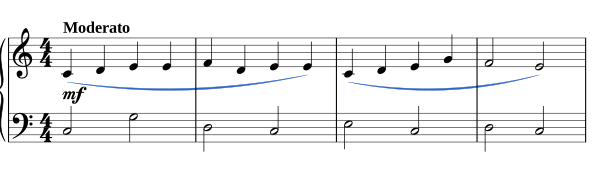
From Old German Dance (Praetorius, level 2), bars 1 to 4, as its edition prints them; the phrase marks in blue pencil.
In 111 of the 851 pieces. The easiest of them: Old German Dance (Praetorius, level 2), Study, Op. 101 No. 38 (Beyer, level 2) and Berceuse, from Enfantillages pittoresques (Satie, level 2).
A phrase that starts before the bar line
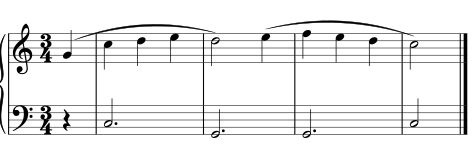
A phrase often starts on the last beat of a bar and leads into the next bar's strong beat, so the phrase mark begins before the bar line. Phrases go across bar lines; the bar lines mark the beat, not the phrases.
How to read it: Read the phrase mark, not the bar: a note just before the bar line that starts a slur belongs to what comes after it, not to the bar it is printed in.
How to play it: Play the note before the bar line lightly, leading into the downbeat, and lift at the end of the phrase before it, not at the bar line.
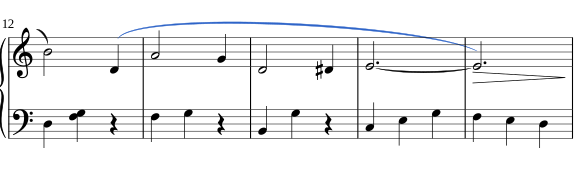
From Carousel Waltz (Gobbaerts, level 2), bars 12 to 16, as its edition prints them; the phrase marks in blue pencil.
In 61 of the 851 pieces. The easiest of them: Carousel Waltz (Gobbaerts, level 2), Elementary Study, Op. 176 No. 2 (Duvernoy, level 2) and Elementary Study, Op. 176 No. 11 (Duvernoy, level 3).
A long line
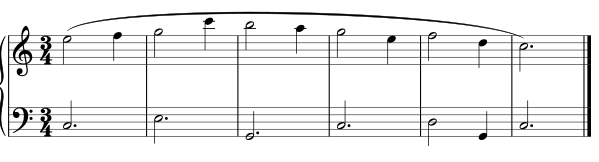
Some phrases run six bars, eight or more without a break: a slow melody, a run that climbs and falls, a song's whole verse. Romantic piano music often writes its slurs this long.
How to read it: Follow the curve to its end, across lines if it goes on; inside it, the smaller breaths are your choice, but the line shouldn't break.
How to play it: Keep the sound joined all the way and pace the loudness: save the loudest point for where the line peaks, often two thirds of the way through, and let it fall away to its end.
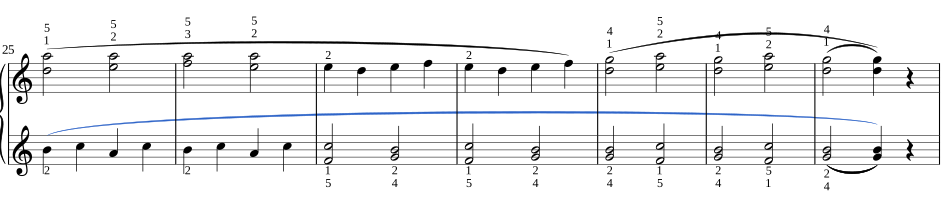
From Berceuse, from Enfantillages pittoresques (Satie, level 2), bars 25 to 31, as its edition prints them; the phrase marks in blue pencil.
In 14 of the 851 pieces. The easiest of them: Berceuse, from Enfantillages pittoresques (Satie, level 2), Andante in F, Op. 82 (Gurlitt, level 2) and Song Without Words (Spindler, level 3).
How long the library's phrase marks are
Most phrase marks in the library's editions are short: 90% of them run a bar or two. Many editions slur a bar or a figure at a time and leave the longer phrase for the reader to find from the cadences and long notes; four-bar marks and longer lines are rarer. So read a short slur as part of a phrase, not always the whole of one.
- 1 bar1,926
- 2 bars1,236
- 3 bars138
- 4 bars173
- 5–8 bars46
- 9–16 bars4
The easiest pieces with a long line
The easiest pieces in the library with a phrase mark of six bars or more: good practice for keeping a line joined and shaped to its end.
- Berceuse, from Enfantillages pittoresques (Satie, level 2)
- Andante in F, Op. 82 (Gurlitt, level 2)
- Song Without Words (Spindler, level 3)
- Children's Study, Op. 37 No. 36 (Lemoine, level 3)
- Children's Study, Op. 37 No. 7 (Lemoine, level 3)
- Gymnopédie No. 1 (Satie, level 4)
- Sonatina in A minor (Reinecke, level 4)
- Scherzo in A (Hummel, level 4)
Phrase marks level by level
How many of the library's pieces at each level print a phrase mark, and how many a four-bar one.
What Clefsight grades
Phrasing isn't graded: a MIDI keyboard tells Clefsight which keys go down and when, not how a line is shaped or joined, so a legato phrase and a detached one score the same if the notes and timing are right.
Phrases help where grading does look. A breath at the end of a phrase is fine as long as the next note comes on time; a stop is a gap at least twice what the music asks. And the player's sections, offered after a take for practice, are cut where the music breaks: at double bars and repeats, else in phrases of up to eight bars.
Play a phrase to its end. Study, Op. 101 No. 38 is the easiest piece in the library with a four-bar phrase mark. Play it at a MIDI keyboard or on the keys on screen, and read each phrase to its end before you start it.
Play Study, Op. 101 No. 38More on the page: cadences, how a phrase ends, articulation, slurs and ties, the pickup measure, dynamics for shaping a line, and how to sight-read, reading ahead.