Learn to read music · Tempo markings
Tempo changes in music: rit., accel. and a tempo
The word over the first bar sets a piece's speed; the words after it bend it: slow down, hold back, press on, come back. Of the 844 pieces in Clefsight's library, 170 (20%) print a tempo change after the first bar, and 312 a change or a pause. Each kind is below as eight beats against a steady eight, and in two real bars where it is printed, in blue pencil.
How a tempo change works
A tempo change is a word or sign that changes the speed partway through a piece. Some change it gradually (ritardando, accelerando), some at once (meno mosso, più mosso), and a tempo puts it back. The fermata holds one note or rest; rubato bends the time freely.
Most are Italian words, usually shortened (rit., accel.) and printed above or between the staves, sometimes followed by a dashed line for as long as the change lasts. A gradual change runs until the next marking or the end; a new speed holds until another word replaces it.
Counted here, a change is a word printed after a piece's first bar (the first bar's words are its opening tempo, on the tempo markings page), or a fermata anywhere, matched whole and counted once per bar; senza rit. (without slowing) isn't counted, and neither is a D.C. ad lib.
Slowing down
rit., ritard., rall., allargando, calando, morendo, smorz., cédez
Ritardando and rallentando both mean slow down gradually, beat by beat, until the next marking. Allargando broadens as it slows, often getting louder; calando, morendo and smorzando slow down and fade away together. French scores print cédez (give way) or ralentir.
How to play it: Slow down a little on each beat, not all at once at the end: the beats should stretch smoothly, like a ball rolling to a stop. Keep counting through it, and save the most slowing for the last notes before the next marking or the end.
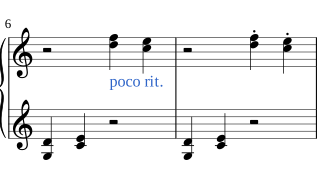
From Piece in C, Op. 117 No. 10 (Gurlitt, level 2), bars 6 to 7, as its edition prints them; the marking in blue pencil.
Printed in 138 of the 844 pieces. The easiest of them: Piece in C, Op. 117 No. 10 (Gurlitt, level 2), For Children No. 4 (Bartók, level 2) and For Children No. 1 (Bartók, level 2).
Held back at once
riten., ritenuto, meno mosso, più lento, largamente
Ritenuto, meno mosso (less moved) and più lento (slower) take a slower speed straight away rather than sliding into it, and keep it until a new marking. Largamente is broadly: slower and fuller.
How to play it: Change speed on the note under the word, then hold the new beat steady. Count one bar of the new speed in your head before you reach it, so the change is a step, not a stumble.
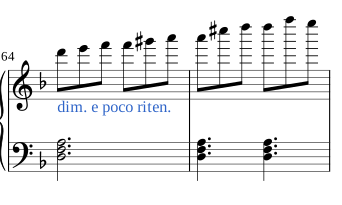
From Tarantella, Op. 100 No. 20 (Burgmüller, level 3), bars 64 to 65, as its edition prints them; the marking in blue pencil.
Printed in 35 of the 844 pieces. The easiest of them: Tarantella, Op. 100 No. 20 (Burgmüller, level 3), Sincerity, Op. 100 No. 1 (Burgmüller, level 3) and Study in C, Op. 17 No. 9 (Couppey, level 3).
Speeding up
accel., stringendo, string., più mosso, animato
Accelerando speeds up gradually; stringendo (tightening) presses on, usually towards a climax. Più mosso (more moved) and animato take a quicker speed at once.
How to play it: Speed up evenly and by less than you think: a run that rushes ahead gets out of control. Keep the fingers close to the keys, and practise the passage at the speed it ends at before you add the change.
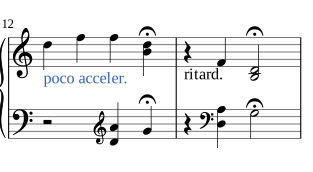
From The Little Traveller, Op. 98 No. 14 (Gretchaninov, level 2), bars 12 to 13, as its edition prints them; the marking in blue pencil.
Printed in 28 of the 844 pieces. The easiest of them: The Little Traveller, Op. 98 No. 14 (Gretchaninov, level 2), On the Accordion, Op. 123 No. 12 (Gretchaninov, level 2) and In the Woodland Glade, Op. 98 No. 6 (Gretchaninov, level 3).
Back to tempo
a tempo, in tempo, Tempo I, Tempo primo, come prima
A tempo (in time) goes back to the speed before the last change, usually after a rit. or a pause. Tempo I or Tempo primo goes back to the first speed of the piece, after a section at another speed.
How to play it: Arrive on the beat: the note under a tempo is back at speed at once, not sped up into. Think of the opening speed a bar before you get there, so the return is clean.
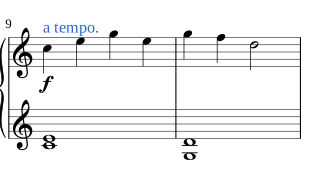
From Piece in C, Op. 117 No. 10 (Gurlitt, level 2), bars 9 to 10, as its edition prints them; the marking in blue pencil.
Printed in 97 of the 844 pieces. The easiest of them: Piece in C, Op. 117 No. 10 (Gurlitt, level 2), For Children No. 4 (Bartók, level 2) and The Little Traveller, Op. 98 No. 14 (Gretchaninov, level 2).
The pause
the fermata, an arc over a dot
A fermata (pause) over a note or rest holds it longer than its value, as long as the music needs; over the last note it is the piece's final breath. Over a bar line it is a short silence.
How to play it: Hold it about twice its length, then a little more at the end of a piece, and listen for the moment to go on. Count the beat again before the next note so the music restarts in time.
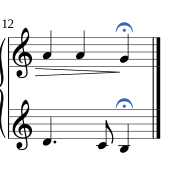
From Evening Song, Op. 101 No. 58 (Beyer, level 2), bar 12, as its edition prints them; the marking in blue pencil.
Printed in 242 of the 844 pieces. The easiest of them: Evening Song, Op. 101 No. 58 (Beyer, level 2), For Children No. 4 (Bartók, level 2) and The Little Traveller, Op. 98 No. 14 (Gretchaninov, level 2).
Free time
rubato, ad lib., a piacere, colla parte, recit.
Rubato (robbed time) stretches some notes and hurries others while the beat goes on underneath; ad libitum and a piacere leave the speed to you; colla parte follows a singer or soloist.
How to play it: Take time where the phrase leans (a high note, a surprising chord) and give it back after, so the bar still ends near where it would. Play it steady first; rubato is shaping a steady line, not losing it.
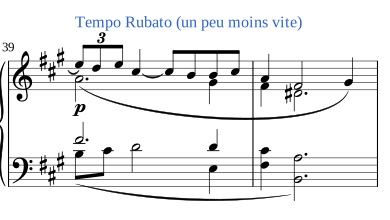
From Arabesque No. 1 (Debussy, level 4), bars 39 to 40, as its edition prints them; the marking in blue pencil.
Printed in 4 of the 844 pieces. The easiest of them: Arabesque No. 1 (Debussy, level 4), Waltz of the Flowers, from The Nutcracker (Tchaikovsky, level 4) and Album Leaf (Scriabin, level 5).
Slowing down at the end
Of the 138 library pieces that print a slowing, 79 print it in their last four bars: the commonest tempo change of all is the one that brings a piece to rest. Even where a score prints nothing, a small broadening into the last chord is usual, and a fermata on it often says so.
Tempo changes level by level
How many of the library's pieces at each level print a tempo change in words after the first bar, and the kinds met there.
| Level | Pieces | Change speed | Kinds |
|---|---|---|---|
| Level 2 | 105 | 7% | slowing down, speeding up, back to tempo and the pause |
| Level 3 | 452 | 16% | slowing down, held back at once, speeding up, back to tempo and the pause |
| Level 4 | 207 | 28% | slowing down, held back at once, speeding up, back to tempo, the pause and free time |
| Level 5 | 61 | 39% | slowing down, held back at once, speeding up, back to tempo, the pause and free time |
| Level 6 | 15 | 27% | slowing down, held back at once, speeding up, back to tempo, the pause and free time |
| Level 7 | 4 | 75% | slowing down, held back at once, back to tempo and the pause |
What Clefsight does with a tempo change
Clefsight grades against your own beat, not the printed speed, so a rit. or an accel. played gradually is followed as a moving tempo: the notes are on time if they fall where your slowing beat puts them. A sudden change is followed once the next notes agree with it, so take the new speed and hold it. At a fermata, hold as long as you like: it isn't counted as a stop.
The click and the count-in keep one speed, the opening one, so they don't slow down with a rit. Practise the notes with the click, then play the changes without it.
Feel the speeds. Set the metronome to a piece's opening speed and to the speed a change asks for, and play a bar at each.
Open the metronomeMore on the page: tempo markings from Largo to Presto, musical terms, dynamics and articulation for the fermata.