Rests in music: how to count them on the piano
A rest is a length of silence, written and counted like a note. Of the 849 pieces in Clefsight's library, 668 (79%) print a rest, 29,512 rests in all. Each kind is below as printed, as it sounds against the count with the silence shaded, and in two real bars where it is printed, its rests in blue pencil.
- Rests of a beat or more558
- Rests shorter than a beat463
- The whole-bar rest234
- One hand waits100
- The dotted rest37
- Both hands rest25
What a rest is
A rest tells you to play nothing for a length of time, and each note value has its rest: the whole rest hangs from the fourth line, the half rest sits on the middle line, the quarter rest is a zigzag, and the eighth and sixteenth rests are a dot on a stem with one hook or two. A dot after a rest adds half its length again, as it does after a note. Every rest beside its note is on the note values chart.
The silence is part of the rhythm. The beat goes on through it, and the note after it comes on its own count, not when the gap feels long enough. Most slips at a rest are the same one: the counting stops, and the next note comes in early.
Counted here, a rest is one its score prints (a rest hidden in the file isn't), named by its length against the beat of the time it is in; a rest that fills its bar is the whole-bar rest. A hand waiting is a staff with no note of its own for two bars or more while the other plays, and a bar where both hands rest is one with no note in either staff before the music's last note.
Rests of a beat or more
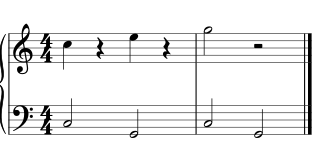
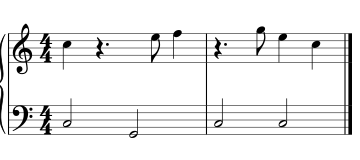
A quarter rest is one beat of silence and a half rest two, in 2/4, 3/4 and 4/4; in 6/8 a dotted quarter rest is one beat. The quarter rest is the zigzag; the half rest is a small block sitting on the middle line, the whole rest the same block hanging from the line above.
What to count: Count the rest out loud exactly as you would a note: "1 2 3 4", playing on "1" and "3" and saying "2" and "4" into the silence. The next note comes on its own number, not when the silence feels long enough.
How to play it: Lift the hand on the rest, so the silence is heard, and keep it just above the next keys. Counting through it is the whole skill: a rest you don't count is where a piece speeds up.
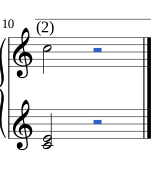
From Piece in C, Op. 117 No. 4 (Gurlitt, level 2), bar 10, as its edition prints them; the rests in blue pencil.
Printed in 558 of the 849 pieces. The easiest of them: Piece in C, Op. 117 No. 4 (Gurlitt, level 2), Exercise Piece in C, Op. 190 No. 3 (Köhler, level 2) and Piece in C, Op. 117 No. 2 (Gurlitt, level 2).
Rests shorter than a beat
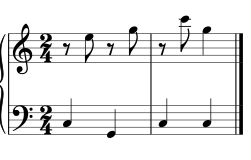
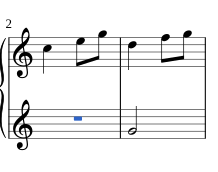
An eighth rest (a dot with a hooked stem) is half a beat, a sixteenth rest (two hooks) a quarter of one. Printed on the beat, it moves the note after it off the beat: the left hand plays on "1" and the right comes in on "&". It is the rest new readers fill without noticing.
What to count: Count in eighths, "1 & 2 &", and say the number of the rest out loud with nothing under it; the note comes on the "&". With sixteenth rests, count "1 e & a".
How to play it: Let the other hand, or your foot, take the beat, and come in just after it, light. If the right hand lands on the beat with the left, the rest has been played as nothing.
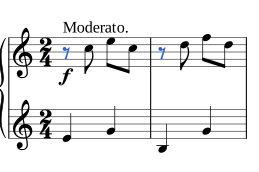
From Study in C, Op. 101 No. 53 (Beyer, level 2), bars 1 to 2, as its edition prints them; the rests in blue pencil.
Printed in 463 of the 849 pieces. The easiest of them: Study in C, Op. 101 No. 53 (Beyer, level 2), Lamentation, Op. 117 No. 16 (Gurlitt, level 2) and Study in C, Op. 101 No. 52 (Beyer, level 2).
The dotted rest
A dot after a rest adds half its length again, as it does after a note: a dotted quarter rest is a beat and a half in 4/4, so the note after it comes on the next beat's "&". A dotted half rest is three beats.
What to count: Count in eighths and keep counting through it: after a dotted quarter rest on "2", say "2 & 3" into the silence and play on "3 &".
How to play it: Read the rest and the note after it as one shape, as you read a dotted note and its eighth: the silence is the long, the note the short. Keep the left hand steady under it.
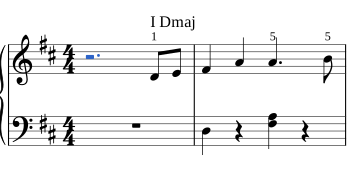
From Oh! Susanna (Foster, level 2), bars 1 to 2, as its edition prints them; the rests in blue pencil.
Printed in 37 of the 849 pieces. The easiest of them: Oh! Susanna (Foster, level 2), Piece in F, BWV Anh. 131 (Anonymous, level 3) and O Come, All Ye Faithful (Wade, level 3).
The whole-bar rest
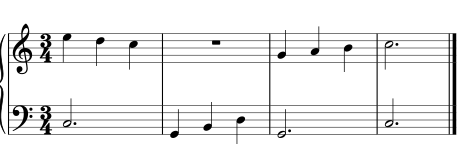
A whole rest alone in a bar means the whole bar is silent, whatever the time: in 3/4 or 6/8 it is three beats or two, not four. Most editions print it centred in the bar. It is the one rest whose length the time signature decides.
What to count: Count the bar through, "1 2 3", with the hand off the keys, and come back in on the next "1". Don't count the whole rest as four beats in 3/4.
How to play it: Use the bar to look ahead to what the hand plays next and get it over the keys. In piano music the other hand usually carries on: let it keep the count.
From Piece in C, Op. 117 No. 5 (Gurlitt, level 2), bars 2 to 3, as its edition prints them; the rests in blue pencil.
Printed in 234 of the 849 pieces. The easiest of them: Piece in C, Op. 117 No. 5 (Gurlitt, level 2), Old MacDonald Had a Farm (Traditional, level 2) and Ode to Joy (Beethoven, level 2).
One hand waits
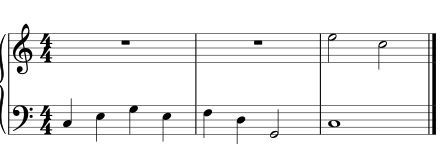
One staff prints whole-bar rests for two bars or more while the other plays: the left hand plays the tune alone, or the right hand waits through an introduction. The hand that rests still counts every bar.
What to count: Count bars as well as beats, "1 2 3 4, 2 2 3 4", so you know which bar the resting hand comes back in. Where the rest has a number over it (a multi-bar rest), count that many bars.
How to play it: Practise the playing hand alone first, then together, with the resting hand on your lap until its bar. Bring it back over its keys a bar early, so its first note isn't a reach.
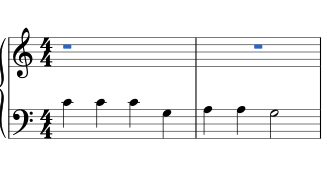
From Old MacDonald Had a Farm (Traditional, level 2), bars 1 to 2, as its edition prints them; the rests in blue pencil.
Printed in 100 of the 849 pieces. The easiest of them: Old MacDonald Had a Farm (Traditional, level 2), The Chase, Op. 117 No. 15 (Gurlitt, level 2) and Row, Row, Row Your Boat (Traditional, level 2).
Both hands rest
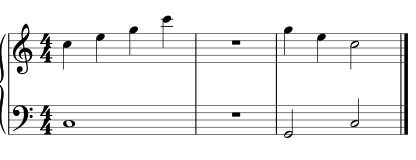
A whole-bar rest on both staves at once: a bar of silence in the middle of the music, sometimes with a pause (a fermata) over it or the letters G.P. (general pause). Silence written out is part of the piece, not a gap in it.
What to count: Count the silent bar exactly, "1 2 3 4", and come back in on time. With a fermata over it, wait as long as feels right, then count yourself back in.
How to play it: Keep both hands still and close to the keys, and let the last chord's sound stop cleanly unless the pedal is marked through. The bar after it starts as if nothing had happened.
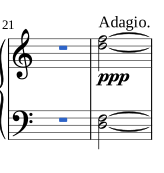
From For Children No. 8 (Bartók, level 2), bars 21 to 22, as its edition prints them; the rests in blue pencil.
Printed in 25 of the 849 pieces. The easiest of them: For Children No. 8 (Bartók, level 2), Tarantella, Op. 100 No. 20 (Burgmüller, level 3) and Study in G, Op. 17 No. 24 (Couppey, level 3).
The library's pieces with the most rests
The pieces that print the most rests a bar, of those eight bars long or more, and that number in blue. In these the silences are as much of the rhythm as the notes, often a hand answering the other or a tune broken into short phrases, so a piece near the top is good practice for counting through them.
- Short Exercise, Op. 821 No. 3 (Czerny, level 3) 6.3 a bar
- Hard Work, Op. 123 No. 7 (Gretchaninov, level 4) 5.8 a bar
- Children's Study, Op. 37 No. 44 (Lemoine, level 4) 5.6 a bar
- Solfeggietto in C minor (Bach, level 5) 5.2 a bar
- La Chevaleresque, Op. 100 No. 25 (Burgmüller, level 3) 4.9 a bar
- March, from The Nutcracker (Tchaikovsky, level 4) 4.8 a bar
- The Witch (Baba Yaga), Op. 39 No. 20 (Tchaikovsky, level 3) 4.7 a bar
- Butterfly, Op. 43 No. 1 (Grieg, level 5) 4.4 a bar
Rests level by level
How many of the library's pieces at each level print a rest shorter than the beat, so a note comes in off the beat after it, and how many have a hand that waits two bars or more while the other plays.
What Clefsight grades
A rest isn't graded itself; the note after it is. It is on time within a tenth of your own beat, so coming in early after a rest is marked early, in blue pencil, as any early note is. A key you press during a rest is an extra note, a red + over the bar, and counts as half a wrong note.
Holding a note on into the rest after it isn't marked: lengths count for little. Nor is a long rest a stop, as long as you wait as written; a stop is a gap at least twice what the music asks.
Count through the rests in a real piece. Study in C, Op. 101 No. 53 is the easiest piece in the library with rests shorter than the beat. Play it at a MIDI keyboard or on the keys on screen, with the click on, and every note after a rest is timed.
Play Study in C, Op. 101 No. 53More on rhythm: how to read rhythm, the note values chart, dotted rhythms, syncopation, the pickup measure and playing with both hands.