Beamed notes: how beams show the beat
A beam joins the stems of eighth notes and shorter, and the way a score groups them shows you the beat before you read a note. Of the 849 pieces in Clefsight's library, 762 (90%) print beams, 68,004 groups in all. Each way of grouping is below as printed, as it sounds against the count, and in two real bars where it is printed, those notes in blue pencil.
- Eighth notes beamed by the beat481
- Sixteenths under a double beam359
- A partial beam231
- An eighth and sixteenths under one beam217
- Four eighths across the half bar159
- Eighths in threes in 6/8122
- A whole bar under one beam103
- A beam across the staves37
What a beam is
A beam is the thick line that joins the stems of eighth notes and shorter in place of their flags: one beam for eighths, two for sixteenths, three for thirty-seconds. The notes under one beam usually make up one beat, so the beams cut the bar into beats you can see.
That is why beams matter more for reading than the flags they replace. Count the groups and you have the beats; look at where a new beam starts and you have found the beat's first note. The time signature says how the beat is grouped: in twos in 2/4, 3/4 and 4/4, in threes in 6/8, and a score beams to match.
Counted here, a group is the notes of one voice from where its beam begins to where it ends, as the score prints it, a chord counted once. Every group is put under one grouping below; 1,983 groups (3%) cross a beat some other way, such as four eighths over beats 2 and 3 of a 3/4 bar, and are counted but not shown.
Eighth notes beamed by the beat
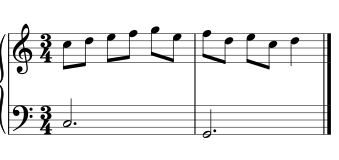
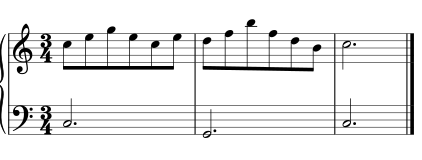
Two eighth notes make a beat in 2/4, 3/4 and 4/4, so they are beamed in pairs, one pair to a beat. Each beam is a beat you can see: count the beams and you have counted the bar, before reading a single note.
What to count: Count eighths, "1 & 2 & 3 &": the first note under each beam is on the number, the second on its "&".
How to read it: Read a pair as one step, the way you read a word: two notes inside one beat. Let the left hand or your foot keep the beat, and the beamed pairs fall into it.
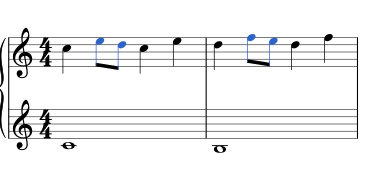
From Exercise Piece in C, Op. 190 No. 13 (Köhler, level 2), bars 1 to 2, as its edition prints them; the notes beamed that way in blue pencil.
Printed in 481 of the 849 pieces, 20,091 groups in all. The easiest of them: Exercise Piece in C, Op. 190 No. 13 (Köhler, level 2), Exercise Piece in C, Op. 190 No. 14 (Köhler, level 2) and Piece in C, Op. 117 No. 5 (Gurlitt, level 2).
Four eighths across the half bar
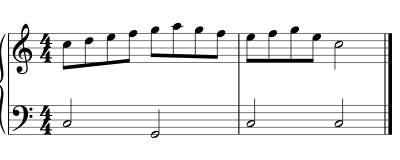
In 4/4 the bar has two halves, and four eighths that fill one half are often beamed together. The beam then shows half a bar, beats 1 and 2 or 3 and 4, never 2 and 3: the middle of the bar stays open so you can see where it is.
What to count: Count "1 & 2 &" under the first beam and "3 & 4 &" under the second. The fifth note of the bar is always on beat 3.
How to read it: Find beat 3 first: it is where a new beam starts. Then each beam is two beats of even eighths, and the hand can read it as one shape, often a scale step or a broken chord.
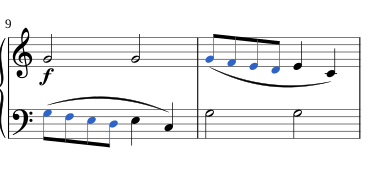
From Old German Dance (Praetorius, level 2), bars 9 to 10, as its edition prints them; the notes beamed that way in blue pencil.
Printed in 159 of the 849 pieces, 5,644 groups in all. The easiest of them: Old German Dance (Praetorius, level 2), Old MacDonald Had a Farm (Traditional, level 2) and Piece in C, Op. 117 No. 8 (Gurlitt, level 2).
A whole bar under one beam
A bar of six eighths in 3/4, or four in 2/4, is often printed under a single beam. It is still three beats (or two): the beam shows the bar as one gesture, a run or a broken chord, not a new beat.
What to count: Count "1 & 2 & 3 &" across the beam: every other note is on a beat. Don't hear it as two groups of three; that is 6/8.
How to read it: Find the beats inside the beam (the first, third and fifth notes) and play them a shade fuller, so the bar keeps its three. The long beam tells you the hand moves in one sweep.
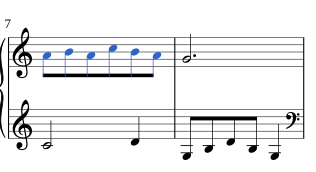
From Study, Op. 101 No. 57 (Beyer, level 2), bars 7 to 8, as its edition prints them; the notes beamed that way in blue pencil.
Printed in 103 of the 849 pieces, 1,616 groups in all. The easiest of them: Study, Op. 101 No. 57 (Beyer, level 2), Allegro in C (Reinagle, level 2) and Study, Op. 101 No. 56 (Beyer, level 2).
Eighths in threes in 6/8
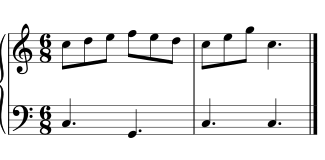
In 6/8, 9/8 and 12/8 the beat is a dotted quarter, three eighths, so the eighths are beamed in threes. Two beams of three is a bar of 6/8; six eighths beamed in pairs instead would be 3/4. The beam is how you tell the two apart.
What to count: Count each beam "1 & a", "2 & a": the first note under each beam is the beat.
How to read it: Feel two beats in a bar of 6/8, one to each beam, with a lilt: the first note of each three a little heavier. Set a metronome to the dotted quarter, one click to a beam.
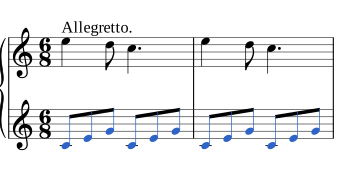
From Study in C, Op. 101 No. 52 (Beyer, level 2), bars 1 to 2, as its edition prints them; the notes beamed that way in blue pencil.
Printed in 122 of the 849 pieces, 7,785 groups in all. The easiest of them: Study in C, Op. 101 No. 52 (Beyer, level 2), Row, Row, Row Your Boat (Traditional, level 2) and Study in C, Op. 101 No. 59 (Beyer, level 2).
Sixteenths under a double beam
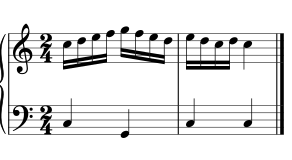
Two beams mean sixteenth notes: four to a beat in 2/4, 3/4 and 4/4, so they are beamed in fours. Three beams are thirty-seconds. However many lines a beam has, one group is still one beat.
What to count: Count sixteenths, "1 e & a 2 e & a": the first note under each beam is on the number.
How to read it: Read the group's shape, not four notes: up, down, a turn. Practise slowly with the beat clicking on the first note of each group, then let the beat carry the run.
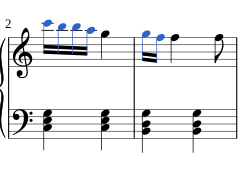
From Gypsy Dance (Haydn, level 3), bars 2 to 3, as its edition prints them; the notes beamed that way in blue pencil.
Printed in 359 of the 849 pieces, 23,028 groups in all. The easiest of them: Allegro in C, K. 1b (Mozart, level 2), Papageno's Aria, from The Magic Flute (Mozart, level 2) and Chorale: Schaff's mit mir, Gott, BWV 514 (Bach, level 2).
An eighth and sixteenths under one beam
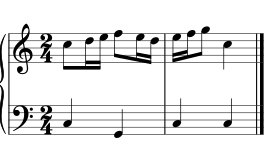
One beam over the whole beat, and a second only over the sixteenths: an eighth and two sixteenths (gallop), or two sixteenths and an eighth (the reverse). The outer beam shows the beat; the inner one shows where it is split.
What to count: Count sixteenths, "1 e & a": an eighth and two sixteenths is played on "1", "&" and "a"; two sixteenths and an eighth on "1", "e" and "&".
How to read it: Look at which end the double beam is on: the quick notes are there. Say the four sixteenths slowly before you play, and keep the eighth its full half beat.
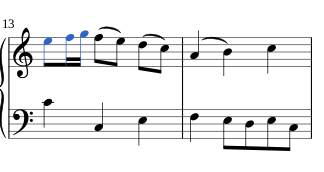
From Chorale: Schaff's mit mir, Gott, BWV 514 (Bach, level 2), bars 13 to 14, as its edition prints them; the notes beamed that way in blue pencil.
Printed in 217 of the 849 pieces, 3,400 groups in all. The easiest of them: Allegro in C, K. 1b (Mozart, level 2), Chorale: Schaff's mit mir, Gott, BWV 514 (Bach, level 2) and Piece in C, Op. 117 No. 11 (Gurlitt, level 3).
A partial beam
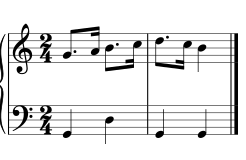
A short stub of a beam on one note: the sixteenth beside a dotted eighth, beamed to it with one full beam and a stub for its second. It says the note is a sixteenth without a flag, and the stub points to the note it belongs with.
What to count: Count sixteenths, "1 e & a": a dotted eighth and its stubbed sixteenth are played on "1" and "a". A stub pointing forward (a sixteenth before a dotted eighth) is the Scotch snap, "1" and "e".
How to read it: Play the stubbed note short and close to the note its stub points at. The commonest slip is to even the pair out into two eighths; the stub is there to stop you.
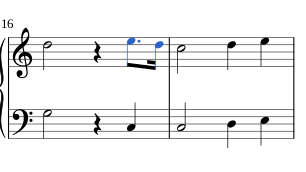
From The Spirit of God (Traditional, level 2), bars 16 to 17, as its edition prints them; the notes beamed that way in blue pencil.
Printed in 231 of the 849 pieces, 4,220 groups in all. The easiest of them: The Spirit of God (Traditional, level 2), I Saw Three Ships (Traditional, level 2) and Polska from Småland (Traditional, level 2).
A beam across the staves
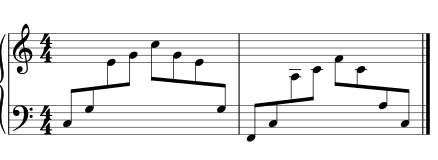
One beam whose notes sit on both staves: a broken chord or a run that starts in the bass and climbs into the treble, printed as one line so you see it as one shape. The hands share it: the notes on the bass staff are the left hand's, the ones above are the right's.
What to count: Count it like any beam, "1 & 2 &": the staff each note sits on says which hand plays it, not when.
How to read it: Read the beam as one line first, then split it: the left hand takes the low notes and hands over smoothly, so the line sounds as if one hand played it.
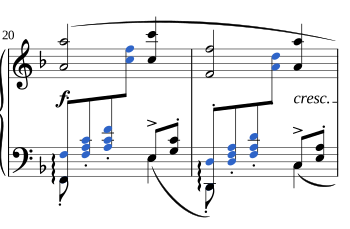
From Intermezzo, from Cavalleria rusticana (Mascagni, level 3), bars 20 to 21, as its edition prints them; the notes beamed that way in blue pencil.
Printed in 37 of the 849 pieces, 237 groups in all. The easiest of them: Chorale: Aus meines Herzens Grunde, BWV 269 (Bach, level 3), Little Canon, Op. 68 No. 27 (Schumann, level 3) and Intermezzo, from Cavalleria rusticana (Mascagni, level 3).
How each time signature is beamed
Every time signature that at least 5 of the library's pieces print, with how many beamed groups they print in it and the three groupings most of those take. Each share is of the groups the library prints in that time.
Beams level by level
How many of the library's pieces at each level print beams, how many print a double beam (sixteenths, alone or with an eighth or a stub), and the groupings met there. Clefsight's reading course teaches eighth notes in G position and moving the hand (level 3) and sixteenths in 4ths and 5ths (level 4).
| Level | Pieces | Beams | Double beams | Groupings |
|---|---|---|---|---|
| Level 2 | 105 | 57% | 8% | eighths beamed by the beat, four eighths across the half bar, a whole bar under one beam, eighths in threes, sixteenths under a double beam, an eighth and sixteenths under one beam and a partial beam |
| Level 3 | 452 | 92% | 48% | eighths beamed by the beat, four eighths across the half bar, a whole bar under one beam, eighths in threes, sixteenths under a double beam, an eighth and sixteenths under one beam, a partial beam and a beam across the staves |
| Level 4 | 212 | 98% | 76% | eighths beamed by the beat, four eighths across the half bar, a whole bar under one beam, eighths in threes, sixteenths under a double beam, an eighth and sixteenths under one beam, a partial beam and a beam across the staves |
| Level 5 | 61 | 100% | 80% | eighths beamed by the beat, four eighths across the half bar, a whole bar under one beam, eighths in threes, sixteenths under a double beam, an eighth and sixteenths under one beam, a partial beam and a beam across the staves |
| Level 6 | 15 | 100% | 80% | eighths beamed by the beat, a whole bar under one beam, eighths in threes, sixteenths under a double beam, an eighth and sixteenths under one beam, a partial beam and a beam across the staves |
| Level 7 | 4 | 100% | 25% | eighths beamed by the beat, four eighths across the half bar, a whole bar under one beam, eighths in threes, sixteenths under a double beam, a partial beam and a beam across the staves |
What Clefsight grades
Clefsight prints each piece's beams as its edition does and grades when each note starts, on time within a tenth of your own beat; the beams aren't graded, they are there to be read. A pair of eighths played unevenly, or a group of sixteenths that rushes, shows as notes marked early or late, in blue pencil.
A beam across the staves is graded like any other notes: each note by the staff it sits on, so the left hand plays what is on the bass staff. Fresh sight-reading, the drills and the exercises beam by the beat, as an edition would.
Read beamed eighths and sixteenths at sight. A short drill of rhythms with eighth and sixteenth notes, at a MIDI keyboard or on the keys on screen. Or tap them in time in the rhythm reading game.
Drill eighths and sixteenthsMore on rhythm: how to read rhythm, the note values chart, time signatures for 6/8, dotted rhythms and syncopation.