Learn to read music · Scales chart
Scale runs and arpeggios: how to read them as one shape
A run is a quick passage built from a scale or a chord: read it note by note and it is a wall of black, read it as a shape and it is one thing to play. Of the 844 pieces in Clefsight's library, 313 (37%) play at least one, 2,880 runs between them. Each kind is below as printed, as it sounds, and in two real bars where it is printed, its notes in blue pencil.
What a run is
A run is a line of quick notes, eighths or shorter, that climbs or falls by the same kind of step: by scale steps, by semitones, or by the 3rds and 4ths of a chord. Composers write them to fill a long note, to lead from one phrase to the next, or simply to dazzle.
Reading one is a different skill from reading a tune. You don't name every note: you find where it starts, where it ends and what it is made of (a scale in the key, a chromatic line, a chord), and the hand fills in the rest from the fingering it already knows. That is why practising scales and arpeggios pays off in pieces.
Counted here, a run is six notes or more by step in one direction (five by semitone, five by 3rds and 4ths spanning an octave or more), each struck one at a time in its part and starting as the last ends, none longer than an eighth note. A run that turns is counted as two.
Scale runs
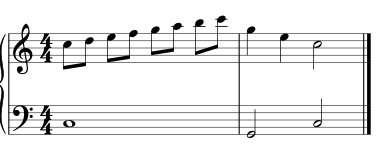
Six notes or more by step in one direction: a piece of a scale, usually in eighths or sixteenths, often an octave or more. More notes than a hand has fingers, so the thumb passes under (going up in the right hand) or a finger crosses over it.
How to read it: Read the first note and the last, then the key signature: everything between is the scale, so you don't read each note. Look for where the run turns or stops, and for any accidental inside it, the one note that isn't the scale.
How to play it: Use the fingering the scale itself takes (the scales chart has every one), and look for printed numbers at the thumb crossings. Practise the run slowly in groups that end on the thumb, then join the groups; let the Steady step's tempo climb with you.
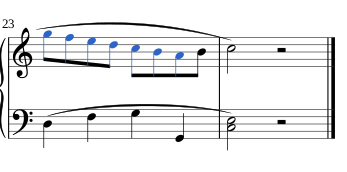
From Elementary Study, Op. 176 No. 2 (Duvernoy, level 2), bars 23 to 24, as its edition prints them, fingering and all; the run's notes in blue pencil.
Played in 275 of the 844 pieces. The easiest of them: Elementary Study, Op. 176 No. 2 (Duvernoy, level 2), Elementary Study, Op. 176 No. 1 (Duvernoy, level 2) and Children's Study, Op. 37 No. 2 (Lemoine, level 2).
Chromatic runs
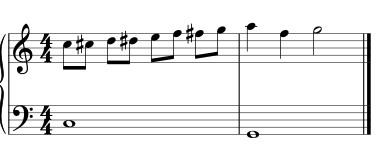
Five notes or more by semitone, every key black and white in turn. On the page it looks busy, with an accidental on nearly every note, but it is the simplest run of all: every next key.
How to read it: Don't read the accidentals one by one: see that the notes climb or fall by the smallest step, find the first and last note, and let the hand fill in every key between.
How to play it: The usual fingering puts 3 on every black key and 1 on the white keys, with 2 where two white keys sit together (E to F, B to C). Keep the hand close to the black keys and the thumb moving under smoothly.
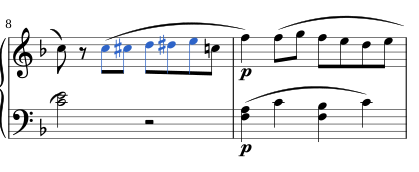
From Elementary Study, Op. 176 No. 8 (Duvernoy, level 3), bars 8 to 9, as its edition prints them, fingering and all; the run's notes in blue pencil.
Played in 61 of the 844 pieces. The easiest of them: Elementary Study, Op. 176 No. 8 (Duvernoy, level 3), Sonatina in C, Op. 36 No. 3: III (Clementi, level 3) and Study in G, Op. 63 No. 5 (Gobbaerts, level 3).
Arpeggios
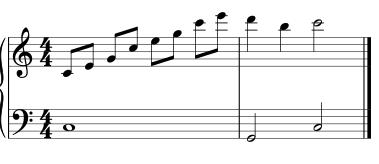
A chord's notes one after another, by 3rds and 4ths in one direction, spanning an octave or more: the chord broken out across the keyboard. In the left hand they are often the accompaniment; in the right, a flourish up to a high note.
How to read it: Name the chord from its lowest notes, then read the run as that chord repeated up or down the octaves; the last note tells you where the hand ends. The stack of 3rds looks like a ladder of lines or of spaces on the staff.
How to play it: The hand stretches over the chord and the thumb passes under at each octave: 1 2 3 1 2 3 5 for a triad in the right hand going up. Practise the chord as a block first, then broken; the arpeggios chart has every major and minor one with its fingering.
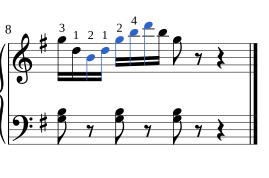
From Short Exercise, Op. 821 No. 17 (Czerny, level 3), bar 8, as its edition prints them, fingering and all; the run's notes in blue pencil.
Played in 72 of the 844 pieces. The easiest of them: Short Exercise, Op. 821 No. 17 (Czerny, level 3), Pastorale, Op. 100 No. 3 (Burgmüller, level 3) and Short Exercise, Op. 821 No. 5 (Czerny, level 3).
Runs between the hands
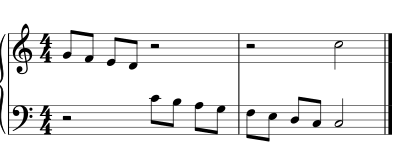
A run that starts in one hand and carries on in the other, one note at a time, so it can sweep further than one hand could: down from the treble into the bass, or up the other way. Each hand plays its own part of the line and the other is silent.
How to read it: Read it as one line across both staves: the notes step on from the treble staff to the bass (or back) and only the clef changes. Find where it passes from hand to hand; an edition may mark that note with r.h. or l.h.
How to play it: Practise the place where the hands meet until the hand-over makes no gap and no bump: the last note of one hand and the first of the other in time, like two fingers of one hand. Then play the whole run slowly.
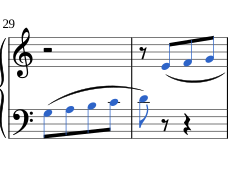
From March of the Grand Staircase, from Enfantillages pittoresques (Satie, level 2), bars 29 to 30, as its edition prints them, fingering and all; the run's notes in blue pencil.
Played in 7 of the 844 pieces. The easiest of them: March of the Grand Staircase, from Enfantillages pittoresques (Satie, level 2), Study in C, Op. 47 No. 2 (Heller, level 3) and Little Prelude in A minor, BWV 942 (Bach, level 4).
The library's pieces with the most runs
The pieces where the largest share of bars starts a run, of those with at least four, and that share in blue. Studies lead, since a study is often one kind of run worked through every key it passes; the longest single run in the library is 49 notes, in The Virtuoso Pianist, No. 40 (Hanon, level 6).
- The Virtuoso Pianist, No. 35 (Hanon, level 3) 97%
- Study, Op. 599 No. 69 (Czerny, level 4) 94%
- The Virtuoso Pianist, No. 38 (Hanon, level 3) 94%
- Children's Study, Op. 37 No. 1 (Lemoine, level 3) 94%
- Invention No. 9 in F minor, BWV 780 (Bach, level 5) 91%
- The School of Velocity, Op. 299 No. 2 (Czerny, level 3) 90%
- Short Exercise, Op. 821 No. 8 (Czerny, level 4) 88%
- Children's Study, Op. 37 No. 2 (Lemoine, level 2) 88%
Runs level by level
How many of the library's pieces at each level play a run, and the kinds met there. Short scale runs come first, just past a hand position; chromatic runs and arpeggios over the octave come later.
| Level | Pieces | Runs | Kinds |
|---|---|---|---|
| Level 2 | 105 | 6% | scale runs and runs between the hands |
| Level 3 | 452 | 29% | scale runs, chromatic runs, arpeggios and runs between the hands |
| Level 4 | 207 | 63% | scale runs, chromatic runs, arpeggios and runs between the hands |
| Level 5 | 61 | 52% | scale runs, chromatic runs, arpeggios and runs between the hands |
| Level 6 | 15 | 80% | scale runs, chromatic runs, arpeggios and runs between the hands |
| Level 7 | 4 | 100% | scale runs, chromatic runs and arpeggios |
Practising a run in a piece
Work out the fingering first and pencil the thumb crossings in, then play the run slowly and evenly, with no accent where the thumb goes under. Practise it in groups that end on a long note or a thumb, then join the groups; start a note or two before the run so the hand arrives ready.
Clefsight's Steady step suits a run: it starts below the marked speed and climbs 5% with each clean take, so the run speeds up only as fast as it stays clean. Loop the bars with the run on the stand, and play them in Wait first if the notes are new.
Know the shapes before the piece. Every major and minor scale with its fingering, to learn the runs pieces are built from. Arpeggios have their own arpeggios chart.
Scales chartMore on reading the hands: left-hand patterns, hand crossing and leaps, piano finger numbers and the five-finger scales.