Learn to read music · Time signatures
Common time and cut time: what C and ¢ mean and how to count them
Common time and cut time are two time signatures printed as a sign instead of numbers. A C is common time, the same as 4/4: four quarter-note beats in a bar. A C with a line through it, ¢, is cut time or alla breve, the same as 2/2: two half-note beats in a bar. In the library, 57 of the 851 pieces open in common time printed as C and 12 in cut time printed as ¢. Each sign is below with two bars of our own, the counts under the notes, and the first bars of a library piece that opens with it, the sign in blue pencil.
How to read C and ¢
Both signs sit where a time signature goes, right after the clef and key signature at the start of the music, and they mean exactly what their numbers mean: C is 4/4 and ¢ is 2/2. A bar of either holds the same notes, a whole note's worth. What differs is the beat: four quarter notes in common time, two half notes in cut time.
So before you play, read the sign as its numbers and ask what gets the beat. In C, count "1 2 3 4". In ¢, count "1 2" with each count a half note long, and the music moves twice as fast for the same number on the metronome.
Common time C, the same as 4/4
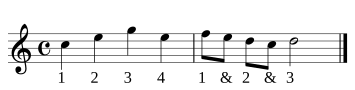
The C in place of a time signature is common time: four quarter-note beats in every bar, exactly as 4/4. It is the most used time in music, and the sign is older than the numbers: a half circle that medieval and Renaissance music used for "imperfect" time, where a long note divides in two (a full circle meant three). So the C does not stand for "common", though the name fits. Bach's inventions, sonatinas, hymns and songs print it.
How to play it: Count four quarter notes to the bar, "1 2 3 4", with the strongest beat on 1 and a lighter one on 3; eighths are "1 & 2 & 3 & 4 &". Nothing about the music changes between a C and a 4/4: they are two ways of printing one time.
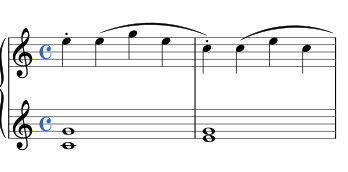
From Study, Op. 139 No. 2 (Czerny, level 2), its first two bars as its edition prints them; the common time sign in blue pencil.
57 of the 851 pieces open with C, and 234 more print the same time as 4/4. The easiest of them: Study, Op. 139 No. 2 (Czerny, level 2), Elementary Study, Op. 176 No. 3 (Duvernoy, level 2) and Gavotte (Telemann, level 2).
Cut time ¢, the same as 2/2, also called alla breve
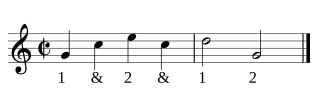
The C with a line through it is cut time, or alla breve: two half-note beats in every bar, exactly as 2/2. A bar holds as many notes as a bar of 4/4, but it is felt in two, so the music moves with a longer stride. Marches, Baroque gavottes and bourrées and quick finales are often in cut time, and so are hymns printed in half notes.
How to play it: Count two beats to the bar, "1 2", one on each half note; quarter notes are then "1 & 2 &". Set the metronome to the half note: a cut-time piece at 80 to the half is as fast as 160 to the quarter. At first you can count it in four, slowly, and when the notes are sure let the count fall to two so the bar flows.
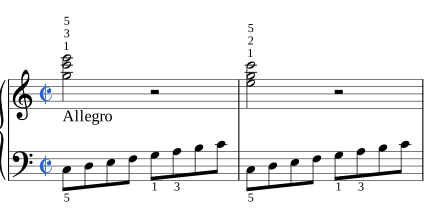
From Children's Study, Op. 37 No. 2 (Lemoine, level 2), its first two bars as its edition prints them; the cut time sign in blue pencil.
12 of the 851 pieces open with ¢, and 16 more print the same time as 2/2. The easiest of them: Children's Study, Op. 37 No. 2 (Lemoine, level 2), Children's Study, Op. 37 No. 1 (Lemoine, level 3) and Children's Study, Op. 37 No. 14 (Lemoine, level 3).
How fast is cut time?
Cut time is not a tempo, only a way of counting, but it usually goes with music that moves: a march, a quick finale, a gavotte. A metronome mark in cut time is given to the half note (a half note = 80), the beat you count, or to the quarter note, so look at which note the mark shows: set the metronome to the half note's number, or to twice it if you count quarters.
The library's 12 pieces in cut time go at 80 half notes a minute at the middle, the same as 160 quarter notes; its pieces in common time go at 108 quarter notes a minute. 3 of the 7 cut-time pieces that print a metronome mark give it to the half note.
What Clefsight does in common and cut time
The count-in clicks the beat the time signature sets. In common time it counts one bar of quarters, "1 2 3 4". In cut time it clicks the half note and, since one bar is only two clicks, counts two bars, "1 2 1 2". The click that goes on through the take keeps that beat and stresses the first of every bar.
Where a cut-time piece is slow enough that its half notes would click fewer than 40 times a minute (under 80 quarter notes a minute), the click counts quarters instead, four to the bar, so you still hear a steady beat. Either way a take is graded note by note against your own steady beat, so the sign changes nothing in how it is marked.
Count any time at a glance. C and ¢ are 4/4 and 2/2 by another name: a short drill of rhythms in each time signature, tapped at a MIDI keyboard or on the keys on screen.
Drill time signaturesMore on counting: time signatures, how to read rhythm, beamed notes, time signature changes, tempo markings and the metronome.
How we counted
Each piece's opening time is read from its score: the first time signature it prints, as the sign where the score marks it as one (common or cut), else as its numbers. Only pieces opening in 4/4 or 2/2 are counted; a time set without being printed is left out. 4 more pieces move into C or ¢ partway through and are not counted as opening in it. A piece's speed is its printed metronome mark, or where it prints none the speed Clefsight suggests for it.