Early 20th-century piano pieces
Music from about 1900 to 1945, by Debussy, Satie, Scriabin and Bartók, who turned from Romantic harmony toward colour, plainness and folk song. Here are 15 pieces by 4 composers, easiest first. Each has easier versions made from the score itself (the right-hand melody alone, then with left-hand roots), so you can start a step down and play it as written later.
- Pieces
- 15
- Levels
- 2 to 5
- Key signatures
- 3 flats to 4 sharps
- Length
- 16 to 106 bars
Reading early 20th-century music
Harmony heard for its colour: chords that don't resolve where Romantic ears expect, scales from older modes, and chords that slide together in parallel.
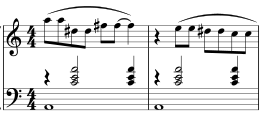
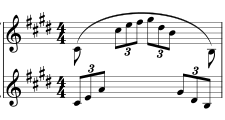
Pieces here: Gymnopédie No. 1 (Satie, level 4); The Little Shepherd, from Children's Corner (Debussy, level 5); Rêverie (Debussy, level 5).
Fewer signposts: Satie wrote his Gnossiennes without bar lines or a time signature and printed advice to the player where a tempo mark would be. Count the beats in each phrase rather than in each bar.
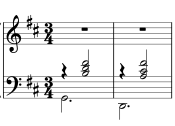
Pieces here: Gnossienne No. 1 (Satie, level 3); Gnossienne No. 3 (Satie, level 4).
Folk song: Bartók set tunes he collected in Hungary and Romania, with their old modes, uneven phrases and accents off the beat.
Pieces here: Romanian Folk Dance No. 2 (Bartók, level 3); Evening in Transylvania (Bartók, level 3).
What the scores print
Of each period's pieces in the library, the share whose score prints each kind of sign. Ornament signs fade after the Baroque, as composers wrote out what they wanted, and marks for loudness, pedal and speed grow through the Romantic period.
| Baroque 1600–1750 | Classical 1750–1820 | Romantic 1820–1900 | Early 20th century 1900–1945 | |
|---|---|---|---|---|
| Ornament signs (trill, mordent, turn) | 48% | 26% | 7% | 0% |
| Loud and soft (p, f, crescendo) | 20% | 60% | 78% | 67% |
| Pedal marks | 3% | 6% | 27% | 7% |
| Slowing and back (rit., a tempo) | 3% | 4% | 32% | 13% |
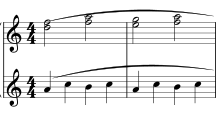
Level 2
A tune over a simple left hand, mostly in one hand position.
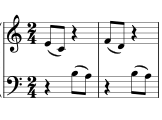
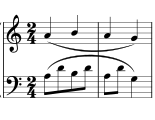
Level 3
Both hands busy, the hand moves around, a sharp or flat or two.
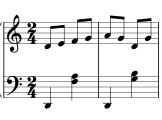
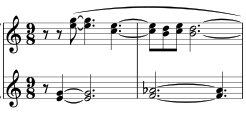
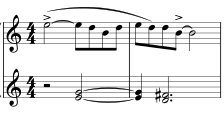
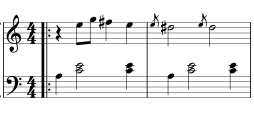
Level 4
Real independence between the hands and more accidentals.
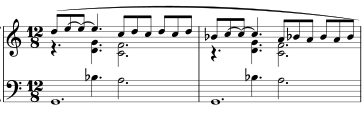
Level 5
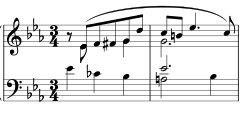
The edge of early intermediate: dense textures, fast passages and far keys.
Composers
Each composer is placed in one period, by when they were writing; one whose working life spans two is placed where most histories place them.
Satie's Gymnopédies date from 1888; he is placed with the early 20th century, beside Debussy, for the plain new music he went on to write.
Debussy was writing from the 1880s; he is placed with the early 20th century, as most histories place him, among those who turned from Romantic harmony.
Scriabin began in Chopin's style, as his Étude Op. 2 No. 1 (1887) shows; histories place him with the early 20th century, for the music he wrote after 1900.
Hymns, carols, popular songs, ragtime, teaching studies and traditional tunes aren't music of a period in this sense, so their composers aren't placed in one, and a hymn tune by a composer placed here is left out too. They have pages of their own: hymns, Christmas music, ragtime, studies and traditional tunes.
Other periods: Baroque piano pieces (1600–1750) · Classical period piano pieces (1750–1820) · Romantic piano pieces (1820–1900)
Open a piece to print any of its versions free, or to play it at your MIDI keyboard with every note marked. New to reading? The level 2 sight-reading exercises are a good warm-up.