Ragtime piano: Scott Joplin's rags and more
Ragtime is the piano music of America around 1900: marches and two-steps with a syncopated tune over a steady, striding left hand, sold as sheet music from the late 1890s. Scott Joplin is its best-known composer, and eight of these pieces are his, one written with his pupil Scott Hayden; with the rags are his concert waltz Bethena and Solace, a serenade over a habanera rhythm. Around them are rags by Tom Turpin, whose Harlem Rag of 1897 was among the first to be published, James Scott, Charles Hunter, Charles L. Johnson and Euday Bowman, and Henry Lodge's Temptation Rag in a simplified arrangement. Each has easier versions made from the score itself, starting with one hand alone.
- Pieces
- 17
- Levels
- 3 to 5
- Key signatures
- 5 flats to 1 sharp
- Length
- 37 to 256 bars
Reading a rag
The left hand of a rag mostly does one thing: a low bass note on the beat, then a chord in the middle of the keyboard between the beats, back and forth. Read it in pairs. Find the bass note, then the chord, and notice that the chord's shape stays the same for as long as the harmony does, often a whole bar or two. The bass is often written as an octave: read the lower note and let your hand find the upper one by its width.
The right hand carries the syncopation: notes that start between the beats and are tied across them, so the accent lands where the left hand isn't. Count aloud, one and two and, with the left hand on the numbers, and place each right-hand note on its number or its and. A note tied over the beat is held through it, not struck again. Rags come in sections of sixteen bars, called strains, and most strains are played twice, so look for the repeat signs and the first and second endings before you start.
Joplin printed a notice on several of his rags: it is never right to play ragtime fast. Take a speed at which the left hand stays perfectly even, since the syncopation is only heard against a steady beat, and practise the hands apart first if the stride is new to you; the easier versions start with one hand alone.
Level 3
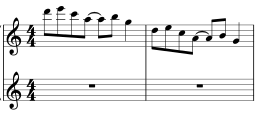
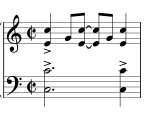
Both hands busy, the hand moves around, a sharp or flat or two. Most of the Notebook minuets, sonatinas, The Entertainer.
Level 4
Real independence between the hands and more accidentals. Bach's inventions and little preludes, Für Elise, Chopin's easier preludes.
-
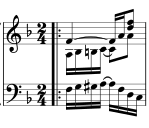 Solace
Scott Joplin 1 flat, 2/4, 64 bars -
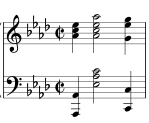 Tickled to Death
Charles Hunter 4 flats, 4/4, 108 bars -
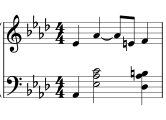 Possum and Taters
Charles Hunter 4 flats, 4/4, 132 bars -
 St. Louis Rag
Tom Turpin no sharps or flats, 2/4, 133 bars -
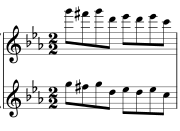 Temptation Rag
Henry Lodge 3 flats, 2/2, 140 bars -
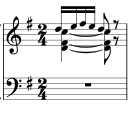 Dill Pickles
Charles L. Johnson 1 sharp, 2/4, 148 bars -
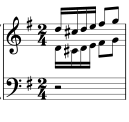 Weeping Willow
Scott Joplin 1 sharp, 2/4, 148 bars -
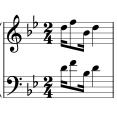 Sun Flower Slow Drag
Scott Joplin / Scott Hayden 2 flats, 2/4, 152 bars -
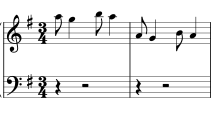 Bethena
Scott Joplin 1 sharp, 3/4, 219 bars -
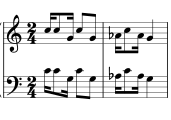 Harlem Rag
Tom Turpin no sharps or flats, 2/4, 256 bars
Level 5
The edge of early intermediate: dense textures, fast passages and far keys. The Moonlight Sonata, Maple Leaf Rag, Solfeggietto.
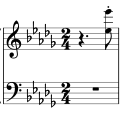
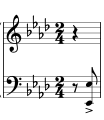
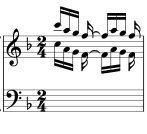
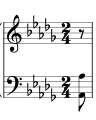
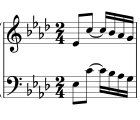
Open a piece to print any of its versions free, or to play it at your MIDI keyboard with every note marked. New to reading? The level 2 sight-reading exercises are a good warm-up.