Baroque piano pieces
Keyboard music from about 1600 to 1750, the years of Bach, Handel, Scarlatti and Rameau, written for the harpsichord, the clavichord and the organ: the piano was invented around 1700, and few of these composers wrote for it. Here are 60 pieces by 12 composers, easiest first. Each has easier versions made from the score itself (the right-hand melody alone, then with left-hand roots), so you can start a step down and play it as written later.
- Pieces
- 60
- Levels
- 2 to 6
- Key signatures
- 4 flats to 6 sharps
- Length
- 9 to 230 bars
Reading Baroque music
Two hands of equal weight. The left hand is often a second tune rather than chords: read it as a line, mostly moving by step against the right hand, and practise each hand alone first.
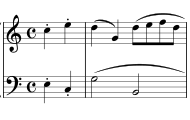
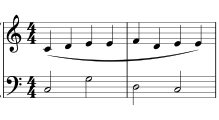
Pieces here: Minuet in G, BWV Anh. 114 (Petzold, level 3); Invention No. 1 in C, BWV 772 (Johann Sebastian Bach, level 3).
Ornaments: trills, mordents and turns printed as small signs over a note, which the player fills in. Learn the notes plain, then add the ornaments once the hands are sure.
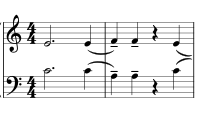
Pieces here: Minuet in F, BWV Anh. 113 (anonymous, level 3); Menuet, from the Premier livre (Rameau, level 3); Courante (Jacquet de La Guerre, level 4).
Dances: the gavotte, hornpipe, sarabande and gigue, each with its own metre and step. Most fall into two halves, each played twice.
Pieces here: Gavotte (Telemann, level 2); Hornpipe in G minor (Purcell, level 3); Sarabande, HWV 437 (Handel, level 3); Gigue (Jacquet de La Guerre, level 4).
Few marks for loudness or speed. The harpsichord couldn't play louder by touch, and players chose speed and loudness for themselves; where a score here prints them, they are mostly an editor's.
What the scores print
Of each period's pieces in the library, the share whose score prints each kind of sign. Ornament signs fade after the Baroque, as composers wrote out what they wanted, and marks for loudness, pedal and speed grow through the Romantic period.
| Baroque 1600–1750 | Classical 1750–1820 | Romantic 1820–1900 | Early 20th century 1900–1945 | |
|---|---|---|---|---|
| Ornament signs (trill, mordent, turn) | 48% | 26% | 7% | 0% |
| Loud and soft (p, f, crescendo) | 20% | 60% | 78% | 67% |
| Pedal marks | 3% | 6% | 27% | 7% |
| Slowing and back (rit., a tempo) | 3% | 4% | 32% | 13% |
Level 2
A tune over a simple left hand, mostly in one hand position.
Level 3
Both hands busy, the hand moves around, a sharp or flat or two.
-
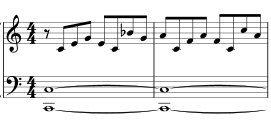 Little Prelude in C, BWV 939
Johann Sebastian Bach no sharps or flats, 4/4, 16 bars -
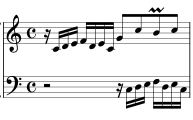 Invention No. 1 in C, BWV 772
Johann Sebastian Bach no sharps or flats, 4/4, 22 bars -
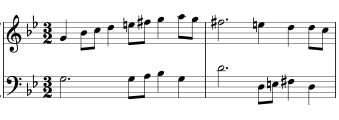 Hornpipe in G minor
Henry Purcell 2 flats, 3/2, 32 bars -
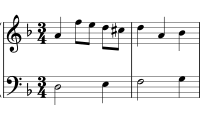 Minuet in D minor, BWV Anh. 132
Anonymous (Notebook for Anna Magdalena Bach) 1 flat, 3/4, 32 bars -
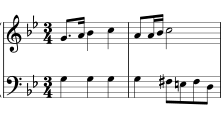 Polonaise in G minor, BWV Anh. 119
Anonymous (Notebook for Anna Magdalena Bach) 2 flats, 3/4, 32 bars -
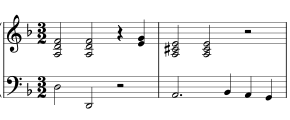 Sarabande, HWV 437
George Frideric Handel 1 flat, 3/2, 32 bars -
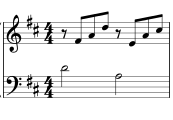 Canon in D
Johann Pachelbel 2 sharps, 4/4, 33 bars, shortened -
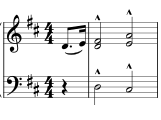 March from Scipio
George Frideric Handel 2 sharps, 4/4, 33 bars -
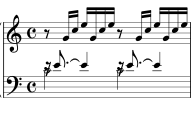 Prelude in C, BWV 846
Johann Sebastian Bach no sharps or flats, 4/4, 35 bars -
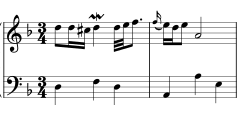 Polonaise in D minor, BWV Anh. 128
Anonymous (Notebook for Anna Magdalena Bach) 1 flat, 3/4, 36 bars -
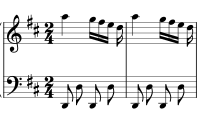 Musette in D, BWV Anh. 126
Anonymous (Notebook for Anna Magdalena Bach) 2 sharps, 2/4, 40 bars -
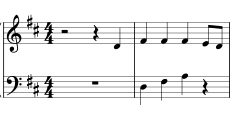 Spring, from The Four Seasons
Antonio Vivaldi 2 sharps, 4/4, 40 bars, shortened -
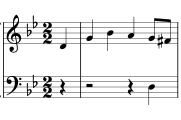 Impertinence, HWV 494
George Frideric Handel 2 flats, 2/2, 41 bars -
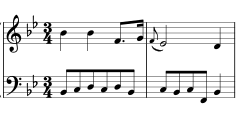 Minuet in B flat, BWV Anh. 118
Anonymous (Notebook for Anna Magdalena Bach) 2 flats, 3/4, 48 bars -
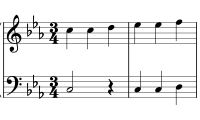 Minuet in C minor, BWV Anh. 121
Anonymous (Notebook for Anna Magdalena Bach) 3 flats, 3/4, 48 bars -
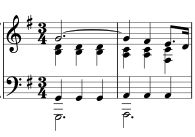 Largo (Ombra mai fu), from Serse
George Frideric Handel 1 sharp, 3/4, 52 bars -
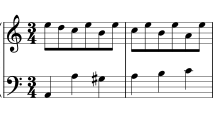 Menuet, from the Premier livre
Jean-Philippe Rameau no sharps or flats, 3/4, 52 bars -
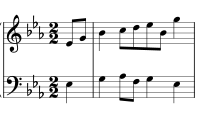 March in E flat, BWV Anh. 127
Anonymous (Notebook for Anna Magdalena Bach) 3 flats, 2/2, 57 bars -
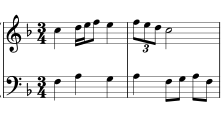 Minuet in F, BWV Anh. 113
Anonymous (Notebook for Anna Magdalena Bach) 1 flat, 3/4, 64 bars -
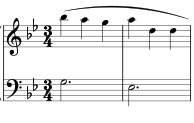 Minuet in G minor, BWV Anh. 115
Christian Petzold 2 flats, 3/4, 64 bars -
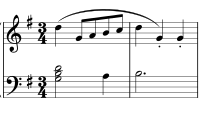 Minuet in G, BWV Anh. 114
Christian Petzold 1 sharp, 3/4, 64 bars -
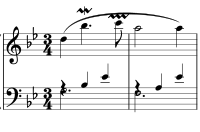 Minuet in G minor, HWV 434
George Frideric Handel 2 flats, 3/4, 92 bars
Level 4
Real independence between the hands and more accidentals.
-
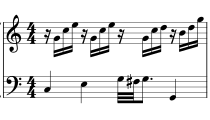 Little Prelude in C, BWV 924
Johann Sebastian Bach no sharps or flats, 4/4, 18 bars -
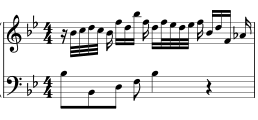 Invention No. 14 in B flat, BWV 785
Johann Sebastian Bach 2 flats, 4/4, 20 bars -
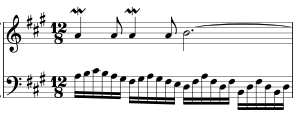 Invention No. 12 in A, BWV 783
Johann Sebastian Bach 3 sharps, 12/8, 21 bars -
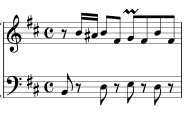 Invention No. 15 in B minor, BWV 786
Johann Sebastian Bach 2 sharps, 4/4, 22 bars -
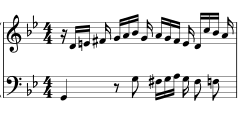 Invention No. 11 in G minor, BWV 782
Johann Sebastian Bach 2 flats, 4/4, 23 bars -
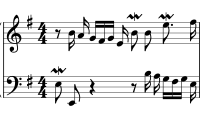 Invention No. 7 in E minor, BWV 778
Johann Sebastian Bach 1 sharp, 4/4, 23 bars -
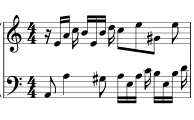 Invention No. 13 in A minor, BWV 784
Johann Sebastian Bach no sharps or flats, 4/4, 25 bars -
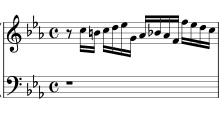 Invention No. 2 in C minor, BWV 773
Johann Sebastian Bach 3 flats, 4/4, 27 bars -
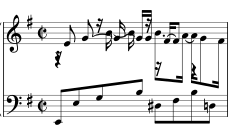 A New Ground
Henry Purcell 1 sharp, 4/4, 31 bars -
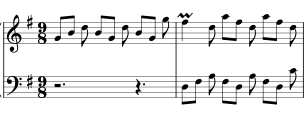 Invention No. 10 in G, BWV 781
Johann Sebastian Bach 1 sharp, 9/8, 32 bars -
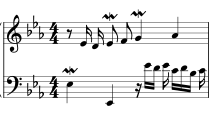 Invention No. 5 in E flat, BWV 776
Johann Sebastian Bach 3 flats, 4/4, 32 bars -
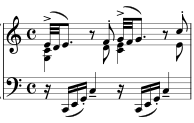 Little Prelude in C, BWV 933
Johann Sebastian Bach no sharps or flats, 4/4, 32 bars -
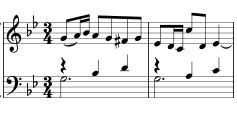 Minuet in G minor, BWV 842
Johann Sebastian Bach 2 flats, 3/4, 32 bars -
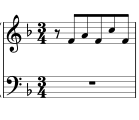 Invention No. 8 in F, BWV 779
Johann Sebastian Bach 1 flat, 3/4, 34 bars -
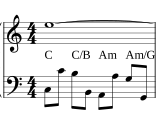 Air on the G String
Johann Sebastian Bach no sharps or flats, 4/4, 36 bars -
 Gigue, from the Suite in G minor, HWV 432
George Frideric Handel 2 flats, 12/8, 39 bars -
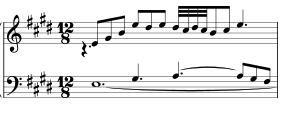 Prelude and Fugue in E, BWV 854
Johann Sebastian Bach 4 sharps, 12/8, 44 bars -
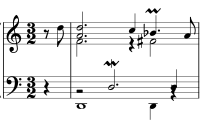 Courante
Élisabeth Jacquet de La Guerre no sharps or flats, 3/2, 45 bars -
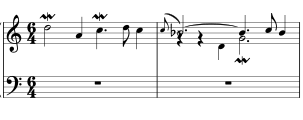 Gigue
Gigue
Élisabeth Jacquet de La Guerre no sharps or flats, 6/4, 64 bars -
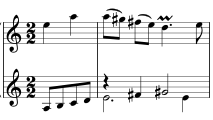 Gavotte, from the Premier livre
Jean-Philippe Rameau no sharps or flats, 2/2, 65 bars -
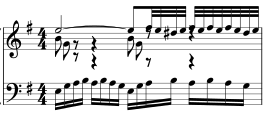 Prelude and Fugue in E minor, BWV 855
Johann Sebastian Bach 1 sharp, 4/4, 73 bars -
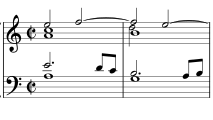 Fantasia in A minor, BWV 904
Johann Sebastian Bach no sharps or flats, 2/2, 74 bars -
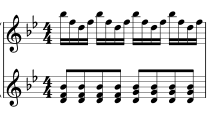 The Arrival of the Queen of Sheba
George Frideric Handel 2 flats, 4/4, 89 bars -
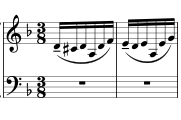 Little Prelude in D minor, BWV 935
Johann Sebastian Bach 1 flat, 3/8, 96 bars -
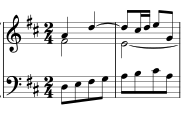 Little Prelude in D, BWV 936
Johann Sebastian Bach 2 sharps, 2/4, 96 bars -
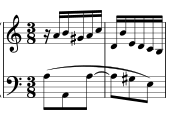 Fantasia, from the Partita No. 3 in A minor, BWV 827
Johann Sebastian Bach no sharps or flats, 3/8, 120 bars -
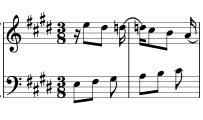 Invention No. 6 in E, BWV 777
Johann Sebastian Bach 4 sharps, 3/8, 124 bars -
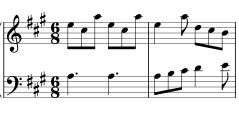 Sonata in A, K. 323
Domenico Scarlatti 3 sharps, 6/8, 125 bars -
 Sonata in D, K. 346
Domenico Scarlatti 2 sharps, 3/8, 196 bars
Level 5
The edge of early intermediate: dense textures, fast passages and far keys.
-
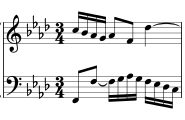 Invention No. 9 in F minor, BWV 780
Johann Sebastian Bach 4 flats, 3/4, 34 bars -
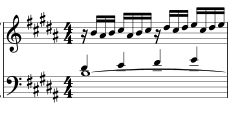 Prelude and Fugue in B, BWV 868
Johann Sebastian Bach 5 sharps, 4/4, 54 bars -
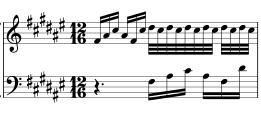 Prelude and Fugue in F sharp, BWV 858
Johann Sebastian Bach 6 sharps, 12/16, 78 bars -
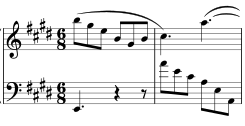 Sonata in E, K. 531
Domenico Scarlatti 4 sharps, 6/8, 230 bars
Level 6
Intermediate: the notes of level 5 at concert speed, held even from the first bar to the last.
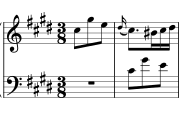
Composers
Each composer is placed in one period, by when they were writing; one whose working life spans two is placed where most histories place them.
- Johann Sebastian Bach 27
- Anonymous (Notebook for Anna Magdalena Bach) 8
- George Frideric Handel 7
- Domenico Scarlatti 4
- Élisabeth Jacquet de La Guerre 2
- Christian Petzold 2
- Henry Purcell 2
- Jean-Philippe Rameau 2
- Antonio Vivaldi 2
- Thomas Arne 1
- Johann Pachelbel 1
- Michael Praetorius 1
- Georg Philipp Telemann 1
Arne lived until 1778, but wrote Rule, Britannia! in 1740, in Handel's London, and is placed with the late Baroque.
Praetorius wrote at the turn from the Renaissance and is placed with the Baroque's first years.
Hymns, carols, popular songs, ragtime, teaching studies and traditional tunes aren't music of a period in this sense, so their composers aren't placed in one, and a hymn tune by a composer placed here is left out too. They have pages of their own: hymns, Christmas music, ragtime, studies and traditional tunes.
Other periods: Classical period piano pieces (1750–1820) · Romantic piano pieces (1820–1900) · Early 20th-century piano pieces (1900–1945)
Open a piece to print any of its versions free, or to play it at your MIDI keyboard with every note marked. New to reading? The level 2 sight-reading exercises are a good warm-up.