Piano sonatinas
Sonatinas a movement at a time, easiest first: Clementi's Sonatinas Op. 36, Kuhlau's Op. 20 No. 1, Attwood's Sonatina in G and the two sonatinas long credited to Beethoven, mostly at level 3; most of Clementi's Op. 36 Nos. 4 to 6, Kuhlau's slow movement and Reinecke's Sonatina in A minor at level 4. Each has easier versions made from the score itself (the right-hand melody alone, then with left-hand roots), so you can start a step down and play it as written later.
- Pieces
- 23
- Levels
- 3 to 5
- Key signatures
- 2 flats to 2 sharps
- Length
- 25 to 181 bars
Reading a sonatina
A sonatina is a small sonata, usually in two or three movements: fast, slow, fast. The first movement is sonata form in miniature: a first tune in the home key, a second in the key a fifth above, a short middle section, then both tunes again, now in the home key. Once you know that, the return is music you have already read.
The left hand is often an Alberti bass, a chord broken bottom, top, middle, top. When you see the chord, you stop reading four notes and read one shape. Scale runs are the right hand's half of the style: read the first and last notes and the fingering where the hand turns, not every note between. Each movement is its own page here, so a slow movement can be learned before the first.
Level 3
Both hands busy, the hand moves around, a sharp or flat or two.
-
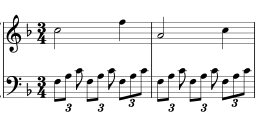 Sonatina in C, Op. 36 No. 1: II
Muzio Clementi 1 flat, 3/4, 26 bars -
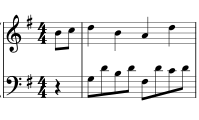 Sonatina in G
Thomas Attwood 1 sharp, 4/4, 28 bars -
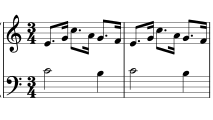 Sonatina in G, Op. 36 No. 2: II
Muzio Clementi no sharps or flats, 3/4, 28 bars -
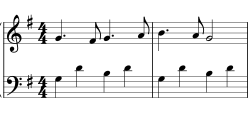 Sonatina in C, Op. 36 No. 3: II
Muzio Clementi 1 sharp, 4/4, 32 bars -
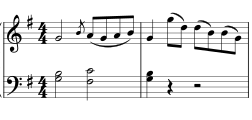 Sonatina in G, Anh. 5
Ludwig van Beethoven 1 sharp, 4/4, 50 bars -
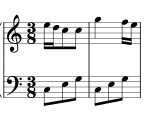 Sonatina in C, Op. 36 No. 1: III
Muzio Clementi no sharps or flats, 3/8, 70 bars -
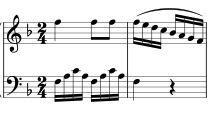 Sonatina in F, Anh. 5
Ludwig van Beethoven 1 flat, 2/4, 71 bars -
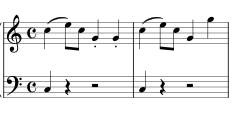 Sonatina in C, Op. 36 No. 1: I
Muzio Clementi no sharps or flats, 4/4, 76 bars -
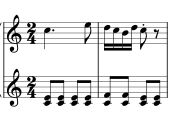 Sonatina in C, Op. 36 No. 3: III
Muzio Clementi no sharps or flats, 2/4, 82 bars -
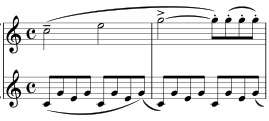 Sonatina in C, Op. 20 No. 1: Allegro
Friedrich Kuhlau no sharps or flats, 4/4, 111 bars -
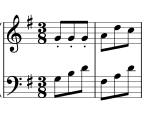 Sonatina in G, Op. 36 No. 2: III
Muzio Clementi 1 sharp, 3/8, 111 bars -
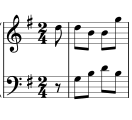 Sonatina in G, Op. 36 No. 2: I
Muzio Clementi 1 sharp, 2/4, 119 bars -
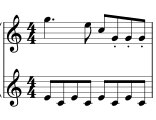 Sonatina in C, Op. 36 No. 3: I
Muzio Clementi no sharps or flats, 4/4, 128 bars
Level 4
Real independence between the hands and more accidentals.
-
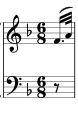 Sonatina in C, Op. 20 No. 1: Andante
Friedrich Kuhlau 1 flat, 6/8, 25 bars -
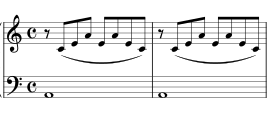 Sonatina in A minor
Carl Reinecke no sharps or flats, 4/4, 64 bars -
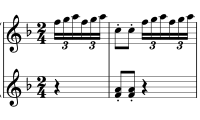 Sonatina in F, Op. 36 No. 4: III
Muzio Clementi 1 flat, 2/4, 79 bars -
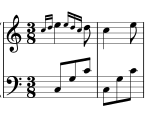 Sonatina in G, Op. 36 No. 5: II
Muzio Clementi no sharps or flats, 3/8, 82 bars -
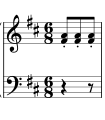 Sonatina in D, Op. 36 No. 6: II
Muzio Clementi 2 sharps, 6/8, 88 bars -
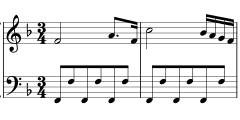 Sonatina in F, Op. 36 No. 4: I
Muzio Clementi 1 flat, 3/4, 142 bars -
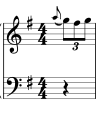 Sonatina in G, Op. 36 No. 5: I
Muzio Clementi 1 sharp, 4/4, 169 bars -
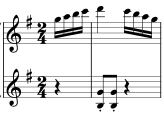 Sonatina in G, Op. 36 No. 5: III
Muzio Clementi 1 sharp, 2/4, 172 bars -
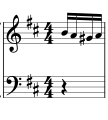 Sonatina in D, Op. 36 No. 6: I
Muzio Clementi 2 sharps, 4/4, 181 bars
Level 5
The edge of early intermediate: dense textures, fast passages and far keys.
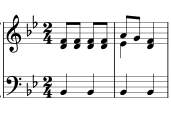
Open a piece to print any of its versions free, or to play it at your MIDI keyboard with every note marked. New to reading? The level 2 sight-reading exercises are a good warm-up.