Richard Storrs Willis (1819–1900)
It Came Upon the Midnight Clear
Hymn tune Carol (1850)
How hard is It Came Upon the Midnight Clear (Willis)? Level 3 of 7 on our scale. Both hands busy, the hand moves around, a sharp or flat or two.
Plays on a MIDI keyboard in Chrome, Edge or Firefox on a computer, or Chrome on an Android phone or tablet, or on the keys on screen without one.
More about It Came Upon the Midnight Clear
In Hymns
No speed is printed on this score. Clefsight plays it at 57 dotted quarters a minute: the usual pace of hymn tunes. The “Plays in” time above is worked out at this speed.
What stands between you and this piece
Clefsight compares the notes of this piece with what you already read. Take the level test and this page will list what's left to learn, item by item.
Versions
Each simpler version only leaves notes out and adds none, so every note in it is the piece's own. Print any of them free.
- As written250 notes
- Melody and a simpler left hand194 notes
- Melody and left-hand roots88 notes
- Right-hand melody71 notes
Its notes with letter names: the sheet music with each note's letter under it, and a drill of the notes it uses.
To practise it on paper: a practice chart for this piece, a week of steps from each hand alone to full tempo, with their speeds.
What it asks of you
- Treble clef from D4 to D5
- Bass clef from A2 to D4, with ledger lines
- Key signature: 2 flats (B♭ major or G minor)
- Accidentals: flats outside the key, naturals
- Rhythm: quarter notes, eighth notes, upbeats (pickup bars), dotted quarter notes
- Intervals: 6ths, 5ths, octaves, 7ths, 4ths, 3rds played together in one hand
- Hands playing together, moving the hand to a new position, one hand moving while the other holds
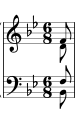
The right hand opens with D and F together, D, D and A together, E♭ and C together, B♭, E♭ and G together, D and F together, E♭ and G together, D and F together twice; the left hand with B♭ and F together twice, B♭ and F♯ together, B♭ and G together, B♭ and A together, B♭, A and F together, B♭ and F together, B♭. Both hands first move to a new position in bar 1. Its highest note is D5, in bar 1, and its lowest A2, in bar 2. It ends with D and B♭ in the right hand over B♭ in the left. From note to note it moves mostly by 6ths (30%), 5ths (29%), and octaves (22%).
Sections
The piece in 2 sections, cut where its music breaks, each read at its own level. Tap one to loop it on the stand until it's clean, then the next.
- Bars 1–8level 3 of 7Right hand D4 and D5 together, D4 and A4 together, E♭4 and C5 together, B♭4, E♭4 and G4 together, D4 and F4 together, E♭4 and G4 together, D4 and F4 together…; left hand B♭2 and F3 together, B♭2 and F♯3 together, B♭2 and G3 together, B♭2 and A3 together, B♭2 and B♭3 together, A2 and F3 together, B♭2 and F3 together, B♭2 and B♭3 together…
- Bars 9–16level 3 of 7Right hand D4 and D5 together, D4 D4, D4 and E4 together, D4 and F♯4 together, D4 and G4 together, G4, D4 and A4 together…; left hand D3, D3 and F♯3 together twice, G3, C3 and A3 together, B♭2 and G3 together, D3 and F♯3 together, G3…
Score typeset by Steve Dunlop for the Mutopia Project (Public Domain), adapted for Clefsight; the composition is public domain: Richard Storrs Willis died in 1900. Public domain in Canada and the United States. It may still be protected where you live. Credits
Community source. A Mutopia Project volunteer's edition that passed our checks: every bar complete, every chord within reach of a hand, repeats that can be followed, and the key its title names. It hasn't been compared bar by bar with a printed edition yet. How we check Heard a wrong note? Tell us