Good Christian Men, Rejoice
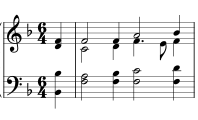
The fourteenth-century carol In dulci jubilo, in Winfred Douglas's four-part harmony from the Episcopal Hymnal (1918)
In Hymns
No speed is printed on this score, so Clefsight plays it at quarter note = 86: the usual pace of hymn tunes. Its length counts from that.
Plays on a MIDI keyboard in Chrome, Edge or Firefox on a computer, or Chrome on an Android phone or tablet, or on the keys on screen without one.
Versions
Each easier version only leaves notes out and adds none, so every note in it is the piece's own. Print any of them free.
- As written226 notes
- Melody and a simpler left hand172 notes
- Melody and left-hand roots76 notes
- Right-hand melody58 notes
The easy version, the melody and a simpler left hand at level 2, engraved on its own page.
To practise it on paper: a practice chart for this piece, a week of steps from each hand alone to full tempo, with their speeds.
What it asks of you
- Treble clef from C4 to D5, with ledger lines
- Bass clef from A2 to D4, with ledger lines
- Key signature: 1 flat (F major or D minor)
- Accidentals: flats outside the key
- Rhythm: quarter notes, half notes, whole notes, dotted half notes, eighth notes, dotted quarter notes
- Intervals: 5ths, octaves, 6ths, 4ths, 10ths, 7ths
- Hands playing together, moving the hand to a new position, one hand moving while the other holds
What stands between you and this piece
Clefsight compares the notes of this piece with what you already read.
Score typed for Clefsight from The Church Pension Fund, New York, 1918 (scan on the Internet Archive), checked note for note, shared under CC0 1.0; the composition is a traditional tune, and so is Winfred Douglas’s arrangement. Credits