Opera for piano
The tunes from the opera house that everyone knows, arranged for piano and printed by level. Papageno's bird-catcher song from The Magic Flute starts at level 2. At level 3 come the drinking song from Verdi's La traviata, Handel's Ombra mai fu (the Largo, sung to a plane tree), Purcell's Trumpet Tune from the semi-opera The Indian Queen, the Intermezzo that Mascagni's Cavalleria rusticana plays while the stage stands empty, Papageno and Papagena's stammering duet, the quick theme of Rossini's Barber of Seville overture and La donna è mobile, the Duke's song from Rigoletto. Wagner's Bridal Chorus and the galop that ends Rossini's William Tell Overture are at level 4, and the Habanera and the Prelude to Carmen, with the Toreador's song, at level 5. Each piece has easier versions made from the score itself, starting with the melody alone.
- Pieces
- 12
- Levels
- 2 to 5
- Key signatures
- 2 flats to 4 sharps
- Length
- 23 to 135 bars
Playing opera on the piano
An aria is a song, and its tune belongs to the singer: let it sound over the accompaniment. Read the right hand's tune alone first until you could sing it, then add the left hand more softly. Where the arranger puts the tune and its chords in one hand, the top note of each chord is the singer's.
Overtures and choruses were written for an orchestra, so a piano version packs many players into two hands. Keep the beat steady before anything else, since Clefsight grades against your own beat, and leave out an inner note of a thick chord while you learn if your hand can't reach it. The easier versions start with the melody alone.
Level 2
A tune over a simple left hand, mostly in one hand position.
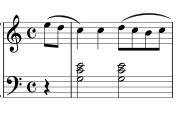
Level 3
Both hands busy, the hand moves around, a sharp or flat or two.
-
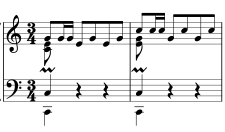 Trumpet Tune, from The Indian Queen
Henry Purcell no sharps or flats, 3/4, 24 bars Checked against the edition -
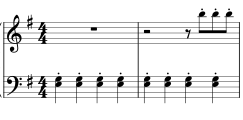 The Barber of Seville: the overture's Allegro
Gioachino Rossini 1 sharp, 4/4, 27 bars Community source -
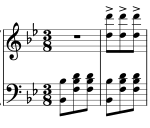 La donna è mobile, from Rigoletto
Giuseppe Verdi 2 flats, 3/8, 44 bars, shortened Community source -
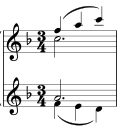 Intermezzo, from Cavalleria rusticana
Pietro Mascagni 1 flat, 3/4, 48 bars Community source -
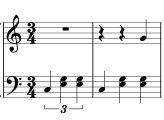 Brindisi, from La traviata
Giuseppe Verdi no sharps or flats, 3/4, 52 bars, shortened Community source -
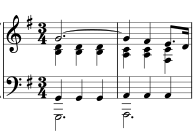 Largo (Ombra mai fu), from Serse
George Frideric Handel 1 sharp, 3/4, 52 bars Community source -
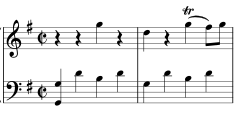 Papageno and Papagena's Duet, from The Magic Flute
Wolfgang Amadeus Mozart 1 sharp, 4/4, 129 bars Community source
Level 4
Real independence between the hands and more accidentals.
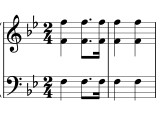
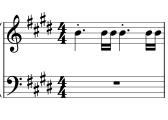
Level 5
The edge of early intermediate: dense textures, fast passages and far keys.
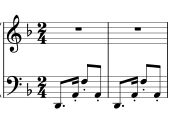
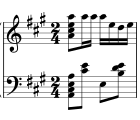
See also: Love songs for piano · Wedding piano pieces · Famous classical piano pieces.
Open a piece to print any of its versions free, or to play it at your MIDI keyboard with every note marked. New to reading? The level 2 sight-reading exercises are a good warm-up.
Learning with someone? Send them this page by email