Piano nocturnes
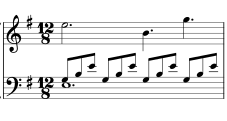
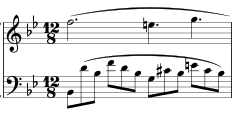
A nocturne is a night piece: a singing tune in the right hand over a left hand that spreads its chords wide across the keyboard, the way a voice is carried by a harp or a guitar. John Field, an Irish pianist who lived in Russia, published the first pieces he called nocturnes in 1812, and Chopin took up the name and wrote twenty-one of his own. Here are three of Field's, all at level 4: No. 10 in E minor, No. 1 in E flat and No. 5 in B flat. Each has easier versions made from the score itself (the right-hand melody alone, then with left-hand roots), so you can learn the tune first and add the left hand later.
- Pieces
- 3
- Level
- 4
- Key signatures
- 3 flats to 1 sharp
- Length
- 37 to 67 bars
Clefsight grades what you read and play: the notes, their rhythm and the two hands together. It doesn't grade rubato, ornaments or tone, and in many nocturnes that is where the difficulty lies. So the library takes a nocturne only where the notes alone read within two grades of the grade Henle's editors give it. Chopin's Nocturnes in E flat, Op. 9 No. 2, in E minor, Op. 72 No. 1, and in C minor, Op. 48 No. 1, read two or more grades easier than Henle grades them, so they are left out.
Reading a nocturne
Read the left hand as chords, not as single notes. Its figure usually keeps one shape for a bar or more, a low bass note and the rest of the chord above it, so find the chord in the first beat and the rest of the bar follows; the bass note on the beat is the one to aim for, since the hand has to jump to it.
The tune moves slowly over it, often in long notes with quick runs between them. Hold the long notes for their full value and keep the left hand quieter, so the tune sings over it. The runs fit into the beat around them: count where the run starts and where it has to land, and fit the notes between at an even pace. Learn the notes at a steady tempo first; the give and take of a nocturne comes after.
Level 4
Real independence between the hands and more accidentals.
Open a piece to print any of its versions free, or to play it at your MIDI keyboard with every note marked. New to reading? The level 2 sight-reading exercises are a good warm-up.
Learning with someone? Send them this page by email