Easy minuets for piano
The minuet is where most players first meet Bach, Mozart and Haydn. Leopold Mozart's Minuet in F is at level 2; at level 3 are the minuets from the Notebook for Anna Magdalena Bach, Petzold's Minuet in G among them, the minuets Mozart wrote as a small child, two by Haydn, Rameau's Menuet and Handel's Minuet in G minor; Bach's own Minuet in G minor, BWV 842, is at level 4. Each has easier versions made from the score itself (the right-hand melody alone, then with left-hand roots), so you can start a step down and play it as written later.
- Pieces
- 18
- Levels
- 2 to 4
- Key signatures
- 3 flats to 3 sharps
- Length
- 32 to 92 bars
Reading a minuet
A minuet is a dance in three: one strong beat and two light ones in every bar, at a walking pace. Its phrases come in pairs, four bars that ask and four that answer, and the piece falls into two halves, each played twice (the repeat signs at the double bar send you back). Mozart's and Haydn's often add a trio, a second minuet, after which the first is played again: Minuet da capo.
In a Baroque minuet the left hand is a second tune, not chords, so read it as a line moving against the right hand, mostly by step. Count three before you start, let the first beat of each bar lean a little, and hold each dotted half note for all three beats: the last beat of a long note is the first thing a hurried reader drops.
Level 2
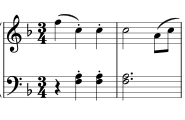
A tune over a simple left hand, mostly in one hand position.
Level 3
Both hands busy, the hand moves around, a sharp or flat or two.
-
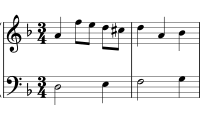 Minuet in D minor, BWV Anh. 132
Anonymous (Notebook for Anna Magdalena Bach) 1 flat, 3/4, 32 bars -
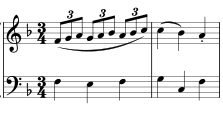 Minuet in F, K. 5
Wolfgang Amadeus Mozart 1 flat, 3/4, 32 bars -
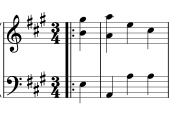 Minuet in A, Hob. IX:8 No. 6
Joseph Haydn 3 sharps, 3/4, 33 bars -
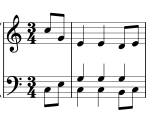 Minuet in C, K. 1f
Wolfgang Amadeus Mozart no sharps or flats, 3/4, 33 bars -
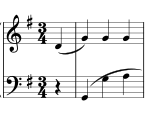 Minuet in G
Joseph Haydn 1 sharp, 3/4, 33 bars -
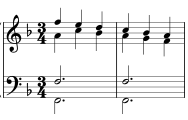 Minuet in F, K. 1d
Wolfgang Amadeus Mozart 1 flat, 3/4, 40 bars -
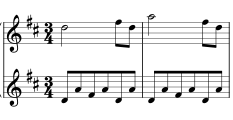 Minuet in D, K. 7
Wolfgang Amadeus Mozart 2 sharps, 3/4, 44 bars -
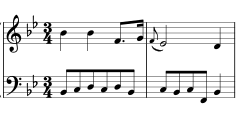 Minuet in B flat, BWV Anh. 118
Anonymous (Notebook for Anna Magdalena Bach) 2 flats, 3/4, 48 bars -
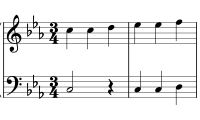 Minuet in C minor, BWV Anh. 121
Anonymous (Notebook for Anna Magdalena Bach) 3 flats, 3/4, 48 bars -
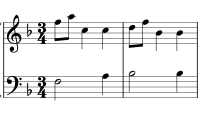 Minuet in F, K. 2
Wolfgang Amadeus Mozart 1 flat, 3/4, 48 bars -
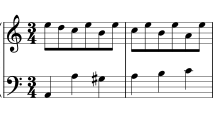 Menuet, from the Premier livre
Jean-Philippe Rameau no sharps or flats, 3/4, 52 bars -
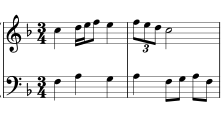 Minuet in F, BWV Anh. 113
Anonymous (Notebook for Anna Magdalena Bach) 1 flat, 3/4, 64 bars -
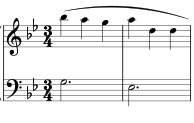 Minuet in G minor, BWV Anh. 115
Christian Petzold 2 flats, 3/4, 64 bars -
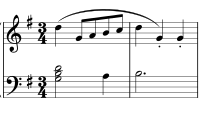 Minuet in G, BWV Anh. 114
Christian Petzold 1 sharp, 3/4, 64 bars -
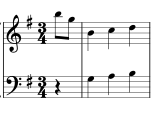 Minuet and Trio in G, K. 1
Wolfgang Amadeus Mozart 1 sharp, 3/4, 81 bars -
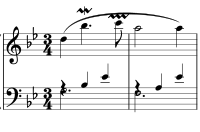 Minuet in G minor, HWV 434
George Frideric Handel 2 flats, 3/4, 92 bars
Level 4
Real independence between the hands and more accidentals.
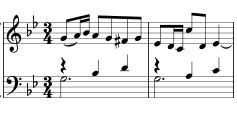
Open a piece to print any of its versions free, or to play it at your MIDI keyboard with every note marked. New to reading? The level 2 sight-reading exercises are a good warm-up.