Marches for piano
Marches, easiest first: Satie's March of the Grand Staircase at level 2; at level 3, the March in E flat from the Notebook for Anna Magdalena Bach, C. P. E. Bach's March in D, Handel's March from Scipio, Schumann's Soldiers' March, Tchaikovsky's March of the Wooden Soldiers, Mozart's Rondo alla turca (the Turkish March) and Chopin's Funeral March in an arrangement; Chopin's Funeral March in C minor, Op. 72, at level 4. Each has easier versions made from the score itself (the right-hand melody alone, then with left-hand roots), so you can start a step down and play it as written later.
- Pieces
- 9
- Levels
- 2 to 4
- Key signatures
- 3 flats to 2 sharps
- Length
- 33 to 108 bars
Reading a march
A march is in two or four, for walking feet: strong, weak, strong, weak. Its phrases are square, four and eight bars, and many have a trio in a new key, often softer, after which the march returns.
The sound of most marches is the dotted rhythm: a long dotted note, then a short one that leads into the next beat. Count it in halves of the beat (one-and-two-and) until the short note falls late enough; played early, a dotted rhythm turns into a lazy pair of even notes.
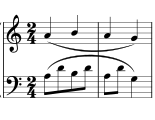
Level 2
A tune over a simple left hand, mostly in one hand position.
Level 3
Both hands busy, the hand moves around, a sharp or flat or two.
-
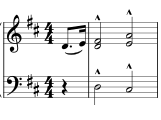 March from Scipio
George Frideric Handel 2 sharps, 4/4, 33 bars -
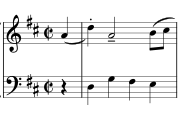 March in D
Carl Philipp Emanuel Bach 2 sharps, 2/2, 45 bars -
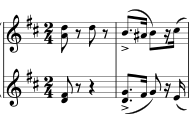 March of the Wooden Soldiers, Op. 39 No. 5
Pyotr Ilyich Tchaikovsky 2 sharps, 2/4, 48 bars -
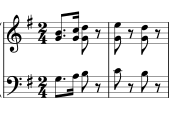 Soldiers' March, Op. 68 No. 2
Robert Schumann 1 sharp, 2/4, 48 bars -
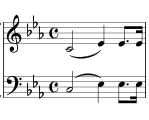
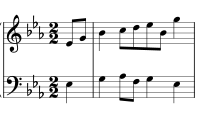 March in E flat, BWV Anh. 127
Anonymous (Notebook for Anna Magdalena Bach) 3 flats, 2/2, 57 bars -
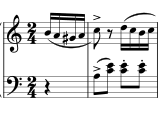 Rondo alla turca (Turkish March)
Wolfgang Amadeus Mozart no sharps or flats, 2/4, 65 bars, shortened -
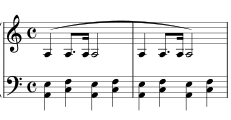 Funeral March, from the Sonata No. 2
Frédéric Chopin no sharps or flats, 4/4, 108 bars
Level 4
Real independence between the hands and more accidentals.
Open a piece to print any of its versions free, or to play it at your MIDI keyboard with every note marked. New to reading? The level 2 sight-reading exercises are a good warm-up.