Lullabies and night pieces for piano
Lullabies and music for the night, to read at the keyboard: the Wiegenlied long credited to Mozart, Satie's Berceuse, Grieg's Berceuse from the Lyric Pieces, Schumann's Child Falling Asleep and Silent Night, whose words sing a child to sleep. Around them are pieces named for the night and for dreaming: Brahms's In stiller Nacht, Gurlitt's Träumerei, Debussy's Rêverie, and a nocturne by John Field, who gave the form its name. Each piece has versions with fewer notes made from the score itself, starting with the melody alone.
- Pieces
- 9
- Levels
- 2 to 5
- Key signatures
- 3 flats to 1 sharp
- Length
- 16 to 101 bars
Reading a lullaby
Most lullabies rock: the left hand repeats one figure bar after bar while the tune moves above it. Read the left hand's first bar, then look only for the bars where it changes, which is usually where the harmony does, and give the rest of your attention to the tune. In a slow piece your eyes have more time than your hands, so use it to read a bar ahead.
Play softly, but keep the tune a little louder than the hand that rocks, and hold the long notes for their full value: a slow piece is most often hurried on its held notes, not its quick ones. Start with the melody alone if the two hands together feel busy; the versions with fewer notes are made for that.
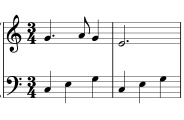
Level 2
A tune over a simple left hand, mostly in one hand position.
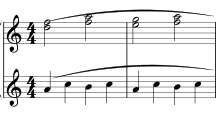
Level 3
Both hands busy, the hand moves around, a sharp or flat or two.
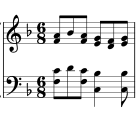
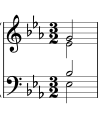
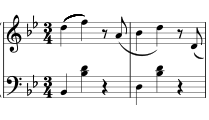
Level 4
Real independence between the hands and more accidentals.
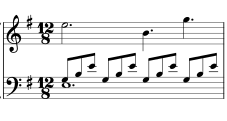
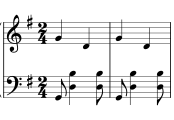
Level 5
The edge of early intermediate: dense textures, fast passages and far keys.
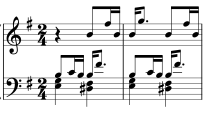
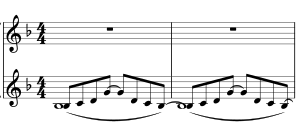
Open a piece to print any of its versions free, or to play it at your MIDI keyboard with every note marked. New to reading? The level 2 sight-reading exercises are a good warm-up.
Learning with someone? Send them this page by email